

3.10 : Chapitre 3 : Exercices de révision
- Page ID
- 197795

\( \newcommand{\vecs}[1]{\overset { \scriptstyle \rightharpoonup} {\mathbf{#1}} } \)
\( \newcommand{\vecd}[1]{\overset{-\!-\!\rightharpoonup}{\vphantom{a}\smash {#1}}} \)
\( \newcommand{\dsum}{\displaystyle\sum\limits} \)
\( \newcommand{\dint}{\displaystyle\int\limits} \)
\( \newcommand{\dlim}{\displaystyle\lim\limits} \)
\( \newcommand{\id}{\mathrm{id}}\) \( \newcommand{\Span}{\mathrm{span}}\)
( \newcommand{\kernel}{\mathrm{null}\,}\) \( \newcommand{\range}{\mathrm{range}\,}\)
\( \newcommand{\RealPart}{\mathrm{Re}}\) \( \newcommand{\ImaginaryPart}{\mathrm{Im}}\)
\( \newcommand{\Argument}{\mathrm{Arg}}\) \( \newcommand{\norm}[1]{\| #1 \|}\)
\( \newcommand{\inner}[2]{\langle #1, #2 \rangle}\)
\( \newcommand{\Span}{\mathrm{span}}\)
\( \newcommand{\id}{\mathrm{id}}\)
\( \newcommand{\Span}{\mathrm{span}}\)
\( \newcommand{\kernel}{\mathrm{null}\,}\)
\( \newcommand{\range}{\mathrm{range}\,}\)
\( \newcommand{\RealPart}{\mathrm{Re}}\)
\( \newcommand{\ImaginaryPart}{\mathrm{Im}}\)
\( \newcommand{\Argument}{\mathrm{Arg}}\)
\( \newcommand{\norm}[1]{\| #1 \|}\)
\( \newcommand{\inner}[2]{\langle #1, #2 \rangle}\)
\( \newcommand{\Span}{\mathrm{span}}\) \( \newcommand{\AA}{\unicode[.8,0]{x212B}}\)
\( \newcommand{\vectorA}[1]{\vec{#1}} % arrow\)
\( \newcommand{\vectorAt}[1]{\vec{\text{#1}}} % arrow\)
\( \newcommand{\vectorB}[1]{\overset { \scriptstyle \rightharpoonup} {\mathbf{#1}} } \)
\( \newcommand{\vectorC}[1]{\textbf{#1}} \)
\( \newcommand{\vectorD}[1]{\overrightarrow{#1}} \)
\( \newcommand{\vectorDt}[1]{\overrightarrow{\text{#1}}} \)
\( \newcommand{\vectE}[1]{\overset{-\!-\!\rightharpoonup}{\vphantom{a}\smash{\mathbf {#1}}}} \)
\( \newcommand{\vecs}[1]{\overset { \scriptstyle \rightharpoonup} {\mathbf{#1}} } \)
\(\newcommand{\longvect}{\overrightarrow}\)
\( \newcommand{\vecd}[1]{\overset{-\!-\!\rightharpoonup}{\vphantom{a}\smash {#1}}} \)
\(\newcommand{\avec}{\mathbf a}\) \(\newcommand{\bvec}{\mathbf b}\) \(\newcommand{\cvec}{\mathbf c}\) \(\newcommand{\dvec}{\mathbf d}\) \(\newcommand{\dtil}{\widetilde{\mathbf d}}\) \(\newcommand{\evec}{\mathbf e}\) \(\newcommand{\fvec}{\mathbf f}\) \(\newcommand{\nvec}{\mathbf n}\) \(\newcommand{\pvec}{\mathbf p}\) \(\newcommand{\qvec}{\mathbf q}\) \(\newcommand{\svec}{\mathbf s}\) \(\newcommand{\tvec}{\mathbf t}\) \(\newcommand{\uvec}{\mathbf u}\) \(\newcommand{\vvec}{\mathbf v}\) \(\newcommand{\wvec}{\mathbf w}\) \(\newcommand{\xvec}{\mathbf x}\) \(\newcommand{\yvec}{\mathbf y}\) \(\newcommand{\zvec}{\mathbf z}\) \(\newcommand{\rvec}{\mathbf r}\) \(\newcommand{\mvec}{\mathbf m}\) \(\newcommand{\zerovec}{\mathbf 0}\) \(\newcommand{\onevec}{\mathbf 1}\) \(\newcommand{\real}{\mathbb R}\) \(\newcommand{\twovec}[2]{\left[\begin{array}{r}#1 \\ #2 \end{array}\right]}\) \(\newcommand{\ctwovec}[2]{\left[\begin{array}{c}#1 \\ #2 \end{array}\right]}\) \(\newcommand{\threevec}[3]{\left[\begin{array}{r}#1 \\ #2 \\ #3 \end{array}\right]}\) \(\newcommand{\cthreevec}[3]{\left[\begin{array}{c}#1 \\ #2 \\ #3 \end{array}\right]}\) \(\newcommand{\fourvec}[4]{\left[\begin{array}{r}#1 \\ #2 \\ #3 \\ #4 \end{array}\right]}\) \(\newcommand{\cfourvec}[4]{\left[\begin{array}{c}#1 \\ #2 \\ #3 \\ #4 \end{array}\right]}\) \(\newcommand{\fivevec}[5]{\left[\begin{array}{r}#1 \\ #2 \\ #3 \\ #4 \\ #5 \\ \end{array}\right]}\) \(\newcommand{\cfivevec}[5]{\left[\begin{array}{c}#1 \\ #2 \\ #3 \\ #4 \\ #5 \\ \end{array}\right]}\) \(\newcommand{\mattwo}[4]{\left[\begin{array}{rr}#1 \amp #2 \\ #3 \amp #4 \\ \end{array}\right]}\) \(\newcommand{\laspan}[1]{\text{Span}\{#1\}}\) \(\newcommand{\bcal}{\cal B}\) \(\newcommand{\ccal}{\cal C}\) \(\newcommand{\scal}{\cal S}\) \(\newcommand{\wcal}{\cal W}\) \(\newcommand{\ecal}{\cal E}\) \(\newcommand{\coords}[2]{\left\{#1\right\}_{#2}}\) \(\newcommand{\gray}[1]{\color{gray}{#1}}\) \(\newcommand{\lgray}[1]{\color{lightgray}{#1}}\) \(\newcommand{\rank}{\operatorname{rank}}\) \(\newcommand{\row}{\text{Row}}\) \(\newcommand{\col}{\text{Col}}\) \(\renewcommand{\row}{\text{Row}}\) \(\newcommand{\nul}{\text{Nul}}\) \(\newcommand{\var}{\text{Var}}\) \(\newcommand{\corr}{\text{corr}}\) \(\newcommand{\len}[1]{\left|#1\right|}\) \(\newcommand{\bbar}{\overline{\bvec}}\) \(\newcommand{\bhat}{\widehat{\bvec}}\) \(\newcommand{\bperp}{\bvec^\perp}\) \(\newcommand{\xhat}{\widehat{\xvec}}\) \(\newcommand{\vhat}{\widehat{\vvec}}\) \(\newcommand{\uhat}{\widehat{\uvec}}\) \(\newcommand{\what}{\widehat{\wvec}}\) \(\newcommand{\Sighat}{\widehat{\Sigma}}\) \(\newcommand{\lt}{<}\) \(\newcommand{\gt}{>}\) \(\newcommand{\amp}{&}\) \(\definecolor{fillinmathshade}{gray}{0.9}\)Exercices de révision des
Vrai ou faux ? Justifiez la réponse par une preuve ou un contre-exemple.
1) Chaque fonction possède une dérivée.
- Réponse
- Faux
2) Une fonction continue possède une dérivée continue.
3) Une fonction continue possède une dérivée.
- Réponse
- Faux
4) Si une fonction est dérivable, elle est continue.
Dans les exercices 5 et 6, utilisez la définition limite de la dérivée pour évaluer exactement la dérivée.
5)\(f(x)=\sqrt{x+4}\)
- Réponse
- \(f'(x) = \dfrac{1}{2\sqrt{x+4}}\)
6)\(f(x)=\dfrac{3}{x}\)
Dans les exercices 7 à 15, trouvez les dérivées des fonctions données.
7)\(f(x)=3x^3−\dfrac{4}{x^2}\)
- Réponse
- \(f'(x) = 9x^2+\frac{8}{x^3}\)
9)\(f(x)=(4−x^2)^3\)
10)\(f(x)=e^{\sin x}\)
- Réponse
- \(f'(x) = e^{\sin x}\cos x\)
11)\(f(x)=\ln(x+2)\)
(12)\(f(x)=x^2\cos x+x\tan x\)
- Réponse
- \(f'(x) = x\sec^2 x+2x\cos x+\tan x−x^2\sin x \)
13)\(f(x)=\sqrt{3x^2+2}\)
(14)\(f(x)=\dfrac{x}{4}\sin^{−1}(x)\)
- Réponse
- \(f'(x) = \frac{1}{4}\left(\frac{x}{\sqrt{1−x^2}}+\sin^{−1} x\right)\)
15)\(x^2y=(y+2)+xy\sin x\)
Dans les exercices 16 à 18, trouvez les dérivées indiquées des différents ordres.
16) Premier dérivé de\(y=x(\ln x)\cos x\)
- Réponse
- \(\dfrac{dy}{dx} = \cos x⋅(\ln x+1)−x(\ln x)\sin x\)
17) Troisième dérivé de\(y=(3x+2)^2\)
18) Deuxième dérivée de\(y=4^x+x^2\sin x\)
- Réponse
- \(\dfrac{d^2y}{dx^2} = 4^x(\ln 4)^2+2\sin x+4x\cos x−x^2\sin x\)
Dans les exercices 19 et 20, trouvez l'équation de la droite tangente aux équations suivantes au point spécifié.
19)\(y=\cos^{−1}(x)+x\) à\(x=0\)
20)\(y=x+e^x−\dfrac{1}{x}\) à\(x=1\)
- Réponse
- \(y = (2+e)x−2\)
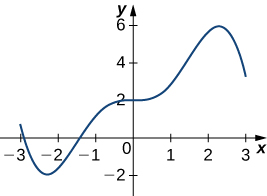
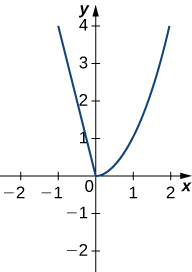
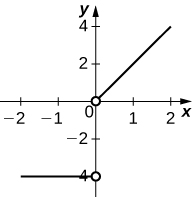
Dans les exercices 21 et 22, dessinez la dérivée des fonctions à l'aide des graphes donnés.
(21)
(22)
- Réponse
Les questions 22 et 23 concernent le niveau de l'eau à Ocean City, dans le New Jersey, en janvier, qui peut être estimé par l'\(w(t)=1.9+2.9\cos(\frac{π}{6}t),\)endroit où il\(t\) est mesuré en heures après minuit, et la hauteur est mesurée en pieds.
22) Trouvez et tracez la dérivée. Quelle est la signification physique ?
23) Découvrez\(w′(3).\) Quelle est la signification physique de cette valeur ?
- Réponse
- \(w′(3)=−\frac{2.9π}{6}\). À 3 heures du matin, la marée descend à un rythme de 1.514 pieds/heure.
Les questions 24 et 25 portent sur la vitesse du vent de l'ouragan Katrina, qui a touché la Nouvelle-Orléans, en Louisiane, en août 2005. Les données sont affichées dans un tableau.
| Quelques heures après minuit, le 26 août | Vitesse du vent (mi/h) |
| 1 | 45 |
| 5 | 75 |
| 11 | 100 |
| 29 | 115 |
| 49 | 145 |
| 58 | 175 |
| 73 | 155 |
| 81 | 125 |
| 85 | 95 |
| 107 | 35 |
Vitesse du vent de l'ouragan KatrinaSource : news.nationalgeographic.com/n... _timeline.html.
24) À l'aide du tableau, estimez la dérivée de la vitesse du vent à l'heure 39. Quelle est la signification physique ?
25) Estimez la dérivée de la vitesse du vent à l'heure 83. Quelle est la signification physique ?
- Réponse
- \(−7.5.\)La vitesse du vent diminue à un rythme de 7,5 mph par heure