

23.5: 生殖系统的真菌感染
- Page ID
- 200347

\( \newcommand{\vecs}[1]{\overset { \scriptstyle \rightharpoonup} {\mathbf{#1}} } \)
\( \newcommand{\vecd}[1]{\overset{-\!-\!\rightharpoonup}{\vphantom{a}\smash {#1}}} \)
\( \newcommand{\dsum}{\displaystyle\sum\limits} \)
\( \newcommand{\dint}{\displaystyle\int\limits} \)
\( \newcommand{\dlim}{\displaystyle\lim\limits} \)
\( \newcommand{\id}{\mathrm{id}}\) \( \newcommand{\Span}{\mathrm{span}}\)
( \newcommand{\kernel}{\mathrm{null}\,}\) \( \newcommand{\range}{\mathrm{range}\,}\)
\( \newcommand{\RealPart}{\mathrm{Re}}\) \( \newcommand{\ImaginaryPart}{\mathrm{Im}}\)
\( \newcommand{\Argument}{\mathrm{Arg}}\) \( \newcommand{\norm}[1]{\| #1 \|}\)
\( \newcommand{\inner}[2]{\langle #1, #2 \rangle}\)
\( \newcommand{\Span}{\mathrm{span}}\)
\( \newcommand{\id}{\mathrm{id}}\)
\( \newcommand{\Span}{\mathrm{span}}\)
\( \newcommand{\kernel}{\mathrm{null}\,}\)
\( \newcommand{\range}{\mathrm{range}\,}\)
\( \newcommand{\RealPart}{\mathrm{Re}}\)
\( \newcommand{\ImaginaryPart}{\mathrm{Im}}\)
\( \newcommand{\Argument}{\mathrm{Arg}}\)
\( \newcommand{\norm}[1]{\| #1 \|}\)
\( \newcommand{\inner}[2]{\langle #1, #2 \rangle}\)
\( \newcommand{\Span}{\mathrm{span}}\) \( \newcommand{\AA}{\unicode[.8,0]{x212B}}\)
\( \newcommand{\vectorA}[1]{\vec{#1}} % arrow\)
\( \newcommand{\vectorAt}[1]{\vec{\text{#1}}} % arrow\)
\( \newcommand{\vectorB}[1]{\overset { \scriptstyle \rightharpoonup} {\mathbf{#1}} } \)
\( \newcommand{\vectorC}[1]{\textbf{#1}} \)
\( \newcommand{\vectorD}[1]{\overrightarrow{#1}} \)
\( \newcommand{\vectorDt}[1]{\overrightarrow{\text{#1}}} \)
\( \newcommand{\vectE}[1]{\overset{-\!-\!\rightharpoonup}{\vphantom{a}\smash{\mathbf {#1}}}} \)
\( \newcommand{\vecs}[1]{\overset { \scriptstyle \rightharpoonup} {\mathbf{#1}} } \)
\(\newcommand{\longvect}{\overrightarrow}\)
\( \newcommand{\vecd}[1]{\overset{-\!-\!\rightharpoonup}{\vphantom{a}\smash {#1}}} \)
\(\newcommand{\avec}{\mathbf a}\) \(\newcommand{\bvec}{\mathbf b}\) \(\newcommand{\cvec}{\mathbf c}\) \(\newcommand{\dvec}{\mathbf d}\) \(\newcommand{\dtil}{\widetilde{\mathbf d}}\) \(\newcommand{\evec}{\mathbf e}\) \(\newcommand{\fvec}{\mathbf f}\) \(\newcommand{\nvec}{\mathbf n}\) \(\newcommand{\pvec}{\mathbf p}\) \(\newcommand{\qvec}{\mathbf q}\) \(\newcommand{\svec}{\mathbf s}\) \(\newcommand{\tvec}{\mathbf t}\) \(\newcommand{\uvec}{\mathbf u}\) \(\newcommand{\vvec}{\mathbf v}\) \(\newcommand{\wvec}{\mathbf w}\) \(\newcommand{\xvec}{\mathbf x}\) \(\newcommand{\yvec}{\mathbf y}\) \(\newcommand{\zvec}{\mathbf z}\) \(\newcommand{\rvec}{\mathbf r}\) \(\newcommand{\mvec}{\mathbf m}\) \(\newcommand{\zerovec}{\mathbf 0}\) \(\newcommand{\onevec}{\mathbf 1}\) \(\newcommand{\real}{\mathbb R}\) \(\newcommand{\twovec}[2]{\left[\begin{array}{r}#1 \\ #2 \end{array}\right]}\) \(\newcommand{\ctwovec}[2]{\left[\begin{array}{c}#1 \\ #2 \end{array}\right]}\) \(\newcommand{\threevec}[3]{\left[\begin{array}{r}#1 \\ #2 \\ #3 \end{array}\right]}\) \(\newcommand{\cthreevec}[3]{\left[\begin{array}{c}#1 \\ #2 \\ #3 \end{array}\right]}\) \(\newcommand{\fourvec}[4]{\left[\begin{array}{r}#1 \\ #2 \\ #3 \\ #4 \end{array}\right]}\) \(\newcommand{\cfourvec}[4]{\left[\begin{array}{c}#1 \\ #2 \\ #3 \\ #4 \end{array}\right]}\) \(\newcommand{\fivevec}[5]{\left[\begin{array}{r}#1 \\ #2 \\ #3 \\ #4 \\ #5 \\ \end{array}\right]}\) \(\newcommand{\cfivevec}[5]{\left[\begin{array}{c}#1 \\ #2 \\ #3 \\ #4 \\ #5 \\ \end{array}\right]}\) \(\newcommand{\mattwo}[4]{\left[\begin{array}{rr}#1 \amp #2 \\ #3 \amp #4 \\ \end{array}\right]}\) \(\newcommand{\laspan}[1]{\text{Span}\{#1\}}\) \(\newcommand{\bcal}{\cal B}\) \(\newcommand{\ccal}{\cal C}\) \(\newcommand{\scal}{\cal S}\) \(\newcommand{\wcal}{\cal W}\) \(\newcommand{\ecal}{\cal E}\) \(\newcommand{\coords}[2]{\left\{#1\right\}_{#2}}\) \(\newcommand{\gray}[1]{\color{gray}{#1}}\) \(\newcommand{\lgray}[1]{\color{lightgray}{#1}}\) \(\newcommand{\rank}{\operatorname{rank}}\) \(\newcommand{\row}{\text{Row}}\) \(\newcommand{\col}{\text{Col}}\) \(\renewcommand{\row}{\text{Row}}\) \(\newcommand{\nul}{\text{Nul}}\) \(\newcommand{\var}{\text{Var}}\) \(\newcommand{\corr}{\text{corr}}\) \(\newcommand{\len}[1]{\left|#1\right|}\) \(\newcommand{\bbar}{\overline{\bvec}}\) \(\newcommand{\bhat}{\widehat{\bvec}}\) \(\newcommand{\bperp}{\bvec^\perp}\) \(\newcommand{\xhat}{\widehat{\xvec}}\) \(\newcommand{\vhat}{\widehat{\vvec}}\) \(\newcommand{\uhat}{\widehat{\uvec}}\) \(\newcommand{\what}{\widehat{\wvec}}\) \(\newcommand{\Sighat}{\widehat{\Sigma}}\) \(\newcommand{\lt}{<}\) \(\newcommand{\gt}{>}\) \(\newcommand{\amp}{&}\) \(\definecolor{fillinmathshade}{gray}{0.9}\)学习目标
- 总结阴道念珠菌病的重要特征
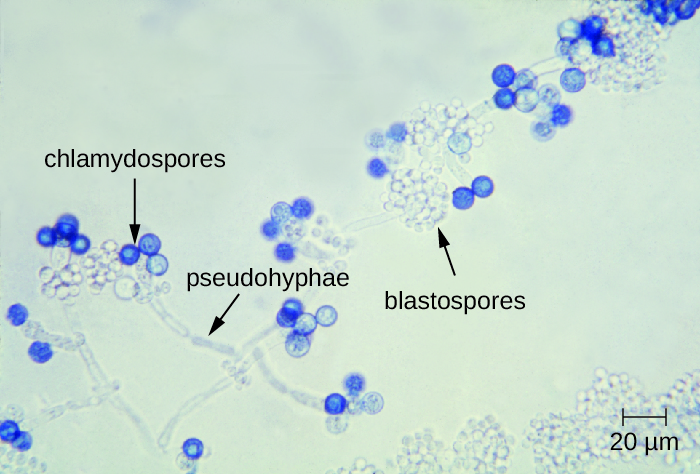
只有一种主要的真菌病原体会影响泌尿生殖系统。 念珠菌是一种能够以酵母形式存在或作为多细胞真菌存在的真菌属。 念珠菌属常见于皮肤、胃肠道、呼吸系统和女性泌尿生殖道的正常、健康微生物群中(图\(\PageIndex{1}\))。 它们可能具有致病性,因为它们能够粘附和侵入宿主细胞,形成生物膜,分泌有助于其在组织中传播的水解酶(例如蛋白酶、磷脂酶和脂肪酶),并改变表型以保护自己免受免疫系统的侵害。 但是,它们通常只有在损害宿主防御能力的条件下才会导致女性生殖道疾病。 虽然至少有20种具有临床重要性的念珠菌,但白色梭菌是真菌性阴道炎最常见的物种。
如前所述,阴道中的乳酸杆菌抑制其他生物的生长,包括细菌和念珠菌,但中断会使念珠菌的数量增加。 典型的中断包括抗生素治疗、疾病(尤其是糖尿病)、妊娠和短暂微生物的存在。 免疫抑制也可以起作用,与HIV感染相关的严重免疫抑制通常会使念珠菌得以茁壮成长。 这可能导致生殖器或阴道念珠菌病,这种疾病以阴道炎为特征,通常被称为酵母菌感染。 当酵母菌感染发生时,会伴有瘙痒(瘙痒)、浓稠的白色或黄色分泌物以及异味的症状。
其他形式的念珠菌病包括皮肤念珠菌病(见皮肤真菌病)和口腔鹅口疮(参见口腔和口腔微生物疾病)。 尽管念珠菌属存在于正常微生物群中,但念珠菌属也可能在个体之间传播。 尽管念珠菌病不被视为性传播感染,但性接触是一种常见的传播方式。
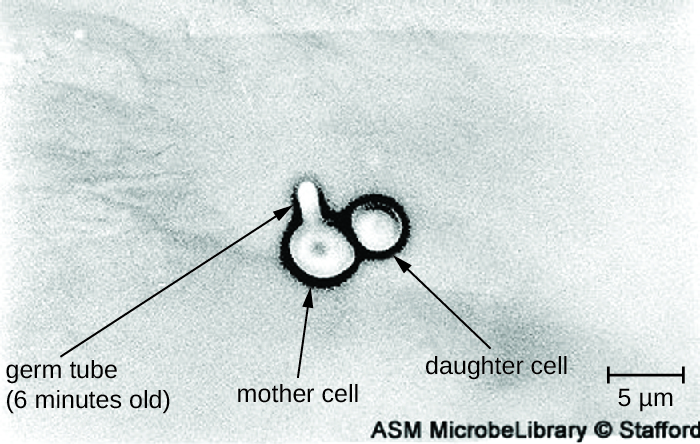
阴道念珠菌病的诊断可以通过对阴道分泌物的显微镜评估来确定念珠菌是否过多。 培养方法用处不大,因为念珠菌是正常微生物群的一部分,会经常出现。 它也很容易被念珠菌污染样本,因为它很常见,因此必须注意妥善处理临床材料。 如果处理出现延迟,可以冷藏样品。 念珠菌是一种二态真菌,因此它不仅以酵母形式存在;培养可用于鉴定从生殖管中发育的衣原体孢子和假菌丝(图\(\PageIndex{2}\))。 生殖管的存在可用于诊断测试,在该测试中,培养的酵母细胞与兔血清相结合,并在几个小时后观察是否存在生殖管。 如果需要,也可以进行分子检测。 例如,Affirm VPII 微生物鉴定测试同时测试阴道微生物 C. albicans、G. vaginalis(见泌尿系统的细菌感染)和阴道滴虫(参见原生动物感染泌尿生殖系统)。
治疗阴道念珠菌病的局部抗真菌药物包括布康唑、咪康唑、克霉唑、噻康唑和制霉菌素。 可以使用氟康唑进行口服治疗。 通常没有明显的感染诱发因素,因此很难预防。
练习\(\PageIndex{1}\)
- 哪些因素会导致念珠菌病?
- 念珠菌病通常如何诊断?
临床重点:第 3 部分
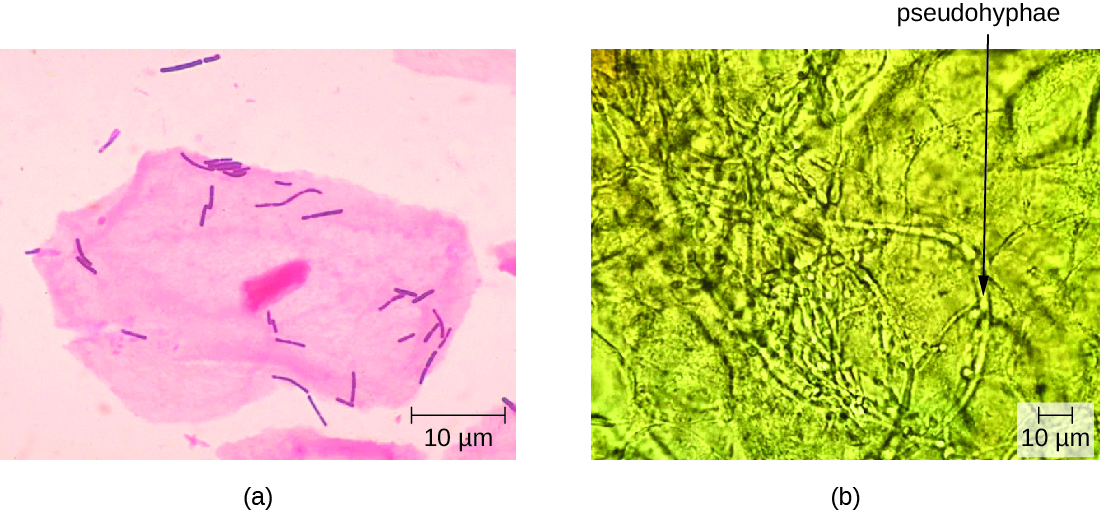
纳迪亚阴道涂片的革兰染色显示,纳迪亚阴道样本中相对于其他物种的乳酸杆菌浓度异常低。 但是,没有线索细胞可见,这表明感染不是细菌性阴道病。 但是一张湿式幻灯片显示酵母细胞过度生长,这表明问题在于念珠菌病或酵母菌感染(图\(\PageIndex{3}\))。 纳迪亚的医生向她保证,这是个好消息。 念珠菌病在怀孕期间很常见,易于治疗。
练习\(\PageIndex{2}\)
知道问题在于念珠菌病,医生会建议什么治疗方法?
关键概念和摘要
- 念珠菌属通常存在于体内的正常微生物群中,包括皮肤、呼吸道、胃肠道和女性泌尿生殖系统。
- 正常阴道微生物群的中断会导致念珠菌过度生长,从而导致阴道念珠菌病。
- 阴道念珠菌病可用局部或口服杀菌剂治疗。 预防很困难。