

17: 与生俱来的非特异性宿主防御
- Page ID
- 200020

\( \newcommand{\vecs}[1]{\overset { \scriptstyle \rightharpoonup} {\mathbf{#1}} } \)
\( \newcommand{\vecd}[1]{\overset{-\!-\!\rightharpoonup}{\vphantom{a}\smash {#1}}} \)
\( \newcommand{\dsum}{\displaystyle\sum\limits} \)
\( \newcommand{\dint}{\displaystyle\int\limits} \)
\( \newcommand{\dlim}{\displaystyle\lim\limits} \)
\( \newcommand{\id}{\mathrm{id}}\) \( \newcommand{\Span}{\mathrm{span}}\)
( \newcommand{\kernel}{\mathrm{null}\,}\) \( \newcommand{\range}{\mathrm{range}\,}\)
\( \newcommand{\RealPart}{\mathrm{Re}}\) \( \newcommand{\ImaginaryPart}{\mathrm{Im}}\)
\( \newcommand{\Argument}{\mathrm{Arg}}\) \( \newcommand{\norm}[1]{\| #1 \|}\)
\( \newcommand{\inner}[2]{\langle #1, #2 \rangle}\)
\( \newcommand{\Span}{\mathrm{span}}\)
\( \newcommand{\id}{\mathrm{id}}\)
\( \newcommand{\Span}{\mathrm{span}}\)
\( \newcommand{\kernel}{\mathrm{null}\,}\)
\( \newcommand{\range}{\mathrm{range}\,}\)
\( \newcommand{\RealPart}{\mathrm{Re}}\)
\( \newcommand{\ImaginaryPart}{\mathrm{Im}}\)
\( \newcommand{\Argument}{\mathrm{Arg}}\)
\( \newcommand{\norm}[1]{\| #1 \|}\)
\( \newcommand{\inner}[2]{\langle #1, #2 \rangle}\)
\( \newcommand{\Span}{\mathrm{span}}\) \( \newcommand{\AA}{\unicode[.8,0]{x212B}}\)
\( \newcommand{\vectorA}[1]{\vec{#1}} % arrow\)
\( \newcommand{\vectorAt}[1]{\vec{\text{#1}}} % arrow\)
\( \newcommand{\vectorB}[1]{\overset { \scriptstyle \rightharpoonup} {\mathbf{#1}} } \)
\( \newcommand{\vectorC}[1]{\textbf{#1}} \)
\( \newcommand{\vectorD}[1]{\overrightarrow{#1}} \)
\( \newcommand{\vectorDt}[1]{\overrightarrow{\text{#1}}} \)
\( \newcommand{\vectE}[1]{\overset{-\!-\!\rightharpoonup}{\vphantom{a}\smash{\mathbf {#1}}}} \)
\( \newcommand{\vecs}[1]{\overset { \scriptstyle \rightharpoonup} {\mathbf{#1}} } \)
\(\newcommand{\longvect}{\overrightarrow}\)
\( \newcommand{\vecd}[1]{\overset{-\!-\!\rightharpoonup}{\vphantom{a}\smash {#1}}} \)
\(\newcommand{\avec}{\mathbf a}\) \(\newcommand{\bvec}{\mathbf b}\) \(\newcommand{\cvec}{\mathbf c}\) \(\newcommand{\dvec}{\mathbf d}\) \(\newcommand{\dtil}{\widetilde{\mathbf d}}\) \(\newcommand{\evec}{\mathbf e}\) \(\newcommand{\fvec}{\mathbf f}\) \(\newcommand{\nvec}{\mathbf n}\) \(\newcommand{\pvec}{\mathbf p}\) \(\newcommand{\qvec}{\mathbf q}\) \(\newcommand{\svec}{\mathbf s}\) \(\newcommand{\tvec}{\mathbf t}\) \(\newcommand{\uvec}{\mathbf u}\) \(\newcommand{\vvec}{\mathbf v}\) \(\newcommand{\wvec}{\mathbf w}\) \(\newcommand{\xvec}{\mathbf x}\) \(\newcommand{\yvec}{\mathbf y}\) \(\newcommand{\zvec}{\mathbf z}\) \(\newcommand{\rvec}{\mathbf r}\) \(\newcommand{\mvec}{\mathbf m}\) \(\newcommand{\zerovec}{\mathbf 0}\) \(\newcommand{\onevec}{\mathbf 1}\) \(\newcommand{\real}{\mathbb R}\) \(\newcommand{\twovec}[2]{\left[\begin{array}{r}#1 \\ #2 \end{array}\right]}\) \(\newcommand{\ctwovec}[2]{\left[\begin{array}{c}#1 \\ #2 \end{array}\right]}\) \(\newcommand{\threevec}[3]{\left[\begin{array}{r}#1 \\ #2 \\ #3 \end{array}\right]}\) \(\newcommand{\cthreevec}[3]{\left[\begin{array}{c}#1 \\ #2 \\ #3 \end{array}\right]}\) \(\newcommand{\fourvec}[4]{\left[\begin{array}{r}#1 \\ #2 \\ #3 \\ #4 \end{array}\right]}\) \(\newcommand{\cfourvec}[4]{\left[\begin{array}{c}#1 \\ #2 \\ #3 \\ #4 \end{array}\right]}\) \(\newcommand{\fivevec}[5]{\left[\begin{array}{r}#1 \\ #2 \\ #3 \\ #4 \\ #5 \\ \end{array}\right]}\) \(\newcommand{\cfivevec}[5]{\left[\begin{array}{c}#1 \\ #2 \\ #3 \\ #4 \\ #5 \\ \end{array}\right]}\) \(\newcommand{\mattwo}[4]{\left[\begin{array}{rr}#1 \amp #2 \\ #3 \amp #4 \\ \end{array}\right]}\) \(\newcommand{\laspan}[1]{\text{Span}\{#1\}}\) \(\newcommand{\bcal}{\cal B}\) \(\newcommand{\ccal}{\cal C}\) \(\newcommand{\scal}{\cal S}\) \(\newcommand{\wcal}{\cal W}\) \(\newcommand{\ecal}{\cal E}\) \(\newcommand{\coords}[2]{\left\{#1\right\}_{#2}}\) \(\newcommand{\gray}[1]{\color{gray}{#1}}\) \(\newcommand{\lgray}[1]{\color{lightgray}{#1}}\) \(\newcommand{\rank}{\operatorname{rank}}\) \(\newcommand{\row}{\text{Row}}\) \(\newcommand{\col}{\text{Col}}\) \(\renewcommand{\row}{\text{Row}}\) \(\newcommand{\nul}{\text{Nul}}\) \(\newcommand{\var}{\text{Var}}\) \(\newcommand{\corr}{\text{corr}}\) \(\newcommand{\len}[1]{\left|#1\right|}\) \(\newcommand{\bbar}{\overline{\bvec}}\) \(\newcommand{\bhat}{\widehat{\bvec}}\) \(\newcommand{\bperp}{\bvec^\perp}\) \(\newcommand{\xhat}{\widehat{\xvec}}\) \(\newcommand{\vhat}{\widehat{\vvec}}\) \(\newcommand{\uhat}{\widehat{\uvec}}\) \(\newcommand{\what}{\widehat{\wvec}}\) \(\newcommand{\Sighat}{\widehat{\Sigma}}\) \(\newcommand{\lt}{<}\) \(\newcommand{\gt}{>}\) \(\newcommand{\amp}{&}\) \(\definecolor{fillinmathshade}{gray}{0.9}\)尽管相对持续地接触环境中的致病微生物,但人类通常不会遭受持续的感染或疾病。 在大多数情况下,人体能够保护自己免受感染的威胁,这要归功于旨在击退、杀死和驱逐致病入侵者的复杂免疫系统。 整个免疫可以描述为两个相互关联的部分:非特异性先天免疫,这是本章的主题,以及特定的适应性宿主防御,将在下一章中讨论。
非特异性先天免疫反应提供了第一道防线,通常可以防止感染在体内站稳脚跟。 这些防御措施之所以被描述为非特异性,是因为它们不针对任何特定的病原体;相反,它们可以抵御各种潜在的病原体。 它们之所以被称为天生的,是因为它们是人类生物体的内在机制。 与特定的适应性防御不同,它们不是随着时间的推移而获得的,也没有 “记忆力”(反复接触特定病原体后不会改善)。
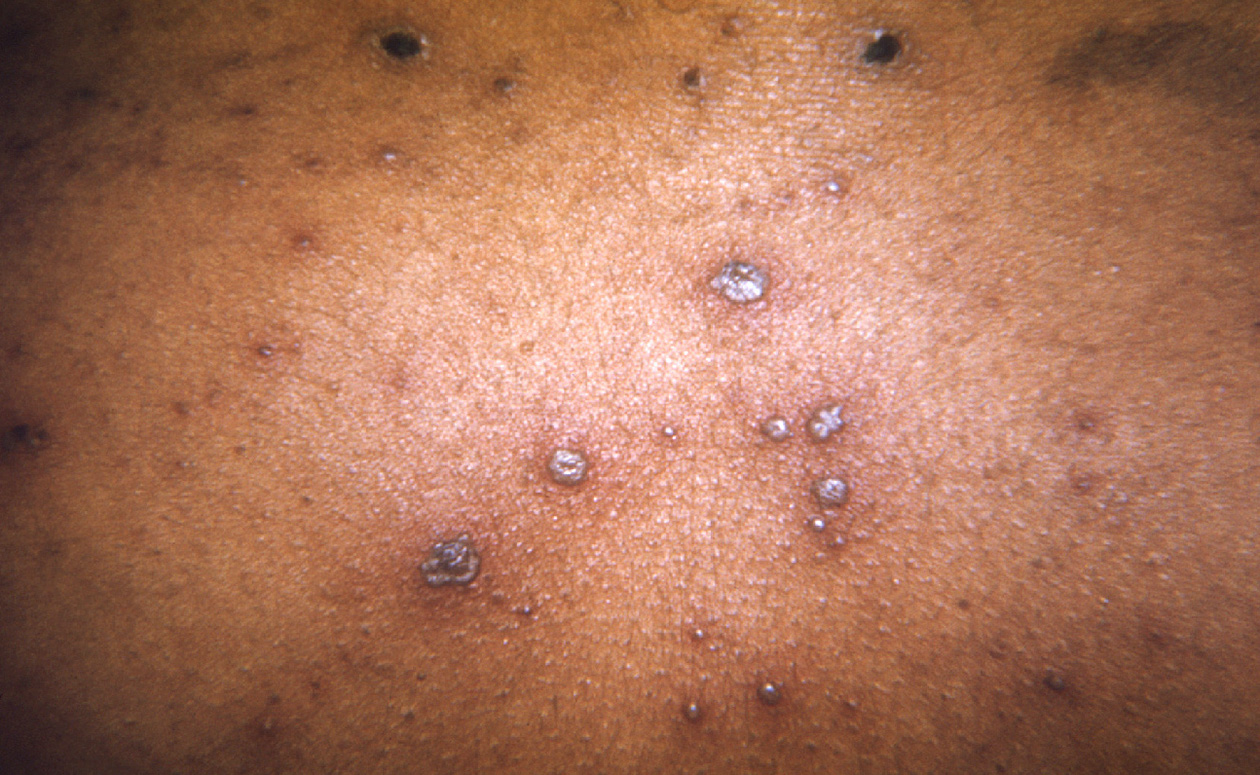
从广义上讲,非特异性先天防御可对潜在病原体作出立即(或非常快速)的反应。 但是,这些反应既不完美也不难以理解。 它们有时会被病原体避开,有时甚至会对身体造成伤害,从而导致感染的体征和症状(图\(\PageIndex{1}\))。
- 17.1: 物理防御
- 非特异性先天免疫通过非特异性阻断微生物进入并将其作为目标进行破坏或从体内清除,从而为抵御感染提供了第一道防线。 先天免疫的物理防御包括物理屏障、去除微生物和碎片的机械作用以及与病原体竞争并抑制病原体生长的微生物组。 全身的皮肤、粘膜和内皮是物理屏障。
- 17.2:化学防御
- 许多内源和外源产生的化学介质表现出非特异性抗微生物功能。 许多化学介质存在于体液中,例如皮脂、唾液、粘液、胃液和肠液、尿液、眼泪、耳垢和阴道分泌物。 存在于皮肤和身体其他部位的抗菌肽(AMP)主要是为了应对病原体的存在而产生的。 这些包括 dermcidin、cathelicidin、防御素、组抑素和细菌素。
- 17.3:细胞防御
- 血液中形成的元素包括红细胞(红细胞)、白细胞(白细胞)和血小板(血小板细胞)。 其中,白细胞主要参与免疫反应。 所有形成的元素都起源于骨髓,是通过造血分化的干细胞(HSC)。 粒细胞是以细胞质中的叶状核和颗粒为特征的白细胞。 这些包括中性粒细胞 (PMN)、嗜酸性粒细胞和嗜碱性粒细胞。
- 17.4:病原体识别和吞噬作用
- 吞噬细胞是识别病原体并通过吞噬作用摧毁病原体的细胞。 识别通常通过使用吞噬细胞受体来实现,这些受体结合病原体上常见的分子,称为病原体相关分子模式(PAMP)。 结合 PAMP 的受体称为模式识别受体或 PRR。 Toll 样受体 (TLR) 是在吞噬细胞中发现的一种PRR。
- 17.5:炎症和发烧
- 炎症是由化学介质和细胞防御对损伤或感染的集体反应引起的。 急性炎症是短暂的,局限于损伤或感染部位。 慢性炎症发生在炎症反应不成功时,可能导致肉芽肿(例如结核病)和疤痕(例如,伴有丙型肝炎病毒感染和肝硬化)的形成。
缩略图:吞噬细胞(黄色,右)吞噬炭疽杆菌(橙色,左)的扫描电子显微照片。 (CC BY 2.5; 通过 PLOS)。