

1.6E:练习
- Page ID
- 205070

\( \newcommand{\vecs}[1]{\overset { \scriptstyle \rightharpoonup} {\mathbf{#1}} } \)
\( \newcommand{\vecd}[1]{\overset{-\!-\!\rightharpoonup}{\vphantom{a}\smash {#1}}} \)
\( \newcommand{\dsum}{\displaystyle\sum\limits} \)
\( \newcommand{\dint}{\displaystyle\int\limits} \)
\( \newcommand{\dlim}{\displaystyle\lim\limits} \)
\( \newcommand{\id}{\mathrm{id}}\) \( \newcommand{\Span}{\mathrm{span}}\)
( \newcommand{\kernel}{\mathrm{null}\,}\) \( \newcommand{\range}{\mathrm{range}\,}\)
\( \newcommand{\RealPart}{\mathrm{Re}}\) \( \newcommand{\ImaginaryPart}{\mathrm{Im}}\)
\( \newcommand{\Argument}{\mathrm{Arg}}\) \( \newcommand{\norm}[1]{\| #1 \|}\)
\( \newcommand{\inner}[2]{\langle #1, #2 \rangle}\)
\( \newcommand{\Span}{\mathrm{span}}\)
\( \newcommand{\id}{\mathrm{id}}\)
\( \newcommand{\Span}{\mathrm{span}}\)
\( \newcommand{\kernel}{\mathrm{null}\,}\)
\( \newcommand{\range}{\mathrm{range}\,}\)
\( \newcommand{\RealPart}{\mathrm{Re}}\)
\( \newcommand{\ImaginaryPart}{\mathrm{Im}}\)
\( \newcommand{\Argument}{\mathrm{Arg}}\)
\( \newcommand{\norm}[1]{\| #1 \|}\)
\( \newcommand{\inner}[2]{\langle #1, #2 \rangle}\)
\( \newcommand{\Span}{\mathrm{span}}\) \( \newcommand{\AA}{\unicode[.8,0]{x212B}}\)
\( \newcommand{\vectorA}[1]{\vec{#1}} % arrow\)
\( \newcommand{\vectorAt}[1]{\vec{\text{#1}}} % arrow\)
\( \newcommand{\vectorB}[1]{\overset { \scriptstyle \rightharpoonup} {\mathbf{#1}} } \)
\( \newcommand{\vectorC}[1]{\textbf{#1}} \)
\( \newcommand{\vectorD}[1]{\overrightarrow{#1}} \)
\( \newcommand{\vectorDt}[1]{\overrightarrow{\text{#1}}} \)
\( \newcommand{\vectE}[1]{\overset{-\!-\!\rightharpoonup}{\vphantom{a}\smash{\mathbf {#1}}}} \)
\( \newcommand{\vecs}[1]{\overset { \scriptstyle \rightharpoonup} {\mathbf{#1}} } \)
\(\newcommand{\longvect}{\overrightarrow}\)
\( \newcommand{\vecd}[1]{\overset{-\!-\!\rightharpoonup}{\vphantom{a}\smash {#1}}} \)
\(\newcommand{\avec}{\mathbf a}\) \(\newcommand{\bvec}{\mathbf b}\) \(\newcommand{\cvec}{\mathbf c}\) \(\newcommand{\dvec}{\mathbf d}\) \(\newcommand{\dtil}{\widetilde{\mathbf d}}\) \(\newcommand{\evec}{\mathbf e}\) \(\newcommand{\fvec}{\mathbf f}\) \(\newcommand{\nvec}{\mathbf n}\) \(\newcommand{\pvec}{\mathbf p}\) \(\newcommand{\qvec}{\mathbf q}\) \(\newcommand{\svec}{\mathbf s}\) \(\newcommand{\tvec}{\mathbf t}\) \(\newcommand{\uvec}{\mathbf u}\) \(\newcommand{\vvec}{\mathbf v}\) \(\newcommand{\wvec}{\mathbf w}\) \(\newcommand{\xvec}{\mathbf x}\) \(\newcommand{\yvec}{\mathbf y}\) \(\newcommand{\zvec}{\mathbf z}\) \(\newcommand{\rvec}{\mathbf r}\) \(\newcommand{\mvec}{\mathbf m}\) \(\newcommand{\zerovec}{\mathbf 0}\) \(\newcommand{\onevec}{\mathbf 1}\) \(\newcommand{\real}{\mathbb R}\) \(\newcommand{\twovec}[2]{\left[\begin{array}{r}#1 \\ #2 \end{array}\right]}\) \(\newcommand{\ctwovec}[2]{\left[\begin{array}{c}#1 \\ #2 \end{array}\right]}\) \(\newcommand{\threevec}[3]{\left[\begin{array}{r}#1 \\ #2 \\ #3 \end{array}\right]}\) \(\newcommand{\cthreevec}[3]{\left[\begin{array}{c}#1 \\ #2 \\ #3 \end{array}\right]}\) \(\newcommand{\fourvec}[4]{\left[\begin{array}{r}#1 \\ #2 \\ #3 \\ #4 \end{array}\right]}\) \(\newcommand{\cfourvec}[4]{\left[\begin{array}{c}#1 \\ #2 \\ #3 \\ #4 \end{array}\right]}\) \(\newcommand{\fivevec}[5]{\left[\begin{array}{r}#1 \\ #2 \\ #3 \\ #4 \\ #5 \\ \end{array}\right]}\) \(\newcommand{\cfivevec}[5]{\left[\begin{array}{c}#1 \\ #2 \\ #3 \\ #4 \\ #5 \\ \end{array}\right]}\) \(\newcommand{\mattwo}[4]{\left[\begin{array}{rr}#1 \amp #2 \\ #3 \amp #4 \\ \end{array}\right]}\) \(\newcommand{\laspan}[1]{\text{Span}\{#1\}}\) \(\newcommand{\bcal}{\cal B}\) \(\newcommand{\ccal}{\cal C}\) \(\newcommand{\scal}{\cal S}\) \(\newcommand{\wcal}{\cal W}\) \(\newcommand{\ecal}{\cal E}\) \(\newcommand{\coords}[2]{\left\{#1\right\}_{#2}}\) \(\newcommand{\gray}[1]{\color{gray}{#1}}\) \(\newcommand{\lgray}[1]{\color{lightgray}{#1}}\) \(\newcommand{\rank}{\operatorname{rank}}\) \(\newcommand{\row}{\text{Row}}\) \(\newcommand{\col}{\text{Col}}\) \(\renewcommand{\row}{\text{Row}}\) \(\newcommand{\nul}{\text{Nul}}\) \(\newcommand{\var}{\text{Var}}\) \(\newcommand{\corr}{\text{corr}}\) \(\newcommand{\len}[1]{\left|#1\right|}\) \(\newcommand{\bbar}{\overline{\bvec}}\) \(\newcommand{\bhat}{\widehat{\bvec}}\) \(\newcommand{\bperp}{\bvec^\perp}\) \(\newcommand{\xhat}{\widehat{\xvec}}\) \(\newcommand{\vhat}{\widehat{\vvec}}\) \(\newcommand{\uhat}{\widehat{\uvec}}\) \(\newcommand{\what}{\widehat{\wvec}}\) \(\newcommand{\Sighat}{\widehat{\Sigma}}\) \(\newcommand{\lt}{<}\) \(\newcommand{\gt}{>}\) \(\newcommand{\amp}{&}\) \(\definecolor{fillinmathshade}{gray}{0.9}\)练习成就完美
查找等效分数
在以下练习中,找到等同于给定分数的三个分数。 用数字或代数展示你的作品。
\(\dfrac{3}{8}\)
- 回答
-
\(\dfrac{6}{16}\),,\(\dfrac{9}{24}\)\(\dfrac{12}{32}\), 答案可能有所不同
\(\dfrac{5}{8}\)
\(\dfrac{5}{9}\)
- 回答
-
\(\dfrac{10}{18}\),,\(\dfrac{15}{27}\)\(\dfrac{20}{36}\), 答案可能有所不同
\(\dfrac{1}{8}\)
简化分数
在以下练习中,进行简化。
\(-\dfrac{40}{88}\)
- 回答
-
\(-\dfrac{5}{11}\)
\(-\dfrac{63}{99}\)
\(-\dfrac{108}{63}\)
- 回答
-
\(-\dfrac{12}{7}\)
\(-\dfrac{104}{48}\)
\(\dfrac{120}{252}\)
- 回答
-
\(\dfrac{10}{21}\)
\(\dfrac{182}{294}\)
\(-\dfrac{3x}{12y}\)
- 回答
-
\(-\dfrac{x}{4y}\)
\(-\dfrac{4x}{32y}\)
\(\dfrac{14x^{2}}{21y}\)
- 回答
-
\(\dfrac{2x^{2}}{3y}\)
\(\dfrac{24a}{32b^{2}}\)
乘以分数
在以下练习中,乘以。
\(\dfrac{3}{4}\cdot \dfrac{9}{10}\)
- 回答
-
\(\dfrac{27}{40}\)
\(\dfrac{4}{5}\cdot \dfrac{2}{7}\)
\(-\dfrac{2}{3}\cdot -\dfrac{3}{8}\)
- 回答
-
\(\dfrac{1}{4}\)
\(-\dfrac{3}{4}\left(-\dfrac{4}{9}\right)\)
\(-\dfrac{5}{9}\cdot \dfrac{3}{10}\)
- 回答
-
\(-\dfrac{1}{6}\)
\(-\dfrac{3}{8}\cdot \dfrac{4}{15}\)
\(\left(-\dfrac{14}{15}\right)\left(\dfrac{9}{20}\right)\)
- 回答
-
\(-\dfrac{21}{50}\)
\(\left(-\dfrac{9}{10}\right)\left(\dfrac{25}{33}\right)\)
\(\left(-\dfrac{63}{84}\right)\left(-\dfrac{44}{90}\right)\)
- 回答
-
\(\dfrac{11}{30}\)
\(\left(-\dfrac{63}{60}\right)\left(-\dfrac{40}{88}\right)\)
\(4\cdot \dfrac{5}{11}\)
- 回答
-
\(\dfrac{20}{11}\)
\(5\cdot \dfrac{8}{3}\)
\(\dfrac{3}{7}\cdot 21n\)
- 回答
-
9n
\(\dfrac{5}{6}\cdot 30m\)
\(-8\cdot\dfrac{17}{4}\)
- 回答
-
−34
\((-1)\left(-\dfrac{6}{7}\right)\)
除以分数
在以下练习中,除以。
\(\dfrac{3}{4}\div \dfrac{2}{3}\)
- 回答
-
\(\dfrac{9}{8}\)
\(\dfrac{4}{5}\div \dfrac{3}{4}\)
\(-\dfrac{7}{9}\div \left(-\dfrac{7}{4}\right)\)
- 回答
-
1
\(-\dfrac{5}{6}\div \left(-\dfrac{5}{6}\right)\)
\(\dfrac{3}{4}\div \dfrac{x}{11}\)
- 回答
-
\(\dfrac{33}{4x}\)
\(\dfrac{2}{5}\div \dfrac{y}{9}\)
\(\dfrac{5}{18}\div -\dfrac{15}{24}\)
- 回答
-
\(-\dfrac{4}{9}\)
\(\dfrac{7}{18}\div \left(-\dfrac{14}{27}\right)\)
\(\dfrac{8u}{15} \div \dfrac{12v}{25}\)
- 回答
-
\(\dfrac{10u}{9v}\)
\(\dfrac{12r}{25}\div \dfrac{18s}{35}\)
\(-5\div \dfrac{1}{2}\)
- 回答
-
-10
\(-3\div \dfrac{1}{4}\)
\(\dfrac{3}{4}\div (-12)\)
- 回答
-
\(\dfrac{1}{16}\)
\(-15\div -\dfrac{5}{3}\)
在以下练习中,进行简化。
\(\dfrac{-\dfrac{8}{21}}{\dfrac{12}{35}}\)
- 回答
-
\(-\dfrac{10}{9}\)
\(\dfrac{-\dfrac{9}{16}}{\dfrac{33}{40}}\)
\(\dfrac{-\dfrac{4}{5}}{2}\)
- 回答
-
\(-\dfrac{2}{5}\)
\(\dfrac{5}{\dfrac{3}{10}}\)
\(\dfrac{\dfrac{m}{3}}{\dfrac{n}{2}}\)
- 回答
-
\(\dfrac{2m}{3n}\)
\(\dfrac{-\dfrac{3}{8}}{-\dfrac{y}{12}}\)
简化使用分数条编写的表达式
在以下练习中,进行简化。
\(\dfrac{22 + 3}{10}\)
- 回答
-
\(\dfrac{5}{2}\)
\(\dfrac{19 - 4}{6}\)
\(\dfrac{48}{24 - 15}\)
- 回答
-
\(\dfrac{16}{3}\)
\(\dfrac{46}{4 + 4}\)
\(\dfrac{-6 + 6}{8 + 4}\)
- 回答
-
0
\(\dfrac{-6 + 3}{17 - 8}\)
\(\dfrac{4\cdot 3}{6\cdot 6}\)
- 回答
-
\(\dfrac{1}{3}\)
\(\dfrac{6\cdot 6}{9\cdot 2}\)
\(\dfrac{4^{2} - 1}{25}\)
- 回答
-
\(\dfrac{3}{5}\)
\(\dfrac{7^{2} + 1}{60}\)
\(\dfrac{8\cdot 3 + 2\cdot 9}{14 + 3}\)
- 回答
-
\(2\dfrac{8}{17}\)
\(\dfrac{9\cdot 6 - 4\cdot 7}{22 + 3}\)
\(\dfrac{5\cdot 6 - 3\cdot 4}{4\cdot 5 -2\cdot 3}\)
- 回答
-
\(\dfrac{9}{7}\)
\(\dfrac{8\cdot 9 - 7\cdot 6}{5\cdot 6 - 9\cdot 2}\)
\(\dfrac{5^{2} - 3^{2}}{3 - 5}\)
- 回答
-
\(-8\)
\(\dfrac{6^{2} - 4^{2}}{4 - 6}\)
\(\dfrac{7\cdot 4 - 2(8 - 5)}{9\cdot 3 - 3\cdot 5}\)
- 回答
-
\(\dfrac{11}{6}\)
\(\dfrac{9\cdot 7 - 3(12- 8)}{8\cdot 7- 6\cdot 6}\)
\(\dfrac{9(8-2)-3(15-7)}{6(7-1) - 3(17-9)}\)
- 回答
-
\(\dfrac{5}{2}\)
\(\dfrac{8(9-2) - 4(14 - 9)}{7(8-3)-3(16 -9)}\)
将短语翻译成带分数的表达式
在以下练习中,将每个英语短语翻译成代数表达式。
\(r\)和的商和之\(s\)和\(10\)
- 回答
-
\(\dfrac{r}{s + 10}\)
\(A\)和 and 的商\(3\)和差\(B\)
and 之差的商\(y\),\(x\)以及\(−3\)
- 回答
-
\(\dfrac{x - y}{-3}\)
and 之\(m\)和的商\(n\),以及\(4q\)
日常数学
烘烤。 巧克力曲奇的食谱需要一\(\frac{3}{4}\)杯红糖。 伊梅尔达想把食谱加倍。
- 伊梅尔达需要多少红糖? 显示您的计算结果。
- 量杯通常以\(\frac{1}{4}\)、\(\frac{1}{3}\)\(\frac{1}{2}\)、和\(1\)杯子为一组。 画一张图,展示伊梅尔达可以用两种不同的方法来测量将饼干配方翻倍所需的红糖。
- 回答
-
- \(1\frac{1}{2}\)杯子
- 答案会有所不同
烘烤。 Nina 正在制作 4 盘软糖,供音乐演奏会结束后食用。 每个平底锅她都需要一\(\frac{2}{3}\)杯炼乳。
- 妮娜需要多少炼乳? 显示您的计算结果。
- 量杯通常以\(\frac{1}{4}\)、\(\frac{1}{3}\)\(\frac{1}{2}\)、和\(1\)杯子为一组。 画一张图,显示 Nina 可以用两种不同的方法来测量一\(4\)锅软糖所需的炼乳。
P@@ ar tions Don 购买了一包重达\(5\)磅的散装糖果。 他想把糖装在装\(\frac{1}{4}\)磅的小袋子里卖掉。 他能从散装包装中装多少小袋糖果?
- 回答
-
\(20\)袋子
Partions Kristen 有@@ 几\(\frac{3}{4}\)码的丝带,她想把它们剪成\(6\)相等的部分,为女儿的\(6\)洋娃娃做发带。 每个娃娃的发带会有多长?
写作练习
拉斐尔想在餐厅点半个中等大小的披萨。 服务员告诉他,中等大小的披萨可以切成\(6\)或切成\(8\)薄片。 他更喜欢\(3\)切\(6\)片还是\(4\)切成\(8\)薄片? 拉斐尔回答说,既然他不是很饿,他更喜欢\(3\)切成\(6\)薄片。 解释拉斐尔的推理有什么问题。
- 回答
-
答案可能有所不同
举一个日常生活中的例子,说明\(\dfrac{1}{2}\cdot \dfrac{2}{3}\)情况如何\(\dfrac{1}{3}\)。
解释如何找到分数的倒数。
- 回答
-
答案可能有所不同
解释如何找到负数的倒数。
自检
ⓐ 完成练习后,使用这份清单来评估你对本节目标的掌握程度。
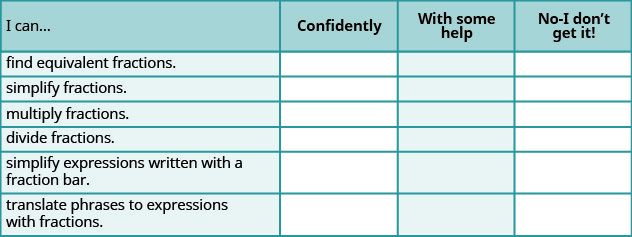
ⓑ 看完清单后,你认为你为下一节做好了充分的准备吗? 为什么或者为什么不呢?