

4.12: 应用函数示例
- Page ID
- 171244

\( \newcommand{\vecs}[1]{\overset { \scriptstyle \rightharpoonup} {\mathbf{#1}} } \)
\( \newcommand{\vecd}[1]{\overset{-\!-\!\rightharpoonup}{\vphantom{a}\smash {#1}}} \)
\( \newcommand{\dsum}{\displaystyle\sum\limits} \)
\( \newcommand{\dint}{\displaystyle\int\limits} \)
\( \newcommand{\dlim}{\displaystyle\lim\limits} \)
\( \newcommand{\id}{\mathrm{id}}\) \( \newcommand{\Span}{\mathrm{span}}\)
( \newcommand{\kernel}{\mathrm{null}\,}\) \( \newcommand{\range}{\mathrm{range}\,}\)
\( \newcommand{\RealPart}{\mathrm{Re}}\) \( \newcommand{\ImaginaryPart}{\mathrm{Im}}\)
\( \newcommand{\Argument}{\mathrm{Arg}}\) \( \newcommand{\norm}[1]{\| #1 \|}\)
\( \newcommand{\inner}[2]{\langle #1, #2 \rangle}\)
\( \newcommand{\Span}{\mathrm{span}}\)
\( \newcommand{\id}{\mathrm{id}}\)
\( \newcommand{\Span}{\mathrm{span}}\)
\( \newcommand{\kernel}{\mathrm{null}\,}\)
\( \newcommand{\range}{\mathrm{range}\,}\)
\( \newcommand{\RealPart}{\mathrm{Re}}\)
\( \newcommand{\ImaginaryPart}{\mathrm{Im}}\)
\( \newcommand{\Argument}{\mathrm{Arg}}\)
\( \newcommand{\norm}[1]{\| #1 \|}\)
\( \newcommand{\inner}[2]{\langle #1, #2 \rangle}\)
\( \newcommand{\Span}{\mathrm{span}}\) \( \newcommand{\AA}{\unicode[.8,0]{x212B}}\)
\( \newcommand{\vectorA}[1]{\vec{#1}} % arrow\)
\( \newcommand{\vectorAt}[1]{\vec{\text{#1}}} % arrow\)
\( \newcommand{\vectorB}[1]{\overset { \scriptstyle \rightharpoonup} {\mathbf{#1}} } \)
\( \newcommand{\vectorC}[1]{\textbf{#1}} \)
\( \newcommand{\vectorD}[1]{\overrightarrow{#1}} \)
\( \newcommand{\vectorDt}[1]{\overrightarrow{\text{#1}}} \)
\( \newcommand{\vectE}[1]{\overset{-\!-\!\rightharpoonup}{\vphantom{a}\smash{\mathbf {#1}}}} \)
\( \newcommand{\vecs}[1]{\overset { \scriptstyle \rightharpoonup} {\mathbf{#1}} } \)
\(\newcommand{\longvect}{\overrightarrow}\)
\( \newcommand{\vecd}[1]{\overset{-\!-\!\rightharpoonup}{\vphantom{a}\smash {#1}}} \)
\(\newcommand{\avec}{\mathbf a}\) \(\newcommand{\bvec}{\mathbf b}\) \(\newcommand{\cvec}{\mathbf c}\) \(\newcommand{\dvec}{\mathbf d}\) \(\newcommand{\dtil}{\widetilde{\mathbf d}}\) \(\newcommand{\evec}{\mathbf e}\) \(\newcommand{\fvec}{\mathbf f}\) \(\newcommand{\nvec}{\mathbf n}\) \(\newcommand{\pvec}{\mathbf p}\) \(\newcommand{\qvec}{\mathbf q}\) \(\newcommand{\svec}{\mathbf s}\) \(\newcommand{\tvec}{\mathbf t}\) \(\newcommand{\uvec}{\mathbf u}\) \(\newcommand{\vvec}{\mathbf v}\) \(\newcommand{\wvec}{\mathbf w}\) \(\newcommand{\xvec}{\mathbf x}\) \(\newcommand{\yvec}{\mathbf y}\) \(\newcommand{\zvec}{\mathbf z}\) \(\newcommand{\rvec}{\mathbf r}\) \(\newcommand{\mvec}{\mathbf m}\) \(\newcommand{\zerovec}{\mathbf 0}\) \(\newcommand{\onevec}{\mathbf 1}\) \(\newcommand{\real}{\mathbb R}\) \(\newcommand{\twovec}[2]{\left[\begin{array}{r}#1 \\ #2 \end{array}\right]}\) \(\newcommand{\ctwovec}[2]{\left[\begin{array}{c}#1 \\ #2 \end{array}\right]}\) \(\newcommand{\threevec}[3]{\left[\begin{array}{r}#1 \\ #2 \\ #3 \end{array}\right]}\) \(\newcommand{\cthreevec}[3]{\left[\begin{array}{c}#1 \\ #2 \\ #3 \end{array}\right]}\) \(\newcommand{\fourvec}[4]{\left[\begin{array}{r}#1 \\ #2 \\ #3 \\ #4 \end{array}\right]}\) \(\newcommand{\cfourvec}[4]{\left[\begin{array}{c}#1 \\ #2 \\ #3 \\ #4 \end{array}\right]}\) \(\newcommand{\fivevec}[5]{\left[\begin{array}{r}#1 \\ #2 \\ #3 \\ #4 \\ #5 \\ \end{array}\right]}\) \(\newcommand{\cfivevec}[5]{\left[\begin{array}{c}#1 \\ #2 \\ #3 \\ #4 \\ #5 \\ \end{array}\right]}\) \(\newcommand{\mattwo}[4]{\left[\begin{array}{rr}#1 \amp #2 \\ #3 \amp #4 \\ \end{array}\right]}\) \(\newcommand{\laspan}[1]{\text{Span}\{#1\}}\) \(\newcommand{\bcal}{\cal B}\) \(\newcommand{\ccal}{\cal C}\) \(\newcommand{\scal}{\cal S}\) \(\newcommand{\wcal}{\cal W}\) \(\newcommand{\ecal}{\cal E}\) \(\newcommand{\coords}[2]{\left\{#1\right\}_{#2}}\) \(\newcommand{\gray}[1]{\color{gray}{#1}}\) \(\newcommand{\lgray}[1]{\color{lightgray}{#1}}\) \(\newcommand{\rank}{\operatorname{rank}}\) \(\newcommand{\row}{\text{Row}}\) \(\newcommand{\col}{\text{Col}}\) \(\renewcommand{\row}{\text{Row}}\) \(\newcommand{\nul}{\text{Nul}}\) \(\newcommand{\var}{\text{Var}}\) \(\newcommand{\corr}{\text{corr}}\) \(\newcommand{\len}[1]{\left|#1\right|}\) \(\newcommand{\bbar}{\overline{\bvec}}\) \(\newcommand{\bhat}{\widehat{\bvec}}\) \(\newcommand{\bperp}{\bvec^\perp}\) \(\newcommand{\xhat}{\widehat{\xvec}}\) \(\newcommand{\vhat}{\widehat{\vvec}}\) \(\newcommand{\uhat}{\widehat{\uvec}}\) \(\newcommand{\what}{\widehat{\wvec}}\) \(\newcommand{\Sighat}{\widehat{\Sigma}}\) \(\newcommand{\lt}{<}\) \(\newcommand{\gt}{>}\) \(\newcommand{\amp}{&}\) \(\definecolor{fillinmathshade}{gray}{0.9}\)函数的应用示例(又名单词问题!) 可以采取多种形式。
准备好使用本章中回顾过的任何类型的函数。
如果工人工作超过40个小时,暑期工作会为加班支付半工资。 40 小时后,工人的工资是每小时工资\($12.00\)的 1.5 倍。
- 编写并绘制一个分段函数,根据工作时数给出每周工资 P。提示:这可能很棘手,想想如何表示超过 40 小时的小时数。
- 工作 45 小时能赚多少钱?
解决方案
- 要编写分段函数,请执行以下操作:
\(P (h) = \left\{\begin{array}{cc} 12h &0 < h \leq 40 \\ 12(40) + 1.5(12)(h − 40) &h > 40\end{array} \right.\)
要绘制此函数的图表,请制作解决方案表:
|
的解决方案表\(P (h) = 12h \) 域名\(0 < h \leq 40\) |
|
| \(h\) | \(P(h)\) |
| 1 | \($12.00\) |
| 10 | \($120.00\) |
| 40 | \($480.00\) |
|
的解决方案表\(P (h) = 12(40) + 1.5(7)(h − 40) \) 简化\(P (h) = 18h − 240 \) 域名\(h > 40\) |
|
| \(h\) | \(P(h)\) |
| 41 | 498 |
| 45 | 570 |
| 50 | 660 |
| 60 | 840 |
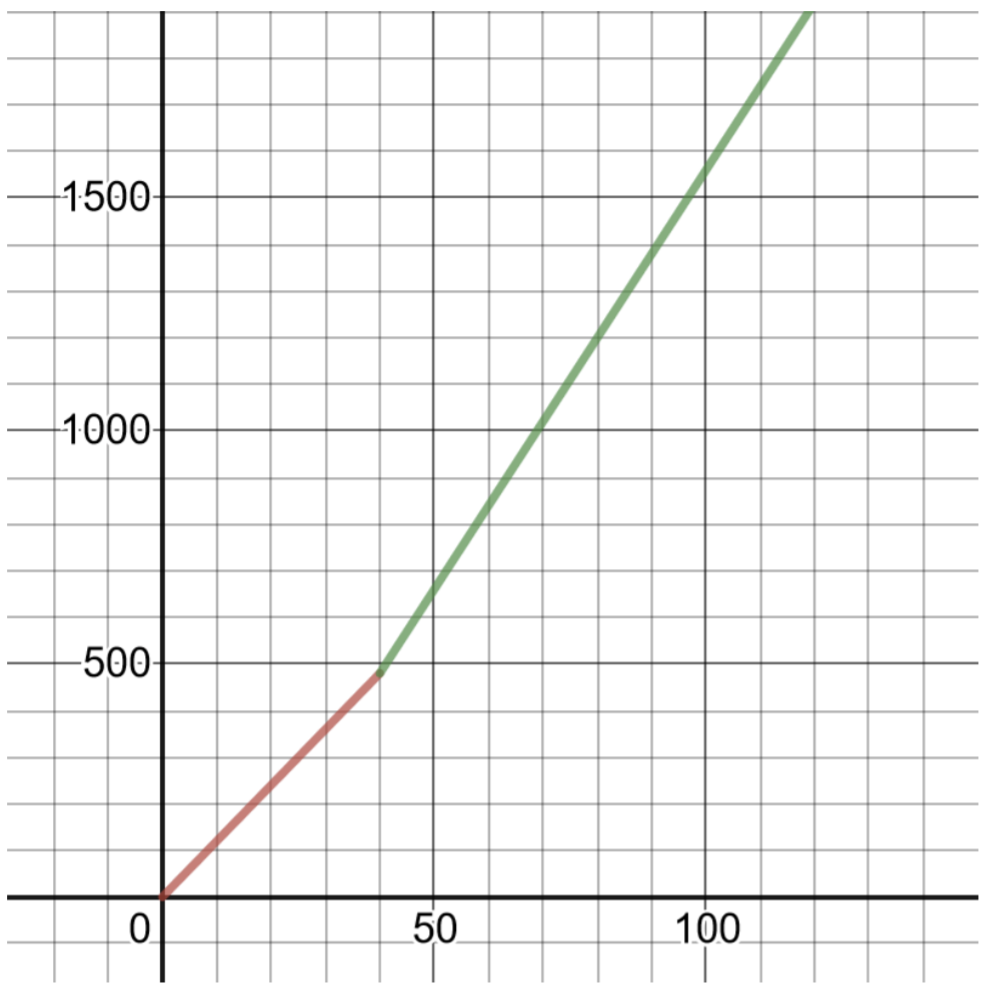
- \($570.00\)工作45小时(参见解决方案表)
美国宇航局在\(t=0\)几秒钟内发射火箭。 它的高度,以海拔米为单位,随时间变化,由下式给出\(h(t) = −4.9t^2 + 46t + 227\)。
- 假设火箭会飞溅到海里,飞溅会在什么时候发生?
- 火箭达到峰值时海拔多高?
解决方案
- 在 splash down 时\(h(t) = 0\),将函数设置为 0 并求解\(t\)。
\(0 = −4.9t 2 + 46t + 227\)
使用二次公式求解这个方程,用\(a = −4.9\)、\(b = 46\)、\(c = 227\)
\(\begin{aligned} t &= \dfrac{−46 \pm \sqrt{46^2 − 4(−4.9)(227) }}{2(−4.9) } && \text{Quadratic Formula} \\ t &= \dfrac{−46 \pm \sqrt{ 2116 + 4449.2 }}{−9.8 } &&\text{Simplify the radical} \\ t &= \dfrac{46 \pm \sqrt{ 6565.2 }}{9.8 } &&\text{Further simplify the radical, divide all terms by -1 (still have } \pm\text{ )} \\t &= \dfrac{46 \pm 81.026 }{9.8 } &&\text{Square root} \\ t &= \dfrac{46 + 81.026 }{9.8 } &&\text{Addition} \\ t &= \dfrac{46 − 81.026 }{9.8} && \text{Subtraction} \\ t& = 12.96 \text{ and } t = −3.57&& \text{Two solutions, reject negative solution because time cannot be negative} \\ t &= 12.96 \text{ seconds }&&\text{Final Answer} \end{aligned}\)
- 火箭达到峰值时海拔多高?
二次函数前导项系数的符号\(h(t) = −4.9t^2 + 46t + 227\)显示抛物线的开口方向。 系数为\(−4.9\),由于系数为负,二次函数向下打开。
现在我们需要找到顶点。 顶点有序对的 y 值将显示范围的起点。
顶点是\(\left(− \dfrac{b }{2a} , f\left( −\dfrac{ b }{2a}\right) \right)\),\(a = −4.9\)和\(b = 46\)
顶点是\(\left(−\dfrac{ 46 }{2(−4.9) }, f\left( − \dfrac{46 }{2(−4.9)}\right)\right)\)
顶点是\((4.694, f (4.694))\)哪个是\((4.694, (−4.9)(4.694)^2 + (46)(4.694) + 227 ))\)或\((4.694, 334.959)\)
火箭在其峰值的高度高于海平面数\(334.959\)米。
为了促进阿拉斯加游轮的团体销售,旅行社将团体中每个\($5\)人的常规票价降低了\($4500\) by。
- 写一个线性方程式,如果\(p\)人们成群旅行\(f(p)\),则给出每人成本。
- 使用方程式确定 50 人的成本。
解决方案
- 由于每人成本的减少幅度相同,因此这是一个线性方程式。
使用\(f(x) = mx + b\),或者让我们把它写成\(f(p) = mp + b\),按\(f(p)\)人均费用计算。
\(f(p) = mp + b\)
由于小组中每人的每人费用减少了5美元,这就是线的斜率。
\(\begin{aligned} f(p)&= −5p + b && \text{Slope-intercept form of the equation of a line} \\ f(p) &= −5p + 4500 &&\text{The y-intercept is the starting point, so the regular ticket price of }$4500 {is the y-intercept} \\ f(p)& = −5p + 4500 && \text{Linear Equation} \end{aligned}\)
- 使用方程式确定 50 人的成本。
\(\begin{aligned} f(50) &= −5(50) + 4500 && \text{Replace p with 50 people in the Linear Equation} \\ f(50) &= −250 + 4500 &&\text{Simplify} \\ f(50) &= 4250 &&\text{Simplify} \\ \text{If }50 &\text{ people take the cruise, the cost per-person for the cruise is } $4250&&\text{Final Answer }\end{aligned}\)
完成以下应用函数问题:
- 裁缝要在夹克背面缝上运动员的名字,则\($5\)每封信收取\($20\)加价的基本费用。
- 写一个线性方程式,找出在夹克背面缝上包含 x 个字母的名字的成本。
- 一个包含 11 个字母的名字的费用是多少?
- 在墨西哥阿卡普尔科,一个受欢迎的旅游胜地是观看男子从悬崖潜入75英尺以下的水域。 潜水员在潜水\(t\)几秒钟后在水\(f(t)\)面之上的身高(以英尺为单位)由下式给出\(f(t) = −16t^2+75\)。
- 潜水持续多长时间?
- 在某个国家,所得税的评估方式如下:最高不征收所得税\($15000\)。 超过\($15000\)的收入按以下税\($30000\)率征税\(12%\)。 超过的收入\($30000\)按以下税率征税\(18%\)。
- 写下上述信息的分段函数并绘制其图形。
- 确定对收入应缴纳的税额\($18000\)。