

4.9: 函数组合
- Page ID
- 171227

\( \newcommand{\vecs}[1]{\overset { \scriptstyle \rightharpoonup} {\mathbf{#1}} } \)
\( \newcommand{\vecd}[1]{\overset{-\!-\!\rightharpoonup}{\vphantom{a}\smash {#1}}} \)
\( \newcommand{\dsum}{\displaystyle\sum\limits} \)
\( \newcommand{\dint}{\displaystyle\int\limits} \)
\( \newcommand{\dlim}{\displaystyle\lim\limits} \)
\( \newcommand{\id}{\mathrm{id}}\) \( \newcommand{\Span}{\mathrm{span}}\)
( \newcommand{\kernel}{\mathrm{null}\,}\) \( \newcommand{\range}{\mathrm{range}\,}\)
\( \newcommand{\RealPart}{\mathrm{Re}}\) \( \newcommand{\ImaginaryPart}{\mathrm{Im}}\)
\( \newcommand{\Argument}{\mathrm{Arg}}\) \( \newcommand{\norm}[1]{\| #1 \|}\)
\( \newcommand{\inner}[2]{\langle #1, #2 \rangle}\)
\( \newcommand{\Span}{\mathrm{span}}\)
\( \newcommand{\id}{\mathrm{id}}\)
\( \newcommand{\Span}{\mathrm{span}}\)
\( \newcommand{\kernel}{\mathrm{null}\,}\)
\( \newcommand{\range}{\mathrm{range}\,}\)
\( \newcommand{\RealPart}{\mathrm{Re}}\)
\( \newcommand{\ImaginaryPart}{\mathrm{Im}}\)
\( \newcommand{\Argument}{\mathrm{Arg}}\)
\( \newcommand{\norm}[1]{\| #1 \|}\)
\( \newcommand{\inner}[2]{\langle #1, #2 \rangle}\)
\( \newcommand{\Span}{\mathrm{span}}\) \( \newcommand{\AA}{\unicode[.8,0]{x212B}}\)
\( \newcommand{\vectorA}[1]{\vec{#1}} % arrow\)
\( \newcommand{\vectorAt}[1]{\vec{\text{#1}}} % arrow\)
\( \newcommand{\vectorB}[1]{\overset { \scriptstyle \rightharpoonup} {\mathbf{#1}} } \)
\( \newcommand{\vectorC}[1]{\textbf{#1}} \)
\( \newcommand{\vectorD}[1]{\overrightarrow{#1}} \)
\( \newcommand{\vectorDt}[1]{\overrightarrow{\text{#1}}} \)
\( \newcommand{\vectE}[1]{\overset{-\!-\!\rightharpoonup}{\vphantom{a}\smash{\mathbf {#1}}}} \)
\( \newcommand{\vecs}[1]{\overset { \scriptstyle \rightharpoonup} {\mathbf{#1}} } \)
\(\newcommand{\longvect}{\overrightarrow}\)
\( \newcommand{\vecd}[1]{\overset{-\!-\!\rightharpoonup}{\vphantom{a}\smash {#1}}} \)
\(\newcommand{\avec}{\mathbf a}\) \(\newcommand{\bvec}{\mathbf b}\) \(\newcommand{\cvec}{\mathbf c}\) \(\newcommand{\dvec}{\mathbf d}\) \(\newcommand{\dtil}{\widetilde{\mathbf d}}\) \(\newcommand{\evec}{\mathbf e}\) \(\newcommand{\fvec}{\mathbf f}\) \(\newcommand{\nvec}{\mathbf n}\) \(\newcommand{\pvec}{\mathbf p}\) \(\newcommand{\qvec}{\mathbf q}\) \(\newcommand{\svec}{\mathbf s}\) \(\newcommand{\tvec}{\mathbf t}\) \(\newcommand{\uvec}{\mathbf u}\) \(\newcommand{\vvec}{\mathbf v}\) \(\newcommand{\wvec}{\mathbf w}\) \(\newcommand{\xvec}{\mathbf x}\) \(\newcommand{\yvec}{\mathbf y}\) \(\newcommand{\zvec}{\mathbf z}\) \(\newcommand{\rvec}{\mathbf r}\) \(\newcommand{\mvec}{\mathbf m}\) \(\newcommand{\zerovec}{\mathbf 0}\) \(\newcommand{\onevec}{\mathbf 1}\) \(\newcommand{\real}{\mathbb R}\) \(\newcommand{\twovec}[2]{\left[\begin{array}{r}#1 \\ #2 \end{array}\right]}\) \(\newcommand{\ctwovec}[2]{\left[\begin{array}{c}#1 \\ #2 \end{array}\right]}\) \(\newcommand{\threevec}[3]{\left[\begin{array}{r}#1 \\ #2 \\ #3 \end{array}\right]}\) \(\newcommand{\cthreevec}[3]{\left[\begin{array}{c}#1 \\ #2 \\ #3 \end{array}\right]}\) \(\newcommand{\fourvec}[4]{\left[\begin{array}{r}#1 \\ #2 \\ #3 \\ #4 \end{array}\right]}\) \(\newcommand{\cfourvec}[4]{\left[\begin{array}{c}#1 \\ #2 \\ #3 \\ #4 \end{array}\right]}\) \(\newcommand{\fivevec}[5]{\left[\begin{array}{r}#1 \\ #2 \\ #3 \\ #4 \\ #5 \\ \end{array}\right]}\) \(\newcommand{\cfivevec}[5]{\left[\begin{array}{c}#1 \\ #2 \\ #3 \\ #4 \\ #5 \\ \end{array}\right]}\) \(\newcommand{\mattwo}[4]{\left[\begin{array}{rr}#1 \amp #2 \\ #3 \amp #4 \\ \end{array}\right]}\) \(\newcommand{\laspan}[1]{\text{Span}\{#1\}}\) \(\newcommand{\bcal}{\cal B}\) \(\newcommand{\ccal}{\cal C}\) \(\newcommand{\scal}{\cal S}\) \(\newcommand{\wcal}{\cal W}\) \(\newcommand{\ecal}{\cal E}\) \(\newcommand{\coords}[2]{\left\{#1\right\}_{#2}}\) \(\newcommand{\gray}[1]{\color{gray}{#1}}\) \(\newcommand{\lgray}[1]{\color{lightgray}{#1}}\) \(\newcommand{\rank}{\operatorname{rank}}\) \(\newcommand{\row}{\text{Row}}\) \(\newcommand{\col}{\text{Col}}\) \(\renewcommand{\row}{\text{Row}}\) \(\newcommand{\nul}{\text{Nul}}\) \(\newcommand{\var}{\text{Var}}\) \(\newcommand{\corr}{\text{corr}}\) \(\newcommand{\len}[1]{\left|#1\right|}\) \(\newcommand{\bbar}{\overline{\bvec}}\) \(\newcommand{\bhat}{\widehat{\bvec}}\) \(\newcommand{\bperp}{\bvec^\perp}\) \(\newcommand{\xhat}{\widehat{\xvec}}\) \(\newcommand{\vhat}{\widehat{\vvec}}\) \(\newcommand{\uhat}{\widehat{\uvec}}\) \(\newcommand{\what}{\widehat{\wvec}}\) \(\newcommand{\Sighat}{\widehat{\Sigma}}\) \(\newcommand{\lt}{<}\) \(\newcommand{\gt}{>}\) \(\newcommand{\amp}{&}\) \(\definecolor{fillinmathshade}{gray}{0.9}\)下图再次出自 Calaway、Hoffman 和 Lippman 的 OER 教科书《商业微积分》,经许可使用(知识共享署名 3.0 美国许可证)。
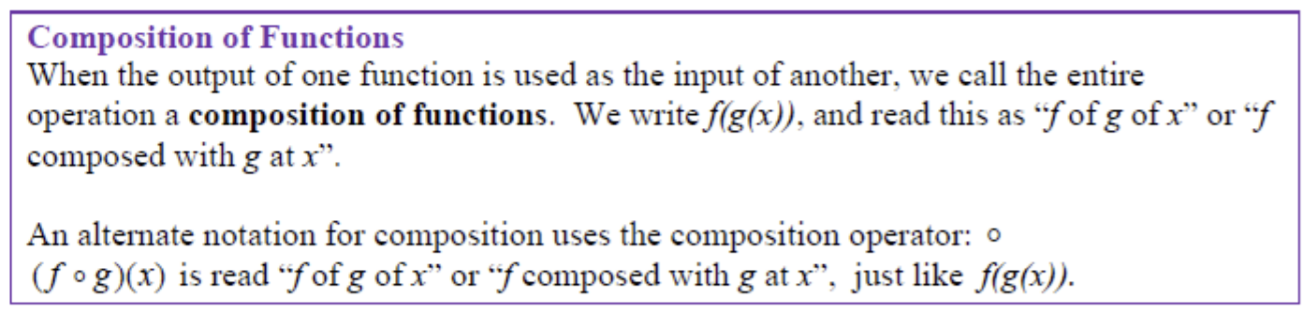
符号\(f(g(x))\)和\(g(f(x))\)可能比使用组合运算符更容易理解。 因为\(f(g(x))\),可以考虑包装一个包裹。 礼物被放入盒子里(礼物是\(g(x)\),盒子是\(f(x)\))\(f(x)\),包装好的礼物包含礼物\(g(x)\)。
如果为\(f(x) = x^2 − 2\) and\(g(x) =\sqrt{x}\),请查找:
- \(f(g(x))\)和复合函数的域
- \(g(f(x))\)和复合函数的域
解决方案
- 函数的组成\(f(g(x))\)是:
\(\begin{aligned} f(g(x)) &&\text{ Function composition, }f \text{ of }g\text{ of }x \\ f(\sqrt{x}) &&\text{ Replace } g(x)\text{ with }\sqrt{x} \\ ( \sqrt{x})^2 − 2 && \text{ In the function } f(x)\text{, every }x \text{ is replaced with } g(x) =\sqrt{x} \\ x − 2 && f(g(x))\text{, answer simplified.} \end{aligned}\)
复合函数的域包含内部函数域的限制以及复合函数的限制。
内部函数的域\(x\)必须\(g(x) = \sqrt{x}\)是非负的,或者采用区间表示法\([0, \infty )\)
复合函数的域,\(x − 2\)都是实数,\((−\infty , \infty )\)
因此,的域\(f(g(x))\)是\([0, \infty )\)。
- 函数的组成\(g(f(x))\)是:
\(\begin{aligned} g(f(x)) &&\text{ Function composition, }g \text{ of } f \text{ of } x \\ g(x^2 − 2)&& \text{ Replace }f(x)\text{ with } x^2 − 2 \\ \sqrt{x^2 − 2} &&\text{ In the function } g(x)\text{, every }x \text{ is replaced with } f(x) = x^2−2 \\ x^2 − 2 && g(f(x))\text{, answer simplified. }\end{aligned}\)
复合函数的域包含内部函数的域以及复合函数的域的限制。
内部函数的域,全部\(f(x) = x^2 − 2\)为实数,或以间隔表示法\((−\infty , \infty )\)
复合函数的域\(\sqrt{x^2} − 2\)是量\(x^2 −2\)必须为非负或\(x^2 −2 \geq 0\)。
\(x^2 − 2 \geq 0\)求解\(x\)、\(x \geq 2\)和\(x \leq −2\)。 在间隔表示法中,\((−\infty , −2] \cup [2, \infty )\)
因此,复合函数的域 g (f (x)) 是限制性更强的域\((−\infty , −2] \cup [2, \infty )\)。
如果为\(f(x) = \dfrac{1 }{x − 4}\) and\(g(x) = \dfrac{5 }{x} + 4\),请查找:
- \(f(g(x))\)和复合函数的域
- \(g(f(x))\)和复合函数的域
解决方案
- 函数的组成\(f(g(x))\)是:
\(\begin{aligned} f(g(x)) \text{ Function composition, } f\text{ of }g \text{ of }x\\ f\left( \dfrac{5}{ x} + 4\right) && \text{ Replace }g(x)\text{ with }\dfrac{5 }{x} + 4 \\ \dfrac{1 }{\left(5 x + 4\right)− 4} && \text{ In the function } f(x)\text{, every x is replaced with } g(x) = \dfrac{5}{ x} + 4 \\ \dfrac{1 }{\dfrac{5 }{x}}&&\text{ Simplify} \\ \dfrac{x }{5} && f(g(x))\text{, answer simplified. }\end{aligned}\)
复合函数的域包含内部函数域的限制以及复合函数的限制。
内部函数的域\(g(x) = 5 x + 4\)是\(x\)这样的所有值,\(x\)不能为 0,或者用间隔表示法\((−\infty , 0) \cup (0, \infty )\)
复合函数的域\(\dfrac{x }{5}\)都是实数,\((−\infty , \infty )\)因此,的域\(f(g(x))\)是\((−\infty , 0) \cup (0, \infty )\)
- 函数的组成\(g(f(x))\)是
\(\begin{aligned} g(f(x))&&\text{Function composition, } g \text{ of } f\text{ of }x \\ g\left( \dfrac{1 }{x −4}\right) &&\text{Replace } f(x) \text{ with }\dfrac{1}{ x − 4}\\ \dfrac{5 }{\dfrac{1 }{x − 4}} + 4 &&\text{In the function } g(x)\text{, every x is replaced with } f(x) = \dfrac{1 }{x − 4}\\ 5(x − 4) + 4 && \text{ Simplify the fraction} \\ 5x − 20 + 4 &&\text{ Simplify more}\\ 5x − 16 && g(f(x))\text{, answer simplified.} \end{aligned}\)
复合函数的域包含内部函数的域以及复合函数的域的限制。
内部函数的域\(f(x) = \dfrac{1}{ x − 4 }\)是 that\(x\neq 4\),或者用区间表示法\((−\infty , 4) \cup (4, \infty )\)
复合函数的域均\(5x − 16\)为实数\((−\infty , \infty )\)。
因此,复合函数的域\(g(f(x))\)是限制性更强的域\((−\infty , 4) \cup (4, \infty)\)。
对于给定函数,请同时找到\(f(g(x))\)和\(g(f(x))\),然后找到复合函数的域。
- \(f(x) = 3x^ 2 + x − 10\),\(g(x) = 1 − 20x\)
- \(f(x) = 3x − 2\),\(g(x) = \dfrac{1}{ 3} x + \dfrac{2 }{3}\)
- \(f(x) = 4x − 1\),\(g(x) = \sqrt{6 + 7x}\)
- \(f(x) = 5x + 2\),\(g(x) = x^2 − 14x\)
- \(f(x) = x^ 2 − 2x + 1\),\(g(x) = 8 − 3x ^2\)
- \(f(x) = x ^2 + 3\),\(g(x) = \sqrt{5 + x^2} \)