
Global

3.5:印度河谷(公元前 3300 年至公元前 1700 年)

  • Page ID
    172514
  • \( \newcommand{\vecs}[1]{\overset { \scriptstyle \rightharpoonup} {\mathbf{#1}} } \)

    \( \newcommand{\vecd}[1]{\overset{-\!-\!\rightharpoonup}{\vphantom{a}\smash {#1}}} \)

    \( \newcommand{\dsum}{\displaystyle\sum\limits} \)

    \( \newcommand{\dint}{\displaystyle\int\limits} \)

    \( \newcommand{\dlim}{\displaystyle\lim\limits} \)

    \( \newcommand{\id}{\mathrm{id}}\) \( \newcommand{\Span}{\mathrm{span}}\)

    ( \newcommand{\kernel}{\mathrm{null}\,}\) \( \newcommand{\range}{\mathrm{range}\,}\)

    \( \newcommand{\RealPart}{\mathrm{Re}}\) \( \newcommand{\ImaginaryPart}{\mathrm{Im}}\)

    \( \newcommand{\Argument}{\mathrm{Arg}}\) \( \newcommand{\norm}[1]{\| #1 \|}\)

    \( \newcommand{\inner}[2]{\langle #1, #2 \rangle}\)

    \( \newcommand{\Span}{\mathrm{span}}\)

    \( \newcommand{\id}{\mathrm{id}}\)

    \( \newcommand{\Span}{\mathrm{span}}\)

    \( \newcommand{\kernel}{\mathrm{null}\,}\)

    \( \newcommand{\range}{\mathrm{range}\,}\)

    \( \newcommand{\RealPart}{\mathrm{Re}}\)

    \( \newcommand{\ImaginaryPart}{\mathrm{Im}}\)

    \( \newcommand{\Argument}{\mathrm{Arg}}\)

    \( \newcommand{\norm}[1]{\| #1 \|}\)

    \( \newcommand{\inner}[2]{\langle #1, #2 \rangle}\)

    \( \newcommand{\Span}{\mathrm{span}}\) \( \newcommand{\AA}{\unicode[.8,0]{x212B}}\)

    \( \newcommand{\vectorA}[1]{\vec{#1}}      % arrow\)

    \( \newcommand{\vectorAt}[1]{\vec{\text{#1}}}      % arrow\)

    \( \newcommand{\vectorB}[1]{\overset { \scriptstyle \rightharpoonup} {\mathbf{#1}} } \)

    \( \newcommand{\vectorC}[1]{\textbf{#1}} \)

    \( \newcommand{\vectorD}[1]{\overrightarrow{#1}} \)

    \( \newcommand{\vectorDt}[1]{\overrightarrow{\text{#1}}} \)

    \( \newcommand{\vectE}[1]{\overset{-\!-\!\rightharpoonup}{\vphantom{a}\smash{\mathbf {#1}}}} \)

    \( \newcommand{\vecs}[1]{\overset { \scriptstyle \rightharpoonup} {\mathbf{#1}} } \)

    \(\newcommand{\longvect}{\overrightarrow}\)

    \( \newcommand{\vecd}[1]{\overset{-\!-\!\rightharpoonup}{\vphantom{a}\smash {#1}}} \)

    \(\newcommand{\avec}{\mathbf a}\) \(\newcommand{\bvec}{\mathbf b}\) \(\newcommand{\cvec}{\mathbf c}\) \(\newcommand{\dvec}{\mathbf d}\) \(\newcommand{\dtil}{\widetilde{\mathbf d}}\) \(\newcommand{\evec}{\mathbf e}\) \(\newcommand{\fvec}{\mathbf f}\) \(\newcommand{\nvec}{\mathbf n}\) \(\newcommand{\pvec}{\mathbf p}\) \(\newcommand{\qvec}{\mathbf q}\) \(\newcommand{\svec}{\mathbf s}\) \(\newcommand{\tvec}{\mathbf t}\) \(\newcommand{\uvec}{\mathbf u}\) \(\newcommand{\vvec}{\mathbf v}\) \(\newcommand{\wvec}{\mathbf w}\) \(\newcommand{\xvec}{\mathbf x}\) \(\newcommand{\yvec}{\mathbf y}\) \(\newcommand{\zvec}{\mathbf z}\) \(\newcommand{\rvec}{\mathbf r}\) \(\newcommand{\mvec}{\mathbf m}\) \(\newcommand{\zerovec}{\mathbf 0}\) \(\newcommand{\onevec}{\mathbf 1}\) \(\newcommand{\real}{\mathbb R}\) \(\newcommand{\twovec}[2]{\left[\begin{array}{r}#1 \\ #2 \end{array}\right]}\) \(\newcommand{\ctwovec}[2]{\left[\begin{array}{c}#1 \\ #2 \end{array}\right]}\) \(\newcommand{\threevec}[3]{\left[\begin{array}{r}#1 \\ #2 \\ #3 \end{array}\right]}\) \(\newcommand{\cthreevec}[3]{\left[\begin{array}{c}#1 \\ #2 \\ #3 \end{array}\right]}\) \(\newcommand{\fourvec}[4]{\left[\begin{array}{r}#1 \\ #2 \\ #3 \\ #4 \end{array}\right]}\) \(\newcommand{\cfourvec}[4]{\left[\begin{array}{c}#1 \\ #2 \\ #3 \\ #4 \end{array}\right]}\) \(\newcommand{\fivevec}[5]{\left[\begin{array}{r}#1 \\ #2 \\ #3 \\ #4 \\ #5 \\ \end{array}\right]}\) \(\newcommand{\cfivevec}[5]{\left[\begin{array}{c}#1 \\ #2 \\ #3 \\ #4 \\ #5 \\ \end{array}\right]}\) \(\newcommand{\mattwo}[4]{\left[\begin{array}{rr}#1 \amp #2 \\ #3 \amp #4 \\ \end{array}\right]}\) \(\newcommand{\laspan}[1]{\text{Span}\{#1\}}\) \(\newcommand{\bcal}{\cal B}\) \(\newcommand{\ccal}{\cal C}\) \(\newcommand{\scal}{\cal S}\) \(\newcommand{\wcal}{\cal W}\) \(\newcommand{\ecal}{\cal E}\) \(\newcommand{\coords}[2]{\left\{#1\right\}_{#2}}\) \(\newcommand{\gray}[1]{\color{gray}{#1}}\) \(\newcommand{\lgray}[1]{\color{lightgray}{#1}}\) \(\newcommand{\rank}{\operatorname{rank}}\) \(\newcommand{\row}{\text{Row}}\) \(\newcommand{\col}{\text{Col}}\) \(\renewcommand{\row}{\text{Row}}\) \(\newcommand{\nul}{\text{Nul}}\) \(\newcommand{\var}{\text{Var}}\) \(\newcommand{\corr}{\text{corr}}\) \(\newcommand{\len}[1]{\left|#1\right|}\) \(\newcommand{\bbar}{\overline{\bvec}}\) \(\newcommand{\bhat}{\widehat{\bvec}}\) \(\newcommand{\bperp}{\bvec^\perp}\) \(\newcommand{\xhat}{\widehat{\xvec}}\) \(\newcommand{\vhat}{\widehat{\vvec}}\) \(\newcommand{\uhat}{\widehat{\uvec}}\) \(\newcommand{\what}{\widehat{\wvec}}\) \(\newcommand{\Sighat}{\widehat{\Sigma}}\) \(\newcommand{\lt}{<}\) \(\newcommand{\gt}{>}\) \(\newcommand{\amp}{&}\) \(\definecolor{fillinmathshade}{gray}{0.9}\)

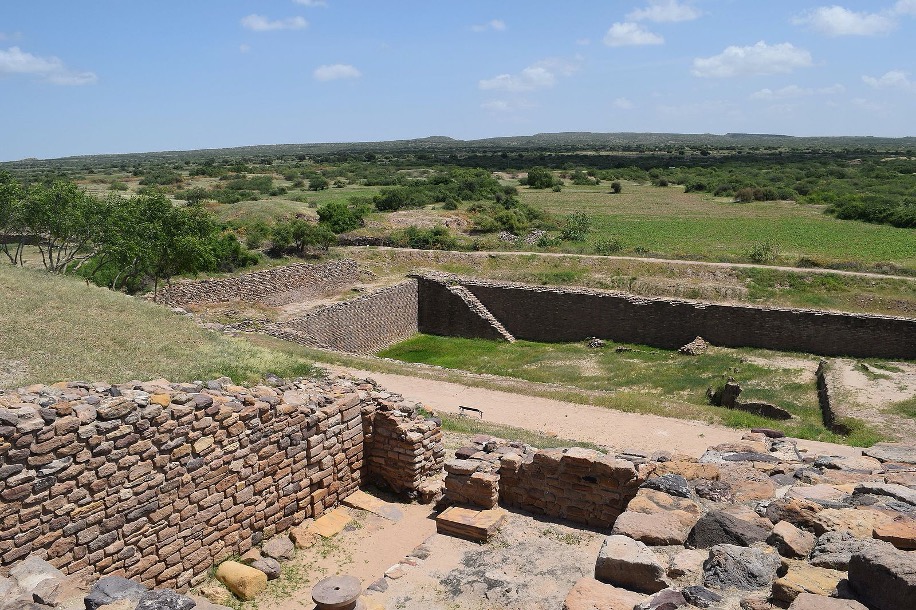
    印度河从广阔的喜马拉雅山脉流入印度河谷,哈拉潘文明在今天的巴基斯坦蓬勃发展。 印度河肥沃的平原和水是人们最重要的自然资源。 最初,哈拉潘人从伊朗的沙漠地区迁移过群山,发现了一个拥有充足水和耕地的地方,成为青铜时代的伟大文明之一。 作为一个繁荣的文明,哈拉潘人是城市规划的主人,他们用水充足,为所有城市建造了水资源系统,包括水库(3.24)、澡堂和洗手间。 他们发达的城市展示了数学的运用,开发了用于建造结构和道路的度量衡系统。 这个高度复杂的社会有驯养的动物,在印度河三角洲种植棉花、豌豆和大麦作物。 他们也是商人,有一类商船在深远的贸易路线上航行。
    clipboard_e8cedb6fd62b27de9fd0e0fbee405339c.png

    3.24 水库

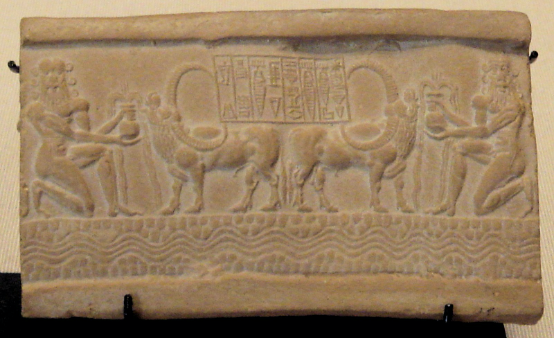
    哈拉潘人用描绘印度河谷不同城市的400-600多个独特场景的人物创作了印章。 这些海豹是在美索不达米亚和印度河谷外发现的,表明与其他文明有贸易。 海豹有录音或绘画语言,如两只长角水牛所示,每只都面对一个看似跪在动物面前的人(3.25),尽管当今的历史学家无法破译它们。
    clipboard_eb7cf0bd8758973e525dbafc3446fb139.pngclipboard_e84b434139a23afd3930e0564ca61fc2c.png

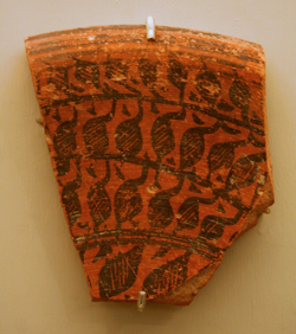
    3.25 气缸封条 3.26 陶器碎片

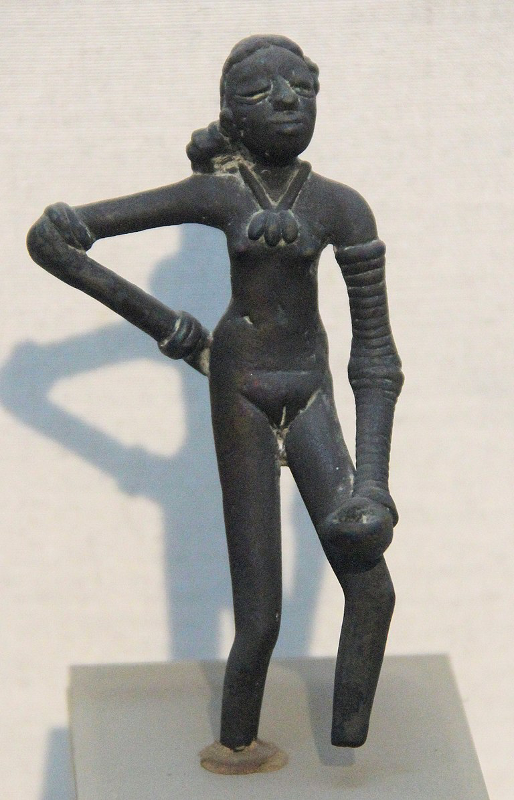
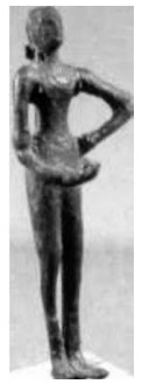
    印度河谷人创造了许多艺术品,包括使用青铜、金和兵马俑制成功利主义和装饰性粘土,上面涂有红纸和黑色颜料(3.26)。 与邻居不同,埃及人,印度人,没有雕刻精美的国王或神像。 相反,他们雕刻了由粘土、石头或青铜制成的人物和动物的小人物,还制作了许多描绘女孩以多种姿势跳舞的小雕像。 跳舞的女孩(3.27)是使用失蜡法用青铜制成的,十厘米高的小雕像展示了一个女孩以自然的姿势站立,仿佛在行动。 第二个女孩(3.28)的姿势很娴静,或者她正在等待轮到她。 这两个数字都表明人们使用铜牌和舞蹈的能力可能是他们文化的重要组成部分。
    clipboard_e80cdc3ffd0ef47e91ec2082d49b219a1.pngclipboard_e844fbd2e6237074e59517d6d1faf3495.png

    3.27 Danc ing Girl 3.28 Danc ing Girl 2

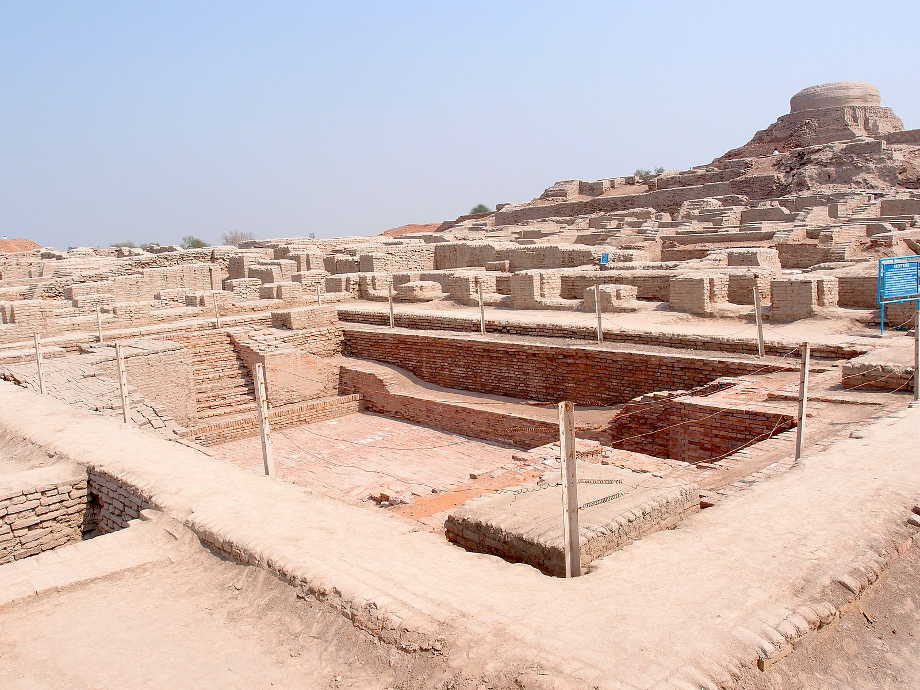
    与他们的同时代人不同,印度河谷的文明没有为众神建造巨大的纪念碑或将领袖埋葬在金墓中,他们相信来世,但更专注于地球上的生活,采取务实的方法。 豪华建筑是Mohenjo-Daro Great Bath of Mohenjo-Daro(3.29),这是已知最早的公共浴池之一,在城市街道中间有一条通道,用于排出雨水和浴池中的水。 它们的设计效率很高,可以将城市中的水排出,类似于我们当今城市中的地下下水道系统。
    clipboard_e658373a87fcc29eb157b0a2e09dc6c25.png

    3.29 洗得很棒

    为提高效率和卫生而设计的城市与当今的城市相似。 城市各处都有水井供人们洗澡和做饭。 这些城市建在高架平台之上,下面的排水管将水从建筑物中排出,街道的布局与当今的城市类似,直线街道彼此成直角。 他们的房屋是用泥砖建造的,在整个山谷中都是标准大小的。 在他们的家中还发现了珠子、各种形状的功利主义陶器和由棉花制成的纺织品,描绘了蓬勃发展的经济以及与美索不达米亚和埃及通过船只和陆地的广泛贸易。

    正如随处可见的那样,伟大的文明也在衰落,印度河谷的哈拉潘人变得容易受到环境变化的影响。 大约在公元前1700年,蓬勃发展的哈拉潘文明崩溃了,随着时间的推移,他们的伟大城市被淤泥掩埋,一直处于休眠状态,直到20世纪20年代被发现。