17.9: 冲击波
- Page ID
- 204204

\( \newcommand{\vecs}[1]{\overset { \scriptstyle \rightharpoonup} {\mathbf{#1}} } \)
\( \newcommand{\vecd}[1]{\overset{-\!-\!\rightharpoonup}{\vphantom{a}\smash {#1}}} \)
\( \newcommand{\dsum}{\displaystyle\sum\limits} \)
\( \newcommand{\dint}{\displaystyle\int\limits} \)
\( \newcommand{\dlim}{\displaystyle\lim\limits} \)
\( \newcommand{\id}{\mathrm{id}}\) \( \newcommand{\Span}{\mathrm{span}}\)
( \newcommand{\kernel}{\mathrm{null}\,}\) \( \newcommand{\range}{\mathrm{range}\,}\)
\( \newcommand{\RealPart}{\mathrm{Re}}\) \( \newcommand{\ImaginaryPart}{\mathrm{Im}}\)
\( \newcommand{\Argument}{\mathrm{Arg}}\) \( \newcommand{\norm}[1]{\| #1 \|}\)
\( \newcommand{\inner}[2]{\langle #1, #2 \rangle}\)
\( \newcommand{\Span}{\mathrm{span}}\)
\( \newcommand{\id}{\mathrm{id}}\)
\( \newcommand{\Span}{\mathrm{span}}\)
\( \newcommand{\kernel}{\mathrm{null}\,}\)
\( \newcommand{\range}{\mathrm{range}\,}\)
\( \newcommand{\RealPart}{\mathrm{Re}}\)
\( \newcommand{\ImaginaryPart}{\mathrm{Im}}\)
\( \newcommand{\Argument}{\mathrm{Arg}}\)
\( \newcommand{\norm}[1]{\| #1 \|}\)
\( \newcommand{\inner}[2]{\langle #1, #2 \rangle}\)
\( \newcommand{\Span}{\mathrm{span}}\) \( \newcommand{\AA}{\unicode[.8,0]{x212B}}\)
\( \newcommand{\vectorA}[1]{\vec{#1}} % arrow\)
\( \newcommand{\vectorAt}[1]{\vec{\text{#1}}} % arrow\)
\( \newcommand{\vectorB}[1]{\overset { \scriptstyle \rightharpoonup} {\mathbf{#1}} } \)
\( \newcommand{\vectorC}[1]{\textbf{#1}} \)
\( \newcommand{\vectorD}[1]{\overrightarrow{#1}} \)
\( \newcommand{\vectorDt}[1]{\overrightarrow{\text{#1}}} \)
\( \newcommand{\vectE}[1]{\overset{-\!-\!\rightharpoonup}{\vphantom{a}\smash{\mathbf {#1}}}} \)
\( \newcommand{\vecs}[1]{\overset { \scriptstyle \rightharpoonup} {\mathbf{#1}} } \)
\(\newcommand{\longvect}{\overrightarrow}\)
\( \newcommand{\vecd}[1]{\overset{-\!-\!\rightharpoonup}{\vphantom{a}\smash {#1}}} \)
\(\newcommand{\avec}{\mathbf a}\) \(\newcommand{\bvec}{\mathbf b}\) \(\newcommand{\cvec}{\mathbf c}\) \(\newcommand{\dvec}{\mathbf d}\) \(\newcommand{\dtil}{\widetilde{\mathbf d}}\) \(\newcommand{\evec}{\mathbf e}\) \(\newcommand{\fvec}{\mathbf f}\) \(\newcommand{\nvec}{\mathbf n}\) \(\newcommand{\pvec}{\mathbf p}\) \(\newcommand{\qvec}{\mathbf q}\) \(\newcommand{\svec}{\mathbf s}\) \(\newcommand{\tvec}{\mathbf t}\) \(\newcommand{\uvec}{\mathbf u}\) \(\newcommand{\vvec}{\mathbf v}\) \(\newcommand{\wvec}{\mathbf w}\) \(\newcommand{\xvec}{\mathbf x}\) \(\newcommand{\yvec}{\mathbf y}\) \(\newcommand{\zvec}{\mathbf z}\) \(\newcommand{\rvec}{\mathbf r}\) \(\newcommand{\mvec}{\mathbf m}\) \(\newcommand{\zerovec}{\mathbf 0}\) \(\newcommand{\onevec}{\mathbf 1}\) \(\newcommand{\real}{\mathbb R}\) \(\newcommand{\twovec}[2]{\left[\begin{array}{r}#1 \\ #2 \end{array}\right]}\) \(\newcommand{\ctwovec}[2]{\left[\begin{array}{c}#1 \\ #2 \end{array}\right]}\) \(\newcommand{\threevec}[3]{\left[\begin{array}{r}#1 \\ #2 \\ #3 \end{array}\right]}\) \(\newcommand{\cthreevec}[3]{\left[\begin{array}{c}#1 \\ #2 \\ #3 \end{array}\right]}\) \(\newcommand{\fourvec}[4]{\left[\begin{array}{r}#1 \\ #2 \\ #3 \\ #4 \end{array}\right]}\) \(\newcommand{\cfourvec}[4]{\left[\begin{array}{c}#1 \\ #2 \\ #3 \\ #4 \end{array}\right]}\) \(\newcommand{\fivevec}[5]{\left[\begin{array}{r}#1 \\ #2 \\ #3 \\ #4 \\ #5 \\ \end{array}\right]}\) \(\newcommand{\cfivevec}[5]{\left[\begin{array}{c}#1 \\ #2 \\ #3 \\ #4 \\ #5 \\ \end{array}\right]}\) \(\newcommand{\mattwo}[4]{\left[\begin{array}{rr}#1 \amp #2 \\ #3 \amp #4 \\ \end{array}\right]}\) \(\newcommand{\laspan}[1]{\text{Span}\{#1\}}\) \(\newcommand{\bcal}{\cal B}\) \(\newcommand{\ccal}{\cal C}\) \(\newcommand{\scal}{\cal S}\) \(\newcommand{\wcal}{\cal W}\) \(\newcommand{\ecal}{\cal E}\) \(\newcommand{\coords}[2]{\left\{#1\right\}_{#2}}\) \(\newcommand{\gray}[1]{\color{gray}{#1}}\) \(\newcommand{\lgray}[1]{\color{lightgray}{#1}}\) \(\newcommand{\rank}{\operatorname{rank}}\) \(\newcommand{\row}{\text{Row}}\) \(\newcommand{\col}{\text{Col}}\) \(\renewcommand{\row}{\text{Row}}\) \(\newcommand{\nul}{\text{Nul}}\) \(\newcommand{\var}{\text{Var}}\) \(\newcommand{\corr}{\text{corr}}\) \(\newcommand{\len}[1]{\left|#1\right|}\) \(\newcommand{\bbar}{\overline{\bvec}}\) \(\newcommand{\bhat}{\widehat{\bvec}}\) \(\newcommand{\bperp}{\bvec^\perp}\) \(\newcommand{\xhat}{\widehat{\xvec}}\) \(\newcommand{\vhat}{\widehat{\vvec}}\) \(\newcommand{\uhat}{\widehat{\uvec}}\) \(\newcommand{\what}{\widehat{\wvec}}\) \(\newcommand{\Sighat}{\widehat{\Sigma}}\) \(\newcommand{\lt}{<}\) \(\newcommand{\gt}{>}\) \(\newcommand{\amp}{&}\) \(\definecolor{fillinmathshade}{gray}{0.9}\)- 解释声震背后的机制
- 描述声震和冲击波之间的区别
- 描述一把弓醒过来
在讨论移动声源和静止观察者的多普勒效应时,我们考虑的唯一案例是声源以低于声速的速度移动的情况。 回想一下,移动源接近静止观测器的观测频率为 f o = f s\(\left(\dfrac{v}{v - v_{s}}\right)\)。 当声源接近声速时,观测到的频率就会增加。 根据方程,如果声源以声速移动,则分母等于零,这意味着观测到的频率是无限的。 如果声源以大于声速的速度移动,则观测到的频率为负。
这可能意味着什么? 当声源接近声速时会发生什么? 一些科学家曾经争辩说,如此大的压力波是声波的建设性干扰造成的,飞机不可能超过声速,因为压力足够大,足以摧毁飞机。 但是现在飞机的飞行速度通常比声速快。 1976 年 7 月 28 日,埃尔登 ·W· 乔尔斯上尉和乔治 ·T· 摩根少校以 3529.60 km/h(2193.20 英里/小时)的速度驾驶洛克希德 SR-71 Blackbird #61 -7958,即 2.85 马赫。 马赫数是声源的速度除以声速:
\[M = \frac{v_{s}}{v} \ldotp \label{17.21}\]
你会看到,当声源接近并超过声速时,就会出现有趣的现象。
多普勒效应和高速度
由接近甚至超过声速的移动源(例如喷气式飞机)发出的声音会怎样? 这个问题的答案不仅适用于声音,也适用于所有其他波浪。 假设一架喷气式飞机几乎直接冲向你,发出频率为 f s 的声音。 飞机的速度 v s 越大,多普勒偏移越大,观测到的 f o 值就越大(图\(\PageIndex{1}\))。
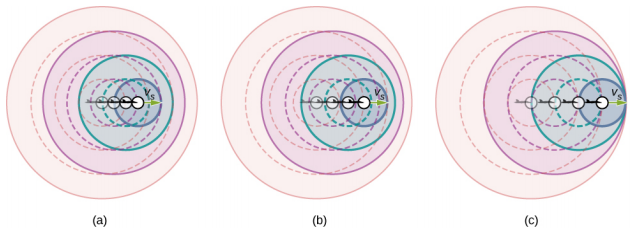
现在,当 vs 接近声速时,fo 接近无穷大,因为 f o = f s 中的分母\(\left(\dfrac{v}{v \mp v_{s}}\right)\)接近零。 以声速计算,此结果意味着在声源前方,每个连续的波浪都会干扰前一个波浪,因为声源以声速向前移动。 观察者在同一时刻得到它们,因此频率是无限的 [图 (c) 部分]。
冲击波和声爆
如果声源超过声速,则在声源通过之前,观察者不会收到任何声音,因此来自接近声源的声音在后退时会与来自声源的声音混合。 这种混音看起来很混乱,但发生了一些有趣的事情——冲击波产生了(图\(\PageIndex{2}\))。
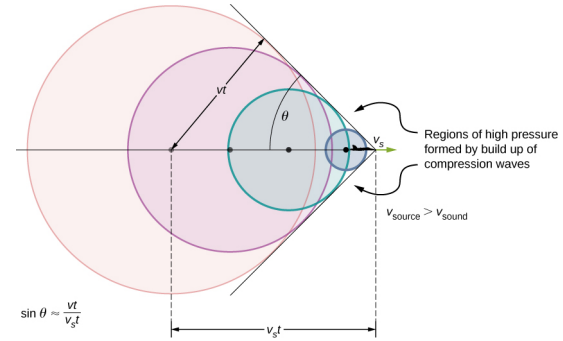
同时到达那里的相似声波沿所示线条(三维圆锥体)产生构造干扰。 这种叠加形成了一种叫做冲击波的干扰,这是一种由物体移动速度比声音更快产生的声音的构造干扰。 在锥体内部,干扰主要是破坏性的,因此那里的声强比冲击波上的声强要小得多。 冲击波的角度可以从几何图形中找到。 在时间 t 中,声源移动了 v s t,声波移动了一段距离 vt,可以使用 sin\(\theta\) = 找到角度\(\frac{vt}{v_{s} t} = \frac{v}{v_{s}}\)。 请注意,马赫数的定义是\(\frac{v_{s}}{v}\),角度的正弦等于马赫数的逆数,
\[\sin \theta = \frac{v}{w_{s}} = \frac{1}{M} \ldotp \label{17.22}\]
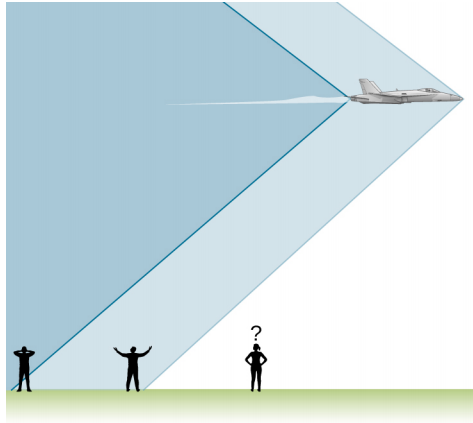
你可能听说过 “音爆” 这个常用术语。 一个常见的误解是,音爆是在飞机突破声屏障时发生的;也就是说,加速到高于声速的速度。 实际上,音爆是在冲击波沿着地面席卷时发生的。
飞机产生两个冲击波,一个来自机头,另一个来自尾巴(图\(\PageIndex{3}\))。 在对航天飞机着陆的电视报道中,经常可以听到两个截然不同的轰鸣声。 它们之间的间隔恰好与航天飞机通过某个点所花费的时间相隔。 地面观察者通常看不到飞机在制造音爆,因为如图所示,它在冲击波到达他们之前就已经过去了。 如果飞机在低空飞行,音爆中的压力可能会造成破坏,破坏窗户并使神经发抖。 由于声震的破坏性很大,因此禁止在人口稠密地区上空进行超音速飞行。
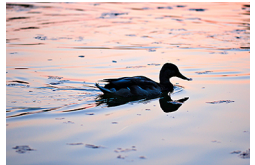
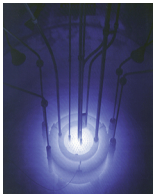
冲击波是称为弓醒的更广泛现象的一个例子。 当波源的移动速度快于波浪传播速度时\(\PageIndex{4}\),就会产生弓尾流,如图中的弓尾流。 水浪从产生点开始绕圈散开,弓尾是熟悉的 V 形尾流,落后于源头。 当亚原子粒子在介质中的传播速度快于光在该介质中的传播速度时,就会产生更具异国情调的弓尾声。 (在真空中,最大光速为 c = 3.00×10⁸ m/s;在水介质中,光速接近 0.75 摄氏度。) 如果粒子在其通道中产生光线,则该光线在圆锥体上扩散,其角度表示粒子的速度,如图所示\(\PageIndex{5}\)。 这种弓尾声被称为切伦科夫辐射,通常在粒子物理学中观察到。