

9.2: 简化平方根
- Page ID
- 204314

\( \newcommand{\vecs}[1]{\overset { \scriptstyle \rightharpoonup} {\mathbf{#1}} } \)
\( \newcommand{\vecd}[1]{\overset{-\!-\!\rightharpoonup}{\vphantom{a}\smash {#1}}} \)
\( \newcommand{\dsum}{\displaystyle\sum\limits} \)
\( \newcommand{\dint}{\displaystyle\int\limits} \)
\( \newcommand{\dlim}{\displaystyle\lim\limits} \)
\( \newcommand{\id}{\mathrm{id}}\) \( \newcommand{\Span}{\mathrm{span}}\)
( \newcommand{\kernel}{\mathrm{null}\,}\) \( \newcommand{\range}{\mathrm{range}\,}\)
\( \newcommand{\RealPart}{\mathrm{Re}}\) \( \newcommand{\ImaginaryPart}{\mathrm{Im}}\)
\( \newcommand{\Argument}{\mathrm{Arg}}\) \( \newcommand{\norm}[1]{\| #1 \|}\)
\( \newcommand{\inner}[2]{\langle #1, #2 \rangle}\)
\( \newcommand{\Span}{\mathrm{span}}\)
\( \newcommand{\id}{\mathrm{id}}\)
\( \newcommand{\Span}{\mathrm{span}}\)
\( \newcommand{\kernel}{\mathrm{null}\,}\)
\( \newcommand{\range}{\mathrm{range}\,}\)
\( \newcommand{\RealPart}{\mathrm{Re}}\)
\( \newcommand{\ImaginaryPart}{\mathrm{Im}}\)
\( \newcommand{\Argument}{\mathrm{Arg}}\)
\( \newcommand{\norm}[1]{\| #1 \|}\)
\( \newcommand{\inner}[2]{\langle #1, #2 \rangle}\)
\( \newcommand{\Span}{\mathrm{span}}\) \( \newcommand{\AA}{\unicode[.8,0]{x212B}}\)
\( \newcommand{\vectorA}[1]{\vec{#1}} % arrow\)
\( \newcommand{\vectorAt}[1]{\vec{\text{#1}}} % arrow\)
\( \newcommand{\vectorB}[1]{\overset { \scriptstyle \rightharpoonup} {\mathbf{#1}} } \)
\( \newcommand{\vectorC}[1]{\textbf{#1}} \)
\( \newcommand{\vectorD}[1]{\overrightarrow{#1}} \)
\( \newcommand{\vectorDt}[1]{\overrightarrow{\text{#1}}} \)
\( \newcommand{\vectE}[1]{\overset{-\!-\!\rightharpoonup}{\vphantom{a}\smash{\mathbf {#1}}}} \)
\( \newcommand{\vecs}[1]{\overset { \scriptstyle \rightharpoonup} {\mathbf{#1}} } \)
\(\newcommand{\longvect}{\overrightarrow}\)
\( \newcommand{\vecd}[1]{\overset{-\!-\!\rightharpoonup}{\vphantom{a}\smash {#1}}} \)
\(\newcommand{\avec}{\mathbf a}\) \(\newcommand{\bvec}{\mathbf b}\) \(\newcommand{\cvec}{\mathbf c}\) \(\newcommand{\dvec}{\mathbf d}\) \(\newcommand{\dtil}{\widetilde{\mathbf d}}\) \(\newcommand{\evec}{\mathbf e}\) \(\newcommand{\fvec}{\mathbf f}\) \(\newcommand{\nvec}{\mathbf n}\) \(\newcommand{\pvec}{\mathbf p}\) \(\newcommand{\qvec}{\mathbf q}\) \(\newcommand{\svec}{\mathbf s}\) \(\newcommand{\tvec}{\mathbf t}\) \(\newcommand{\uvec}{\mathbf u}\) \(\newcommand{\vvec}{\mathbf v}\) \(\newcommand{\wvec}{\mathbf w}\) \(\newcommand{\xvec}{\mathbf x}\) \(\newcommand{\yvec}{\mathbf y}\) \(\newcommand{\zvec}{\mathbf z}\) \(\newcommand{\rvec}{\mathbf r}\) \(\newcommand{\mvec}{\mathbf m}\) \(\newcommand{\zerovec}{\mathbf 0}\) \(\newcommand{\onevec}{\mathbf 1}\) \(\newcommand{\real}{\mathbb R}\) \(\newcommand{\twovec}[2]{\left[\begin{array}{r}#1 \\ #2 \end{array}\right]}\) \(\newcommand{\ctwovec}[2]{\left[\begin{array}{c}#1 \\ #2 \end{array}\right]}\) \(\newcommand{\threevec}[3]{\left[\begin{array}{r}#1 \\ #2 \\ #3 \end{array}\right]}\) \(\newcommand{\cthreevec}[3]{\left[\begin{array}{c}#1 \\ #2 \\ #3 \end{array}\right]}\) \(\newcommand{\fourvec}[4]{\left[\begin{array}{r}#1 \\ #2 \\ #3 \\ #4 \end{array}\right]}\) \(\newcommand{\cfourvec}[4]{\left[\begin{array}{c}#1 \\ #2 \\ #3 \\ #4 \end{array}\right]}\) \(\newcommand{\fivevec}[5]{\left[\begin{array}{r}#1 \\ #2 \\ #3 \\ #4 \\ #5 \\ \end{array}\right]}\) \(\newcommand{\cfivevec}[5]{\left[\begin{array}{c}#1 \\ #2 \\ #3 \\ #4 \\ #5 \\ \end{array}\right]}\) \(\newcommand{\mattwo}[4]{\left[\begin{array}{rr}#1 \amp #2 \\ #3 \amp #4 \\ \end{array}\right]}\) \(\newcommand{\laspan}[1]{\text{Span}\{#1\}}\) \(\newcommand{\bcal}{\cal B}\) \(\newcommand{\ccal}{\cal C}\) \(\newcommand{\scal}{\cal S}\) \(\newcommand{\wcal}{\cal W}\) \(\newcommand{\ecal}{\cal E}\) \(\newcommand{\coords}[2]{\left\{#1\right\}_{#2}}\) \(\newcommand{\gray}[1]{\color{gray}{#1}}\) \(\newcommand{\lgray}[1]{\color{lightgray}{#1}}\) \(\newcommand{\rank}{\operatorname{rank}}\) \(\newcommand{\row}{\text{Row}}\) \(\newcommand{\col}{\text{Col}}\) \(\renewcommand{\row}{\text{Row}}\) \(\newcommand{\nul}{\text{Nul}}\) \(\newcommand{\var}{\text{Var}}\) \(\newcommand{\corr}{\text{corr}}\) \(\newcommand{\len}[1]{\left|#1\right|}\) \(\newcommand{\bbar}{\overline{\bvec}}\) \(\newcommand{\bhat}{\widehat{\bvec}}\) \(\newcommand{\bperp}{\bvec^\perp}\) \(\newcommand{\xhat}{\widehat{\xvec}}\) \(\newcommand{\vhat}{\widehat{\vvec}}\) \(\newcommand{\uhat}{\widehat{\uvec}}\) \(\newcommand{\what}{\widehat{\wvec}}\) \(\newcommand{\Sighat}{\widehat{\Sigma}}\) \(\newcommand{\lt}{<}\) \(\newcommand{\gt}{>}\) \(\newcommand{\amp}{&}\) \(\definecolor{fillinmathshade}{gray}{0.9}\)在本节结束时,您将能够:
- 使用 Product 属性简化平方根
- 使用 Quotient 属性简化平方根
在最后一节中,我们估计了两个连续整数之间一个数字的平方根。 我们可以说介\(\sqrt{50}\)于 7 和 8 之间。 当数字足够小,我们可以使用 [链接] 时,这很容易做到。
但是,如果我们想估算\(\sqrt{500}\)呢? 如果我们先简化平方根,我们就能很容易地估算出来。 简化平方根还有其他原因,正如你将在本章后面看到的那样。
如果平方根的基数不包含完美平方因子,则认为平方根是简化的。
\(\sqrt{a}\)如果 a 没有完美平方因子,则认为是简化的。
所以简化\(\sqrt{31}\)了。 但\(\sqrt{32}\)并未简化,因为 16 是 32 的完美平方因子。
使用产品属性简化平方根
我们将用来简化平方根表达式的属性与指数的属性类似。 我们知道这一点\((ab)^m=a^{m}b^{m}\)。 平方根的相应属性就是这样说的\(\sqrt{ab}=\sqrt{a}·\sqrt{b}\)。
如果 a, b 是非负实数,那么\(\sqrt{ab}=\sqrt{a}·\sqrt{b}\)。
我们使用平方根乘积属性从基数中移除所有完美平方因子。 我们将在示例中展示如何执行此操作。
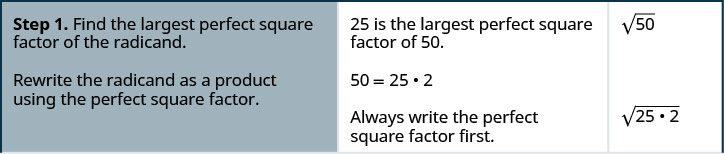
如何使用乘积属性简化平方根
简化:\(\sqrt{50}\)。
- 回答
-


简化:\(\sqrt{48}\)。
- 回答
-
\(4\sqrt{3}\)
简化:\(\sqrt{45}\)。
- 回答
-
\(3\sqrt{5}\)
请注意,在前面的示例中,简化形式为\(\sqrt{50}\) is \(5\sqrt{2}\), which is the product of an integer and a square root. We always write the integer in front of the square root.
- 找出基数的最大完美平方因子。 使用完美平方因子将基数重写为乘积。
- 使用乘积法则将激进重写为两个激进的乘积。
- 简化完美正方形的平方根。
简化:\(\sqrt{500}\)。
- 回答
-
\[\begin{array}{ll} {}&{\sqrt{500}}\\ {\text{Rewrite the radicand as a product using the largest perfect square factor}}&{\sqrt{100·5}}\\ {\text{Rewrite the radical as the product of two radicals}}&{\sqrt{100}·\sqrt{5}}\\ {\text{Simplify}}&{10\sqrt{5}}\\ \end{array}\]
简化:\(\sqrt{288}\)。
- 回答
-
\(12\sqrt{2}\)
简化:\(\sqrt{432}\)。
- 回答
-
\(12\sqrt{3}\)
我们可以使用简化的表格\(10\sqrt{5}\)来估算\(\sqrt{500}\)。 我们知道介\(\sqrt{5}\)于 2 和 3 之间,而且\(\sqrt{500}\)是\(10\sqrt{5}\)。 因此,介\(\sqrt{500}\)于 20 和 30 之间。
下一个例子与前面的例子很相似,但带有变量。
简化:\(\sqrt{x^3}\)。
- 回答
-
\[\begin{array}{ll} {}&{\sqrt{x^3}}\\ {\text{Rewrite the radicand as a product using the largest perfect square factor}}&{\sqrt{x^2·x}}\\ {\text{Rewrite the radical as the product of two radicals}}&{\sqrt{x^2}·\sqrt{x}}\\ {\text{Simplify}}&{x\sqrt{x}}\\ \end{array}\]
简化:\(\sqrt{b^5}\)。
- 回答
-
\(b^2\sqrt{b}\)
简化:\(\sqrt{p^9}\)。
- 回答
-
\(p^4\sqrt{p}\)
当@@ 自由基中也有系数时,我们遵循同样的程序。
简化:\(\sqrt{25y^5}\)。
- 回答
-
\[\begin{array}{ll} {}&{\sqrt{25y^5}}\\ {\text{Rewrite the radicand as a product using the largest perfect square factor.}}&{\sqrt{25y^4·y}}\\ {\text{Rewrite the radical as the product of two radicals.}}&{\sqrt{25y^4}·\sqrt{y}}\\ {\text{Simplify.}}&{5y^2\sqrt{y}}\\ \end{array}\]
简化:\(\sqrt{16x^7}\)。
- 回答
-
\(4x^3\sqrt{x}\)
简化:\(\sqrt{49v^9}\)。
- 回答
-
\(7v^4\sqrt{v}\)
在下一个示例中,常量和变量都有完美的平方因子。
简化:\(\sqrt{72n^7}\)。
- 回答
-
\[\begin{array}{ll} {}&{\sqrt{72n^7}}\\ {\text{Rewrite the radicand as a product using the largest perfect square factor.}}&{\sqrt{36n^{6}·2n}}\\ {\text{Rewrite the radical as the product of two radicals.}}&{\sqrt{36n^{6}}·\sqrt{2n}}\\ {\text{Simplify.}}&{6n^3\sqrt{2n}}\\ \end{array}\]
简化:\(\sqrt{32y^5}\)。
- 回答
-
\(4y^2\sqrt{2y}\)
简化:\(\sqrt{75a^9}\)。
- 回答
-
\(5a^4\sqrt{3a}\)
简化:\(\sqrt{63u^{3}v^{5}}\)。
- 回答
-
\[\begin{array}{ll} {}&{\sqrt{63u^{3}v^{5}}}\\ {\text{Rewrite the radicand as a product using the largest perfect square factor.}}&{\sqrt{9u^{2}v^{4}·7uv}}\\ {\text{Rewrite the radical as the product of two radicals.}}&{\sqrt{9u^{2}v^{4}}·\sqrt{7uv}}\\ {\text{Simplify.}}&{3uv^{2}\sqrt{7uv}}\\ \end{array}\]
简化:\(\sqrt{98a^{7}b^{5}}\)。
- 回答
-
\(7a^{3}b^{2}\sqrt{2ab}\)
简化:\(\sqrt{180m^{9}n^{11}}\)。
- 回答
-
\(6m^{4}n^{5}\sqrt{5mn}\)
我们已经看到了如何使用运算顺序来简化一些带有激进的表达式。 为了简化\(\sqrt{25}+\sqrt{144}\) we must simplify each square root separately first, then add to get the sum of 17.
表达式\(\sqrt{17}+\sqrt{7}\)无法简化,首先,我们需要简化每个平方根,但是 17 和 7 都不包含完美平方因子。
在下一个示例中,我们得到了一个整数和一个平方根的总和。 我们简化了平方根,但无法将结果表达式添加到整数中。
简化:\(3+\sqrt{32}\)。
- 回答
-
\[\begin{array}{ll} {}&{3+\sqrt{32}}\\ {\text{Rewrite the radicand as a product using the largest perfect square factor.}}&{3+\sqrt{16·2}}\\ {\text{Rewrite the radical as the product of two radicals.}}&{3+\sqrt{16}·\sqrt{2}}\\ {\text{Simplify.}}&{3+4\sqrt{2}}\\ \end{array}\]
这些术语不一样,因此我们无法添加它们。 尝试添加一个整数和一个激进就像尝试添加一个整数和一个变量——它们不像术语!
简化:\(5+\sqrt{75}\)。
- 回答
-
\(5+5\sqrt{3}\)
简化:\(2+\sqrt{98}\)。
- 回答
-
\(2+7\sqrt{2}\)
下一个示例包括一个分数,分子中有一个激进分数。 请记住,为了简化分数,在分子和分母中需要一个公用因子。
简化:\(\frac{4−\sqrt{48}}{2}\)。
- 回答
-
\[\begin{array}{ll} {}&{\frac{4−\sqrt{48}}{2}}\\ {\text{Rewrite the radicand as a product using thelargest perfect square factor.}}&{\frac{4−\sqrt{16·3}}{2}}\\ {\text{Rewrite the radical as the product of two radicals.}}&{\frac{4−\sqrt{16}·\sqrt{3}}{2}}\\ {\text{Simplify.}}&{\frac{4−4\sqrt{3}}{2}}\\ {\text{Factor the common factor from thenumerator.}}&{\frac{4(1−\sqrt{3})}{2}}\\ {\text{Remove the common factor, 2, from thenumerator and denominator.}}&{2(1−\sqrt{3})}\\ \end{array}\]
简化:\(\frac{10−\sqrt{75}}{5}\)。
- 回答
-
\(2−\sqrt{3}\)
简化:\(\frac{6−\sqrt{45}}{3}\)。
- 回答
-
\(2−\sqrt{5}\)
使用 Quotient 属性简化平方根
每当你必须简化平方根时,你应该采取的第一步就是确定基数是否是完美的正方形。 完美平方分数是其中分子和分母都是完美平方的分数。
简化:\(\sqrt{\frac{9}{64}}\)。
- 回答
-
\[\begin{array}{ll} {}&{\sqrt{\frac{9}{64}}}\\ {\text{Since} (\frac{3}{8})^2}&{\frac{3}{8}}\\ \end{array}\]
简化:\(\sqrt{\frac{25}{16}}\)。
- 回答
-
\(\frac{5}{4}\)
简化:\(\sqrt{\frac{49}{81}}\)。
- 回答
-
\(\frac{7}{9}\)
如果分子和分母有任何共同因子,请将其删除。 你可能会找到一个完美的平方分数!
简化:\(\sqrt{\frac{45}{80}}\)。
- 回答
-
\[\begin{array}{ll} {}&{\sqrt{\frac{45}{80}}}\\ {\text{Simplify inside the radical first. Rewrite showing the common factors of the numerator and denominator.}}&{\sqrt{\frac{5·9}{5·16}}}\\ {\text{Simplify the fraction by removing common factors.}}&{\sqrt{\frac{9}{16}}}\\ {\text{Simplify.} (\frac{3}{4})^2 =\frac{9}{16}}&{\frac{3}{4}}\\ \end{array}\]
简化:\(\sqrt{\frac{75}{48}}\)。
- 回答
-
\(\frac{5}{4}\)
简化:\(\sqrt{\frac{98}{162}}\)。
- 回答
-
\(\frac{7}{9}\)
在最后一个例子中,我们的第一步是通过移除常见因子来简化激进项下的分数。 在下一个示例中,我们将使用 Quotient Property 在激进下进行简化。 我们通过减去它们的指数来除以相似的基数\(\frac{a^m}{a^n} = a^{m-n}\),\(a \ne 0\)。
简化:\(\sqrt{\frac{m^6}{m^4}}\)。
- 回答
-
\[\begin{array}{ll} {}&{\sqrt{\frac{m^6}{m^4}}}\\ {\text{Simplify the fraction inside the radical first}}&{}\\ {}&{\sqrt{m^2}}\\ {\text{Divide the like bases by subtracting the exponents.}}&{}\\ {\text{Simplify.}}&{m}\\ \end{array}\]
简化:\(\sqrt{\frac{a^8}{a^6}}\)。
- 回答
-
一个
简化:\(\sqrt{\frac{x^{14}}{x^{10}}}\)。
- 回答
-
\(x^2\)
简化:\(\sqrt{\frac{48p^7}{3p^3}}\)。
- 回答
-
\[\begin{array}{ll} {}&{\sqrt{\frac{48p^7}{3p^3}}}\\ {\text{Simplify the fraction inside the radical first.}}&{\sqrt{16p^4}}\\ {\text{Simplify.}}&{4p^2}\\ \end{array}\]
简化:\(\sqrt{\frac{75x^5}{3x}}\)。
- 回答
-
\(5x^2\)
简化:\(\sqrt{\frac{72z^{12}}{2z^{10}}}\)。
- 回答
-
6z
还记得权属性的商吗? 它说我们可以通过将分子和分母分别提高到幂来将分数提高到幂次。
\((\frac{a}{b})^m=\frac{a^{m}}{b^{m}}\),\( b \ne 0\)
我们可以使用类似的属性来简化分数的平方根。 从分子和分母中移除所有常用因子后,如果分数不是完美的正方形,我们将分别简化分子和分母。
如果 a, b 是非负实数\(b \ne 0\),那么
\(\sqrt{\frac{a}{b}}=\frac{\sqrt{a}}{\sqrt{b}}\)
简化:\(\sqrt{\frac{21}{64}}\)。
- 回答
-
\[\begin{array}{ll} {}&{\sqrt{\frac{21}{64}}}\\ {\text{We cannot simplify the fraction inside the radical. Rewrite using the quotient property.}}&{\frac{\sqrt{21}}{\sqrt{64}}}\\ {\text{Simplify the square root of 64. The numerator cannot be simplified.}}&{\frac{\sqrt{21}}{8}}\\ \end{array}\]
简化:\(\sqrt{\frac{19}{49}}\)。
- 回答
-
\(\frac{\sqrt{19}}{7}\)
简化:\(\sqrt{\frac{28}{81}}\)
- 回答
-
\(\frac{2\sqrt{7}}{9}\)
如何使用商属性简化平方根
简化:\(\sqrt{\frac{27m^3}{196}}\)。
- 回答
-



简化:\(\sqrt{\frac{24p^3}{49}}\)
- 回答
-
\(\frac{2p\sqrt{6p}}{7}\)
简化:\(\sqrt{\frac{48x^5}{100}}\)
- 回答
-
\(\frac{2x^2\sqrt{3x}}{5}\)
- 尽可能简化 radicand 中的分数。
- 使用 Quotient Property 将激进重写为两个部首的商。
- 简化分子和分母中的基数。
简化:\(\sqrt{\frac{45x^5}{y^4}}\)。
- 回答
-
\[\begin{array}{ll} {}&{\sqrt{\frac{45x^5}{y^4}}}\\ {\text{We cannot simplify the fraction inside the radical. Rewrite using the quotient property.}}&{\frac{\sqrt{45x^5}}{\sqrt{y^4}}}\\ {\text{Simplify the radicals in the numerator and the denominator.}}&{\frac{\sqrt{9x^4}\sqrt{5x}}{y^2}}\\ {\text{Simplify.}}&{\frac{3x^2\sqrt{5x}}{y^2}}\\ \end{array}\]
简化:\(\sqrt{\frac{80m^3}{n^6}}\)
- 回答
-
\(\frac{4m\sqrt{5m}}{n^3}\)
简化:\(\sqrt{\frac{54u^7}{v^8}}\)。
- 回答
-
\(\frac{3u^3\sqrt{6u}}{v^4}\)
如果可能的话,一定要先简化 radicand 中的分数。
简化:\(\sqrt{\frac{81d^9}{25d^4}}\)。
- 回答
-
\[\begin{array}{ll} {}&{\sqrt{\frac{81d^9}{25d^4}}}\\ {\text{Simplify the fraction in the radicand.}}&{\sqrt{\frac{81d^5}{25}}}\\ {\text{Rewrite using the quotient property.}}&{\frac{\sqrt{81d^5}}{\sqrt{25}}}\\ {\text{Simplify the radicals in the numerator and the denominator.}}&{\frac{\sqrt{81d^4}\sqrt{d}}{5}}\\ {\text{Simplify.}}&{\frac{9d^2\sqrt{d}}{5}}\\ \end{array}\]
简化:\(\sqrt{\frac{64x^7}{9x^3}}\)。
- 回答
-
\(\frac{8x^2}{3}\)
简化:\(\sqrt{\frac{16a^9}{100a^5}}\)。
- 回答
-
\(\frac{2a^2}{5}\)
简化:\(\sqrt{\frac{18p^5q^7}{32pq^2}}\)。
- 回答
-
\[\begin{array}{ll} {}&{\sqrt{\frac{18p^5q^7}{32pq^2}}}\\ {\text{Simplify the fraction in the radicand.}}&{\sqrt{\frac{9p^4q^5}{16}}}\\ {\text{Rewrite using the quotient property.}}&{\frac{\sqrt{9p^4q^5}}{\sqrt{16}}}\\ {\text{Simplify the radicals in the numerator and the denominator.}}&{\frac{\sqrt{9p^4q^4}\sqrt{q}}{4}}\\ {\text{Simplify.}}&{\frac{3p^2q^2\sqrt{q}}{4}}\\ \end{array}\]
简化:\(\sqrt{\frac{50x^5y^3}{72x^4y}}\)。
- 回答
-
\(\frac{5y\sqrt{x}}{6}\)
简化:\(\sqrt{\frac{48m^7n^2}{125m^5n^9}}\)。
- 回答
-
\(\frac{4m\sqrt{3}}{5n^3\sqrt{5n}}\)
关键概念
- 如果 a 没有完美@@ 平方因子,\(\sqrt{a}\)则认为简化平方根是简化的。
- 平方根的乘积属性如果 a, b 是非负实数,那么
\(\sqrt{ab}=\sqrt{a}·\sqrt{b}\)
- 使用产品属性简化平方根要使用产品属性简化平方根:
- 找出基数的最大完美平方因子。 使用完美平方因子将 radicand 重写为乘积。
- 使用乘积法则将激进重写为两个激进的乘积。
- 简化完美正方形的平方根。
- 平方根的商属性如果 a, b 是非负实数\(b \ne 0\),那么
\(\sqrt{\frac{a}{b}}=\frac{\sqrt{a}}{\sqrt{b}}\)
- 使用 Quotient 属性简化平方根要使用 Quotient 属性简化平方根:
- 尽可能简化 radicand 中的分数。
- 使用商法则将激进重写为两个激进的商。
- 简化分子和分母中的基数。