

4.6E : Exercices pour la section 4.6
- Page ID
- 197712
\( \newcommand{\vecs}[1]{\overset { \scriptstyle \rightharpoonup} {\mathbf{#1}} } \)
\( \newcommand{\vecd}[1]{\overset{-\!-\!\rightharpoonup}{\vphantom{a}\smash {#1}}} \)
\( \newcommand{\dsum}{\displaystyle\sum\limits} \)
\( \newcommand{\dint}{\displaystyle\int\limits} \)
\( \newcommand{\dlim}{\displaystyle\lim\limits} \)
\( \newcommand{\id}{\mathrm{id}}\) \( \newcommand{\Span}{\mathrm{span}}\)
( \newcommand{\kernel}{\mathrm{null}\,}\) \( \newcommand{\range}{\mathrm{range}\,}\)
\( \newcommand{\RealPart}{\mathrm{Re}}\) \( \newcommand{\ImaginaryPart}{\mathrm{Im}}\)
\( \newcommand{\Argument}{\mathrm{Arg}}\) \( \newcommand{\norm}[1]{\| #1 \|}\)
\( \newcommand{\inner}[2]{\langle #1, #2 \rangle}\)
\( \newcommand{\Span}{\mathrm{span}}\)
\( \newcommand{\id}{\mathrm{id}}\)
\( \newcommand{\Span}{\mathrm{span}}\)
\( \newcommand{\kernel}{\mathrm{null}\,}\)
\( \newcommand{\range}{\mathrm{range}\,}\)
\( \newcommand{\RealPart}{\mathrm{Re}}\)
\( \newcommand{\ImaginaryPart}{\mathrm{Im}}\)
\( \newcommand{\Argument}{\mathrm{Arg}}\)
\( \newcommand{\norm}[1]{\| #1 \|}\)
\( \newcommand{\inner}[2]{\langle #1, #2 \rangle}\)
\( \newcommand{\Span}{\mathrm{span}}\) \( \newcommand{\AA}{\unicode[.8,0]{x212B}}\)
\( \newcommand{\vectorA}[1]{\vec{#1}} % arrow\)
\( \newcommand{\vectorAt}[1]{\vec{\text{#1}}} % arrow\)
\( \newcommand{\vectorB}[1]{\overset { \scriptstyle \rightharpoonup} {\mathbf{#1}} } \)
\( \newcommand{\vectorC}[1]{\textbf{#1}} \)
\( \newcommand{\vectorD}[1]{\overrightarrow{#1}} \)
\( \newcommand{\vectorDt}[1]{\overrightarrow{\text{#1}}} \)
\( \newcommand{\vectE}[1]{\overset{-\!-\!\rightharpoonup}{\vphantom{a}\smash{\mathbf {#1}}}} \)
\( \newcommand{\vecs}[1]{\overset { \scriptstyle \rightharpoonup} {\mathbf{#1}} } \)
\(\newcommand{\longvect}{\overrightarrow}\)
\( \newcommand{\vecd}[1]{\overset{-\!-\!\rightharpoonup}{\vphantom{a}\smash {#1}}} \)
\(\newcommand{\avec}{\mathbf a}\) \(\newcommand{\bvec}{\mathbf b}\) \(\newcommand{\cvec}{\mathbf c}\) \(\newcommand{\dvec}{\mathbf d}\) \(\newcommand{\dtil}{\widetilde{\mathbf d}}\) \(\newcommand{\evec}{\mathbf e}\) \(\newcommand{\fvec}{\mathbf f}\) \(\newcommand{\nvec}{\mathbf n}\) \(\newcommand{\pvec}{\mathbf p}\) \(\newcommand{\qvec}{\mathbf q}\) \(\newcommand{\svec}{\mathbf s}\) \(\newcommand{\tvec}{\mathbf t}\) \(\newcommand{\uvec}{\mathbf u}\) \(\newcommand{\vvec}{\mathbf v}\) \(\newcommand{\wvec}{\mathbf w}\) \(\newcommand{\xvec}{\mathbf x}\) \(\newcommand{\yvec}{\mathbf y}\) \(\newcommand{\zvec}{\mathbf z}\) \(\newcommand{\rvec}{\mathbf r}\) \(\newcommand{\mvec}{\mathbf m}\) \(\newcommand{\zerovec}{\mathbf 0}\) \(\newcommand{\onevec}{\mathbf 1}\) \(\newcommand{\real}{\mathbb R}\) \(\newcommand{\twovec}[2]{\left[\begin{array}{r}#1 \\ #2 \end{array}\right]}\) \(\newcommand{\ctwovec}[2]{\left[\begin{array}{c}#1 \\ #2 \end{array}\right]}\) \(\newcommand{\threevec}[3]{\left[\begin{array}{r}#1 \\ #2 \\ #3 \end{array}\right]}\) \(\newcommand{\cthreevec}[3]{\left[\begin{array}{c}#1 \\ #2 \\ #3 \end{array}\right]}\) \(\newcommand{\fourvec}[4]{\left[\begin{array}{r}#1 \\ #2 \\ #3 \\ #4 \end{array}\right]}\) \(\newcommand{\cfourvec}[4]{\left[\begin{array}{c}#1 \\ #2 \\ #3 \\ #4 \end{array}\right]}\) \(\newcommand{\fivevec}[5]{\left[\begin{array}{r}#1 \\ #2 \\ #3 \\ #4 \\ #5 \\ \end{array}\right]}\) \(\newcommand{\cfivevec}[5]{\left[\begin{array}{c}#1 \\ #2 \\ #3 \\ #4 \\ #5 \\ \end{array}\right]}\) \(\newcommand{\mattwo}[4]{\left[\begin{array}{rr}#1 \amp #2 \\ #3 \amp #4 \\ \end{array}\right]}\) \(\newcommand{\laspan}[1]{\text{Span}\{#1\}}\) \(\newcommand{\bcal}{\cal B}\) \(\newcommand{\ccal}{\cal C}\) \(\newcommand{\scal}{\cal S}\) \(\newcommand{\wcal}{\cal W}\) \(\newcommand{\ecal}{\cal E}\) \(\newcommand{\coords}[2]{\left\{#1\right\}_{#2}}\) \(\newcommand{\gray}[1]{\color{gray}{#1}}\) \(\newcommand{\lgray}[1]{\color{lightgray}{#1}}\) \(\newcommand{\rank}{\operatorname{rank}}\) \(\newcommand{\row}{\text{Row}}\) \(\newcommand{\col}{\text{Col}}\) \(\renewcommand{\row}{\text{Row}}\) \(\newcommand{\nul}{\text{Nul}}\) \(\newcommand{\var}{\text{Var}}\) \(\newcommand{\corr}{\text{corr}}\) \(\newcommand{\len}[1]{\left|#1\right|}\) \(\newcommand{\bbar}{\overline{\bvec}}\) \(\newcommand{\bhat}{\widehat{\bvec}}\) \(\newcommand{\bperp}{\bvec^\perp}\) \(\newcommand{\xhat}{\widehat{\xvec}}\) \(\newcommand{\vhat}{\widehat{\vvec}}\) \(\newcommand{\uhat}{\widehat{\uvec}}\) \(\newcommand{\what}{\widehat{\wvec}}\) \(\newcommand{\Sighat}{\widehat{\Sigma}}\) \(\newcommand{\lt}{<}\) \(\newcommand{\gt}{>}\) \(\newcommand{\amp}{&}\) \(\definecolor{fillinmathshade}{gray}{0.9}\)Pour les exercices 1 à 5, examinez les graphiques. Déterminez où se situent les asymptotes verticales.
1)
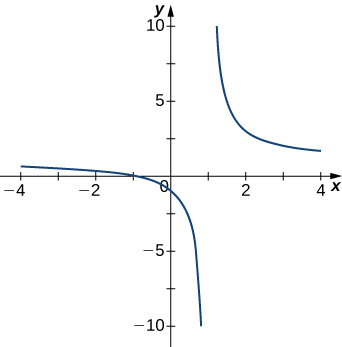
- Réponse
- \(x=1\)
2)
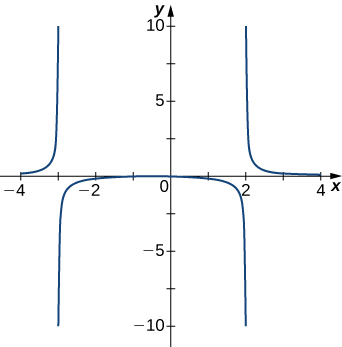
3)
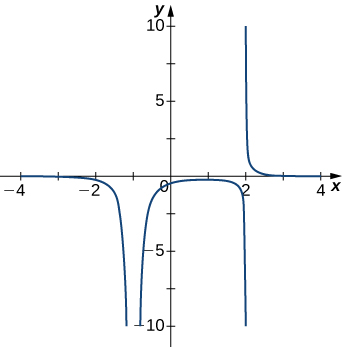
- Réponse
- \(x=−1,\;x=2\)
4)
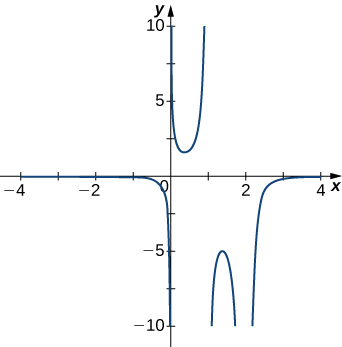
5)
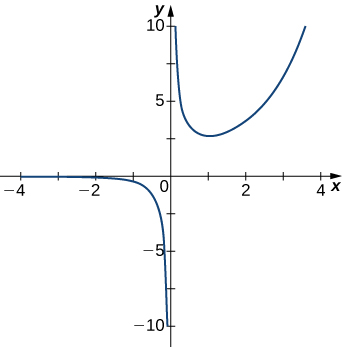
- Réponse
- \(x=0\)
Pour les fonctions des exercices 6\(f(x)\) à 10, déterminez s'il existe une asymptote à\(x=a\). Justifiez votre réponse sans utiliser de graphique sur une calculatrice.
6)\(f(x)=\dfrac{x+1}{x^2+5x+4},\quad a=−1\)
7)\(f(x)=\dfrac{x}{x−2},\quad a=2\)
- Réponse
- Oui, il existe une asymptote verticale à\(x = 2\).
8)\(f(x)=(x+2)^{3/2},\quad a=−2\)
9)\(f(x)=(x−1)^{−1/3},\quad a=1\)
- Réponse
- Oui, il existe une asymptote verticale à\(x = 1\).
10)\(f(x)=1+x^{−2/5},\quad a=1\)
Dans les exercices 11 à 20, évaluez la limite.
11)\(\displaystyle \lim_{x→∞}\frac{1}{3x+6}\)
- Réponse
- \(\displaystyle \lim_{x→∞}\frac{1}{3x+6} = 0\)
(12)\(\displaystyle \lim_{x→∞}\frac{2x−5}{4x}\)
13)\(\displaystyle \lim_{x→∞}\frac{x^2−2x+5}{x+2}\)
- Réponse
- \(\displaystyle \lim_{x→∞}\frac{x^2−2x+5}{x+2} = ∞\)
(14)\(\displaystyle \lim_{x→−∞}\frac{3x^3−2x}{x^2+2x+8}\)
15)\(\displaystyle \lim_{x→−∞}\frac{x^4−4x^3+1}{2−2x^2−7x^4}\)
- Réponse
- \(\displaystyle \lim_{x→−∞}\frac{x^4−4x^3+1}{2−2x^2−7x^4} = −\frac{1}{7}\)
16)\(\displaystyle \lim_{x→∞}\frac{3x}{\sqrt{x^2+1}}\)
17)\(\displaystyle \lim_{x→−∞}\frac{\sqrt{4x^2−1}}{x+2}\)
- Réponse
- \(\displaystyle \lim_{x→−∞}\frac{\sqrt{4x^2−1}}{x+2} = -2\)
18)\(\displaystyle \lim_{x→∞}\frac{4x}{\sqrt{x^2−1}}\)
19)\(\displaystyle \lim_{x→−∞}\frac{4x}{\sqrt{x^2−1}}\)
- Réponse
- \(\displaystyle \lim_{x→−∞}\frac{4x}{\sqrt{x^2−1}} = -4\)
(20)\(\displaystyle \lim_{x→∞}\frac{2\sqrt{x}}{x−\sqrt{x}+1}\)
Pour les exercices 21 à 25, trouvez les asymptotes horizontales et verticales.
(21)\(f(x)=x−\dfrac{9}{x}\)
- Réponse
- Horizontal : aucun,
vertical :\(x=0\)
22)\(f(x)=\dfrac{1}{1−x^2}\)
23)\(f(x)=\dfrac{x^3}{4−x^2}\)
- Réponse
- Horizontal : aucun,
vertical :\(x=±2\)
(24)\(f(x)=\dfrac{x^2+3}{x^2+1}\)
25)\(f(x)=\sin(x)\sin(2x)\)
- Réponse
- Horizontal : aucun,
vertical : aucun
26)\(f(x)=\cos x+\cos(3x)+\cos(5x)\)
(27)\(f(x)=\dfrac{x\sin(x)}{x^2−1}\)
- Réponse
- Horizontal :\(y=0,\)
Vertical :\(x=±1\)
28)\(f(x)=\dfrac{x}{\sin(x)}\)
(29)\(f(x)=\dfrac{1}{x^3+x^2}\)
- Réponse
- Horizontal :\(y=0,\)
Vertical :\(x=0\) et\(x=−1\)
(30)\(f(x)=\dfrac{1}{x−1}−2x\)
31)\(f(x)=\dfrac{x^3+1}{x^3−1}\)
- Réponse
- Horizontal :\(y=1,\)
Vertical :\(x=1\)
32)\(f(x)=\dfrac{\sin x+\cos x}{\sin x−\cos x}\)
33)\(f(x)=x−\sin x\)
- Réponse
- Horizontal : aucun,
vertical : aucun
34)\(f(x)=\dfrac{1}{x}−\sqrt{x}\)
Pour les exercices 35 à 38, construisez une fonction\(f(x)\) qui possède les asymptotes donnés.
35)\(x=1\) et\(y=2\)
- Réponse
- Les réponses peuvent varier, par exemple :\(y=\dfrac{2x}{x−1}\)
36)\(x=1\) et\(y=0\)
(37)\(y=4, \;x=−1\)
- Réponse
- Les réponses peuvent varier, par exemple :\(y=\dfrac{4x}{x+1}\)
38)\(x=0\)
Dans les exercices 39 à 43, tracez la fonction sur une calculatrice graphique sur la fenêtre\(x=[−5,5]\) et estimez l'asymptote ou la limite horizontale. Calculez ensuite l'asymptote ou la limite horizontale réelle.
39) [T]\(f(x)=\dfrac{1}{x+10}\)
- Réponse
- \(\displaystyle \lim_{x→∞}\frac{1}{x+10}=0\)\(f\)a donc une asymptote horizontale de\(y=0\).
40) [T]\(f(x)=\dfrac{x+1}{x^2+7x+6}\)
41) [T]\(\displaystyle \lim_{x→−∞}x^2+10x+25\)
- Réponse
- \(\displaystyle \lim_{x→−∞}x^2+10x+25 = ∞\)
42) [T]\(\displaystyle \lim_{x→−∞}\frac{x+2}{x^2+7x+6}\)
43) [T]\(\displaystyle \lim_{x→∞}\frac{3x+2}{x+5}\)
- Réponse
- \(\displaystyle \lim_{x→∞}\frac{3x+2}{x+5}=3\)cette fonction a donc une asymptote horizontale de\(y=3\).
Dans les exercices 44 à 55, dessinez un graphique des fonctions sans utiliser de calculatrice. Assurez-vous de noter toutes les caractéristiques importantes du graphique : maxima et minima locaux, points d'inflexion et comportement asymptotique.
44)\(y=3x^2+2x+4\)
45)\(y=x^3−3x^2+4\)
- Réponse
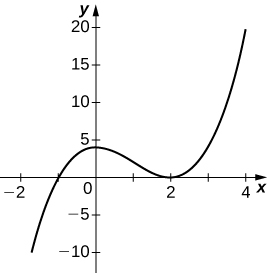
46)\(y=\dfrac{2x+1}{x^2+6x+5}\)
47)\(y=\dfrac{x^3+4x^2+3x}{3x+9}\)
- Réponse
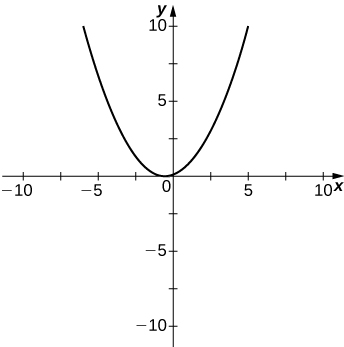
48)\(y=\dfrac{x^2+x−2}{x^2−3x−4}\)
49)\(y=\sqrt{x^2−5x+4}\)
- Réponse
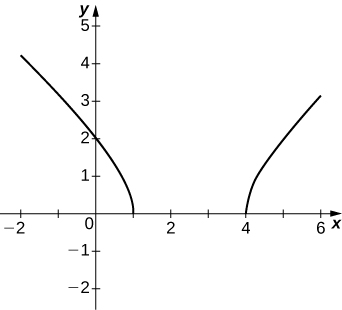
50)\(y=2x\sqrt{16−x^2}\)
51)\(y=\dfrac{\cos x}{x}\), sur\(x=[−2π,2π]\)
- Réponse
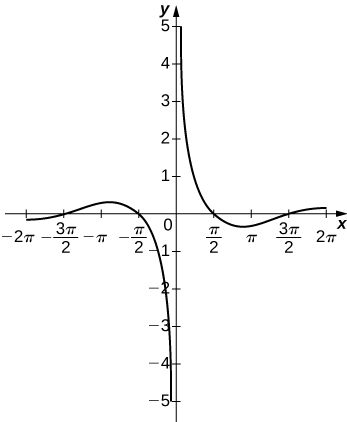
52)\(y=e^x−x^3\)
53)\(y=x\tan x, \quad x=[−π,π]\)
- Réponse
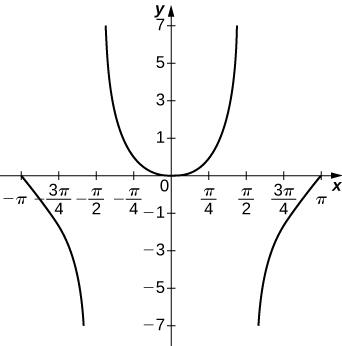
(54)\(y=x\ln(x), \quad x>0\)
55)\(y=x^2\sin(x),\quad x=[−2π,2π]\)
- Réponse
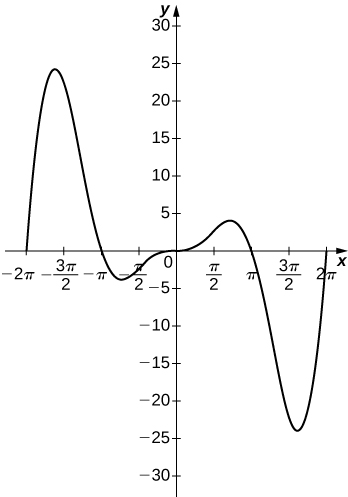
56) Car\(f(x)=\dfrac{P(x)}{Q(x)}\) pour avoir une asymptote\(y=2\) alors aux polynômes\(P(x)\) et\(Q(x)\) doit avoir quelle relation ?
57) Car\(f(x)=\dfrac{P(x)}{Q(x)}\) pour avoir une asymptote at\(x=0\), alors les polynômes\(P(x)\) et\(Q(x).\) doit avoir quelle relation ?
- Réponse
- \(Q(x).\)doit avoir\(x^{k+1}\) comme facteur, où\(P(x)\) a\(x^k\) comme facteur.
58) Si\(f′(x)\) a des asymptotes à\(y=3\) et\(x=1\), alors\(f(x)\) quelles asymptotes ?
59) Les deux\(f(x)=\dfrac{1}{x−1}\)\(g(x)=\dfrac{1}{(x−1)^2}\) ont des asymptotes\(x=1\) et\(y=0.\) quelle est la différence la plus évidente entre ces deux fonctions ?
- Réponse
- \(\displaystyle \lim_{x→1^−}f(x)=-\infty \text{ and } \lim_{x→1^−}g(x)=\infty\)
60) Vrai ou faux : chaque ratio de polynômes possède des asymptotes verticales.