7.7: 哥特式巴黎圣母院(始于公元 1163 年)
- Page ID
- 171967
\( \newcommand{\vecs}[1]{\overset { \scriptstyle \rightharpoonup} {\mathbf{#1}} } \)
\( \newcommand{\vecd}[1]{\overset{-\!-\!\rightharpoonup}{\vphantom{a}\smash {#1}}} \)
\( \newcommand{\dsum}{\displaystyle\sum\limits} \)
\( \newcommand{\dint}{\displaystyle\int\limits} \)
\( \newcommand{\dlim}{\displaystyle\lim\limits} \)
\( \newcommand{\id}{\mathrm{id}}\) \( \newcommand{\Span}{\mathrm{span}}\)
( \newcommand{\kernel}{\mathrm{null}\,}\) \( \newcommand{\range}{\mathrm{range}\,}\)
\( \newcommand{\RealPart}{\mathrm{Re}}\) \( \newcommand{\ImaginaryPart}{\mathrm{Im}}\)
\( \newcommand{\Argument}{\mathrm{Arg}}\) \( \newcommand{\norm}[1]{\| #1 \|}\)
\( \newcommand{\inner}[2]{\langle #1, #2 \rangle}\)
\( \newcommand{\Span}{\mathrm{span}}\)
\( \newcommand{\id}{\mathrm{id}}\)
\( \newcommand{\Span}{\mathrm{span}}\)
\( \newcommand{\kernel}{\mathrm{null}\,}\)
\( \newcommand{\range}{\mathrm{range}\,}\)
\( \newcommand{\RealPart}{\mathrm{Re}}\)
\( \newcommand{\ImaginaryPart}{\mathrm{Im}}\)
\( \newcommand{\Argument}{\mathrm{Arg}}\)
\( \newcommand{\norm}[1]{\| #1 \|}\)
\( \newcommand{\inner}[2]{\langle #1, #2 \rangle}\)
\( \newcommand{\Span}{\mathrm{span}}\) \( \newcommand{\AA}{\unicode[.8,0]{x212B}}\)
\( \newcommand{\vectorA}[1]{\vec{#1}} % arrow\)
\( \newcommand{\vectorAt}[1]{\vec{\text{#1}}} % arrow\)
\( \newcommand{\vectorB}[1]{\overset { \scriptstyle \rightharpoonup} {\mathbf{#1}} } \)
\( \newcommand{\vectorC}[1]{\textbf{#1}} \)
\( \newcommand{\vectorD}[1]{\overrightarrow{#1}} \)
\( \newcommand{\vectorDt}[1]{\overrightarrow{\text{#1}}} \)
\( \newcommand{\vectE}[1]{\overset{-\!-\!\rightharpoonup}{\vphantom{a}\smash{\mathbf {#1}}}} \)
\( \newcommand{\vecs}[1]{\overset { \scriptstyle \rightharpoonup} {\mathbf{#1}} } \)
\(\newcommand{\longvect}{\overrightarrow}\)
\( \newcommand{\vecd}[1]{\overset{-\!-\!\rightharpoonup}{\vphantom{a}\smash {#1}}} \)
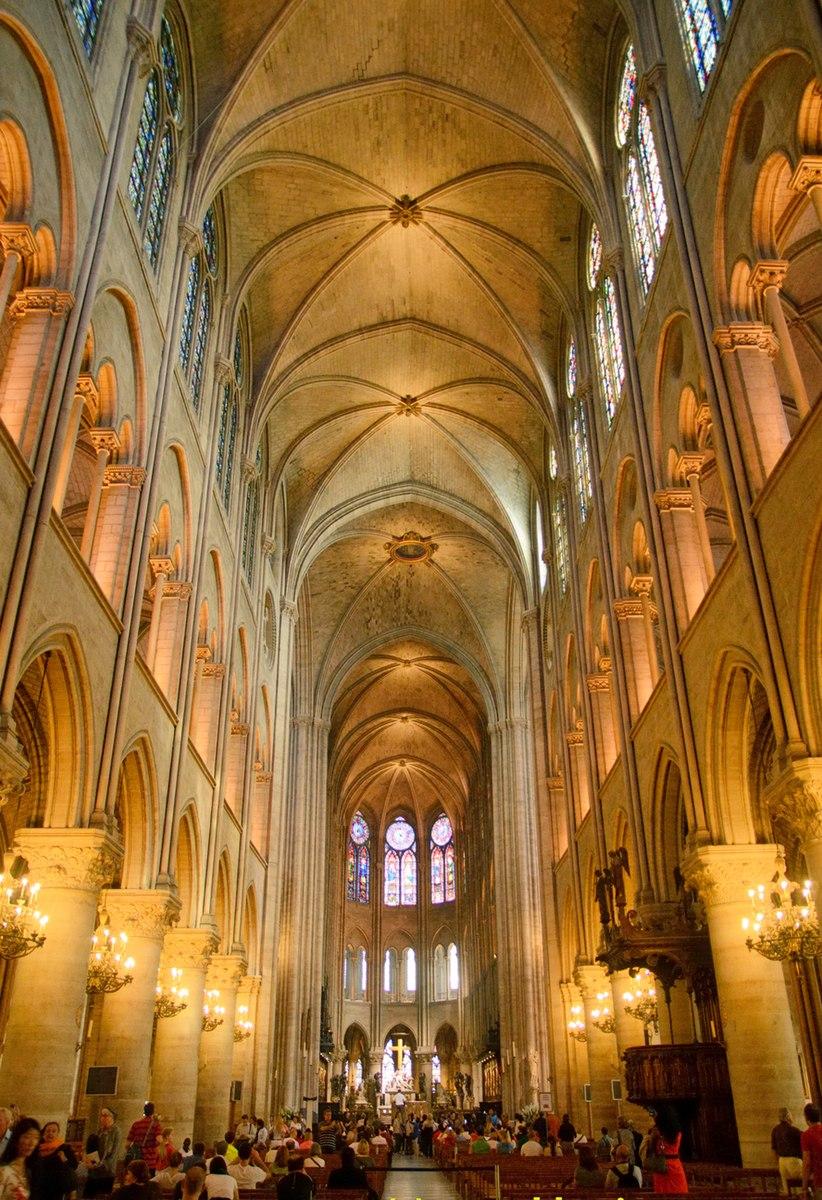
\(\newcommand{\avec}{\mathbf a}\) \(\newcommand{\bvec}{\mathbf b}\) \(\newcommand{\cvec}{\mathbf c}\) \(\newcommand{\dvec}{\mathbf d}\) \(\newcommand{\dtil}{\widetilde{\mathbf d}}\) \(\newcommand{\evec}{\mathbf e}\) \(\newcommand{\fvec}{\mathbf f}\) \(\newcommand{\nvec}{\mathbf n}\) \(\newcommand{\pvec}{\mathbf p}\) \(\newcommand{\qvec}{\mathbf q}\) \(\newcommand{\svec}{\mathbf s}\) \(\newcommand{\tvec}{\mathbf t}\) \(\newcommand{\uvec}{\mathbf u}\) \(\newcommand{\vvec}{\mathbf v}\) \(\newcommand{\wvec}{\mathbf w}\) \(\newcommand{\xvec}{\mathbf x}\) \(\newcommand{\yvec}{\mathbf y}\) \(\newcommand{\zvec}{\mathbf z}\) \(\newcommand{\rvec}{\mathbf r}\) \(\newcommand{\mvec}{\mathbf m}\) \(\newcommand{\zerovec}{\mathbf 0}\) \(\newcommand{\onevec}{\mathbf 1}\) \(\newcommand{\real}{\mathbb R}\) \(\newcommand{\twovec}[2]{\left[\begin{array}{r}#1 \\ #2 \end{array}\right]}\) \(\newcommand{\ctwovec}[2]{\left[\begin{array}{c}#1 \\ #2 \end{array}\right]}\) \(\newcommand{\threevec}[3]{\left[\begin{array}{r}#1 \\ #2 \\ #3 \end{array}\right]}\) \(\newcommand{\cthreevec}[3]{\left[\begin{array}{c}#1 \\ #2 \\ #3 \end{array}\right]}\) \(\newcommand{\fourvec}[4]{\left[\begin{array}{r}#1 \\ #2 \\ #3 \\ #4 \end{array}\right]}\) \(\newcommand{\cfourvec}[4]{\left[\begin{array}{c}#1 \\ #2 \\ #3 \\ #4 \end{array}\right]}\) \(\newcommand{\fivevec}[5]{\left[\begin{array}{r}#1 \\ #2 \\ #3 \\ #4 \\ #5 \\ \end{array}\right]}\) \(\newcommand{\cfivevec}[5]{\left[\begin{array}{c}#1 \\ #2 \\ #3 \\ #4 \\ #5 \\ \end{array}\right]}\) \(\newcommand{\mattwo}[4]{\left[\begin{array}{rr}#1 \amp #2 \\ #3 \amp #4 \\ \end{array}\right]}\) \(\newcommand{\laspan}[1]{\text{Span}\{#1\}}\) \(\newcommand{\bcal}{\cal B}\) \(\newcommand{\ccal}{\cal C}\) \(\newcommand{\scal}{\cal S}\) \(\newcommand{\wcal}{\cal W}\) \(\newcommand{\ecal}{\cal E}\) \(\newcommand{\coords}[2]{\left\{#1\right\}_{#2}}\) \(\newcommand{\gray}[1]{\color{gray}{#1}}\) \(\newcommand{\lgray}[1]{\color{lightgray}{#1}}\) \(\newcommand{\rank}{\operatorname{rank}}\) \(\newcommand{\row}{\text{Row}}\) \(\newcommand{\col}{\text{Col}}\) \(\renewcommand{\row}{\text{Row}}\) \(\newcommand{\nul}{\text{Nul}}\) \(\newcommand{\var}{\text{Var}}\) \(\newcommand{\corr}{\text{corr}}\) \(\newcommand{\len}[1]{\left|#1\right|}\) \(\newcommand{\bbar}{\overline{\bvec}}\) \(\newcommand{\bhat}{\widehat{\bvec}}\) \(\newcommand{\bperp}{\bvec^\perp}\) \(\newcommand{\xhat}{\widehat{\xvec}}\) \(\newcommand{\vhat}{\widehat{\vvec}}\) \(\newcommand{\uhat}{\widehat{\uvec}}\) \(\newcommand{\what}{\widehat{\wvec}}\) \(\newcommand{\Sighat}{\widehat{\Sigma}}\) \(\newcommand{\lt}{<}\) \(\newcommand{\gt}{>}\) \(\newcommand{\amp}{&}\) \(\definecolor{fillinmathshade}{gray}{0.9}\)巴黎圣母院大教堂(7.29)位于法国巴黎的西提岛,是哥特式建筑的最佳典范之一,也是世界上最著名的教堂之一。 这座大教堂始于公元1163年,当时修建了一条独特的道路来运输建筑物资,导致新场地上的几座房屋被拆除。
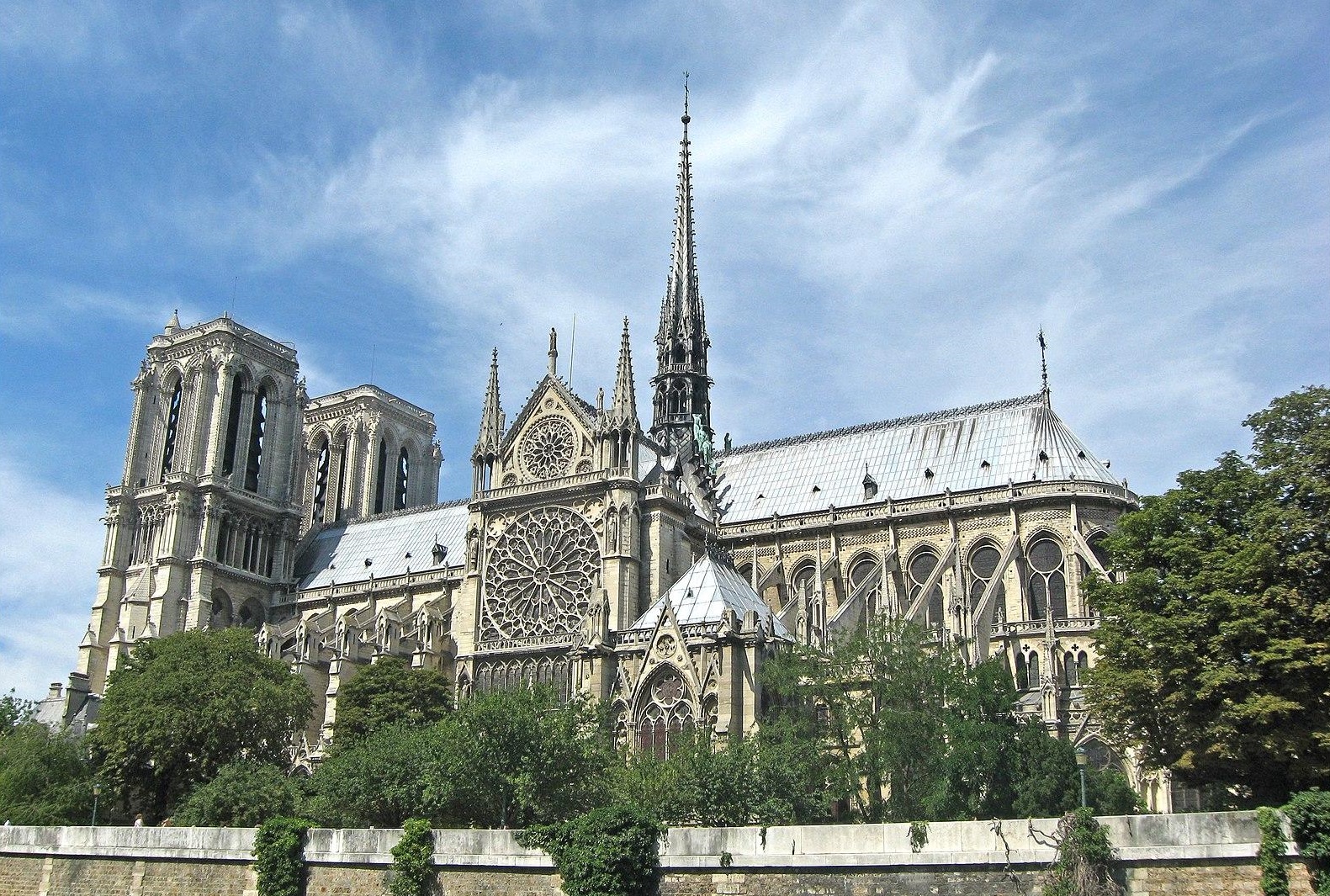
哥特式大教堂有大墙的窗户,展示着阳光直射的颜色,周围环绕着由飞行扶手组成的蜘蛛网络,顶部还有装饰性的石像鬼。 在此期间,哥特式建筑成为许多伟大的教堂和城堡所熟悉的特征,并导致城镇竞相建造最重要和最宏伟的大教堂。 建造一座大教堂消耗了周边城镇的劳动力,偶尔需要100多年的时间才能完成。 在整个西欧天主教地区,哥特式大教堂开始一块一块石头地从地上升到越来越高的高度。
该建筑包括独特的结构、尖拱门、罗纹拱顶和飞行支柱。 尖拱门(7.30)使教堂的高度得以飙升,并在这些哥特式教堂中为窗户提供宽敞的空间,而不是厚墙罗马式教堂中的限制。 由于罗纹拱顶(7.31)的发明和建筑,更高的教堂和更大的窗户的建筑能力成为可能。 在屋顶附近使用石头的强度是可以想象的,在中间建造多个相交的桶形拱顶。
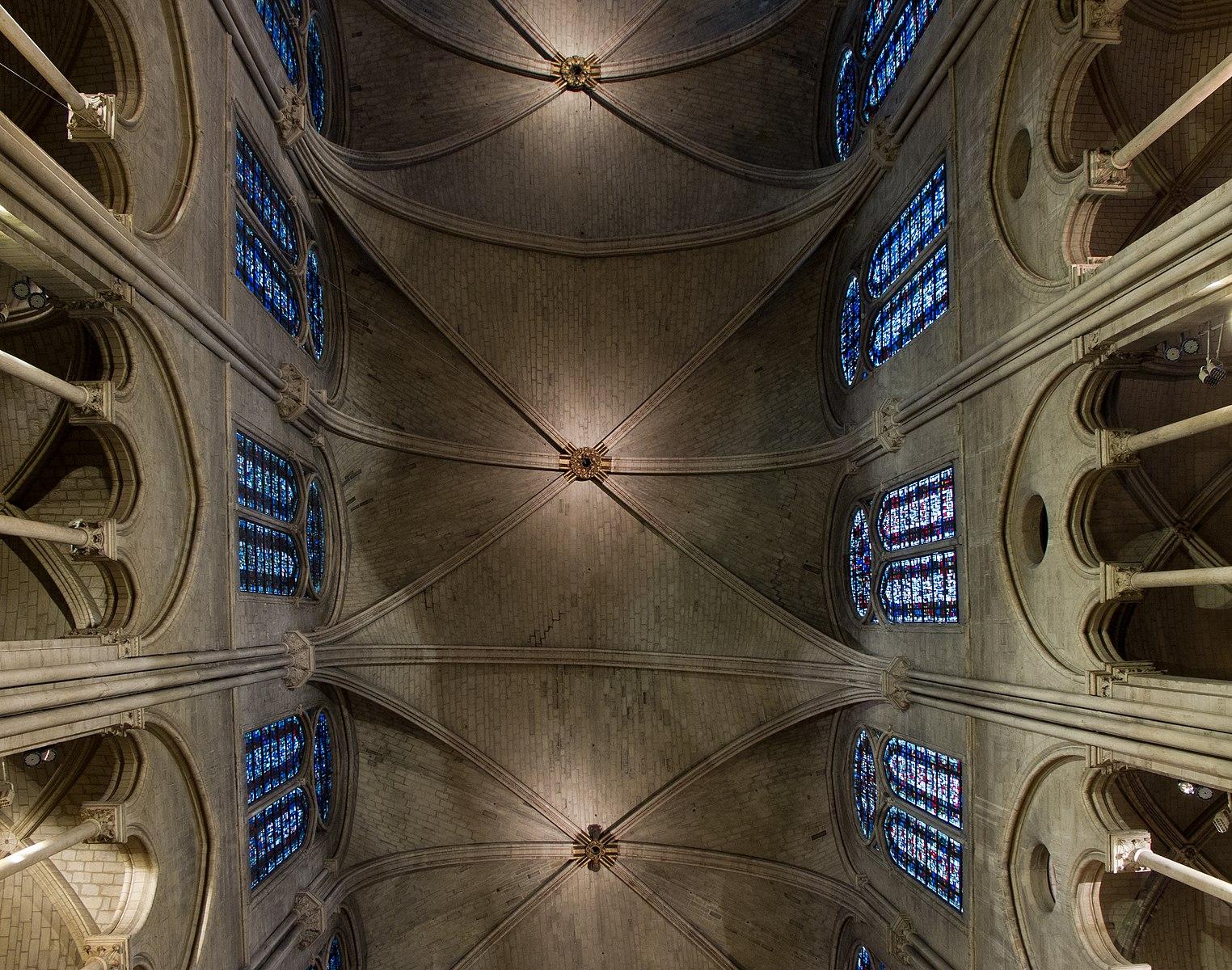
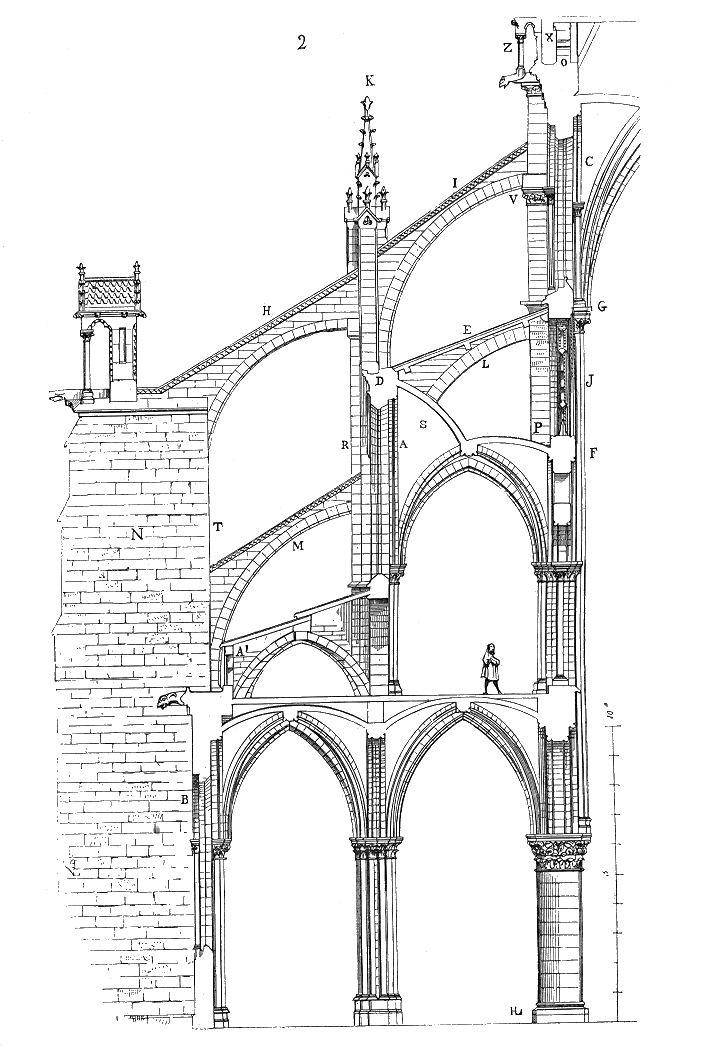
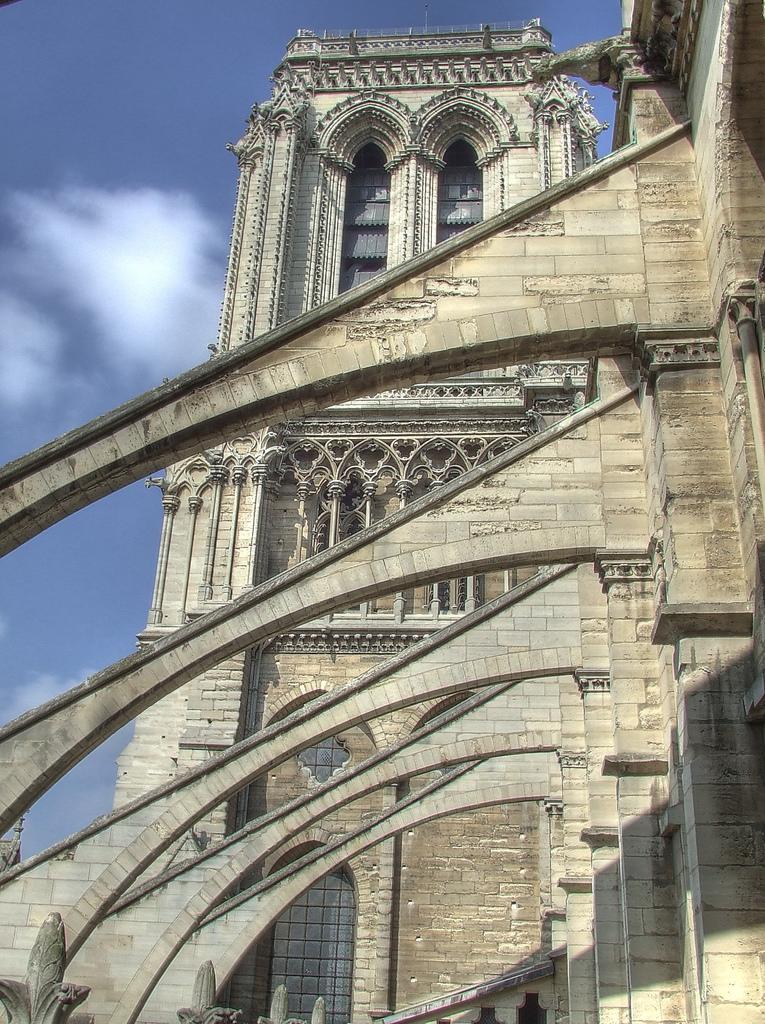
随着哥特式教堂的高度上升,他们为彩色玻璃建造了大型开口,但是,随着墙壁高度的增加,墙壁的横向力开始向外推动,导致上方沉重的石头负荷掉落。 飞行支柱(7.32)的设计是将力量从尖拱门重定向到地面。 它们从墙壁投射到地基,通过承受横向推力的压力和稳定墙壁来支撑高墙的重量。 飞行支柱成为该建筑的建筑部分(7.33)。
这座大教堂是对哥特式建筑的致敬,教堂的布局遵循了大教堂的风格。 中殿是建筑物的中央通道,通常以圆形末端结束,形成后殿,中殿两侧都有额外的过道,由柱廊隔开。 耳堂穿过中殿和后殿之间的过道,这使建筑物呈十字形状,合唱团区域位于中殿和耳堂相交的地方。
大教堂风格是指一个非常大的开放式公共聚会场所。
大教堂是分部分建造的;公元 1163 年至 1177 年的合唱区、公元 1218 年完工的高坛、公元 1208 年完工的 transepts 和中殿,西立面和装修细节终于在公元 1240 年完工。 多年来,许多不同的建筑师参与了这座建筑的设计,从而使不同的部分和塔楼具有独特的风格和高度。 每位建筑师都专门研究建筑物的不同方面;例如,一位建筑师的工作是监督玫瑰窗的组装。 其他建筑师则专注于塔楼下的大厅。
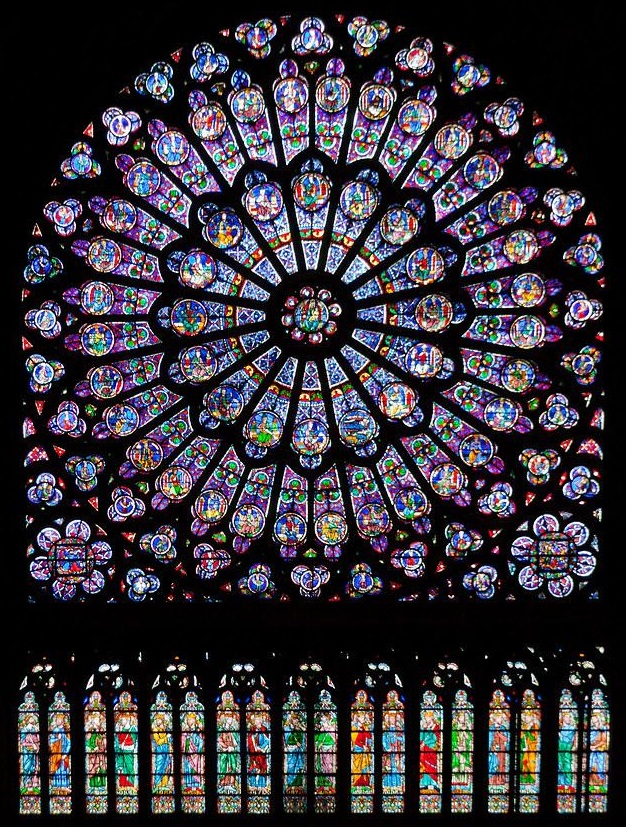
众多设计修改之一发生在建造 transepts 时,尤其是北耳堂的山墙传送门,这一变化是用壮观的玫瑰(7.34)窗户取代了普通的窗户。 这个想法非常成功,他们为南耳堂增加了一扇类似的窗口。 两个耳堂传送门上装饰着来自不同宗教故事的图像,这些图像用于在每周一次的宗教聚会上教信徒。
这座大教堂是最早使用飞行扶手和拱形外部支撑的建筑物之一,专为结构的稳定性而设计。 最初,最初的建筑图纸不包括飞行扶手;但是,在施工开始后,哥特式建筑的薄墙开始破裂。 尖拱连接时,重力开始向外推动,这可能导致墙壁倒塌。 建筑师设计了位于确切失效点的建筑物周围的支撑支撑;压裂停止了。 其他高大教堂正在破裂,这促使飞行扶手成为哥特时代建筑的标准。
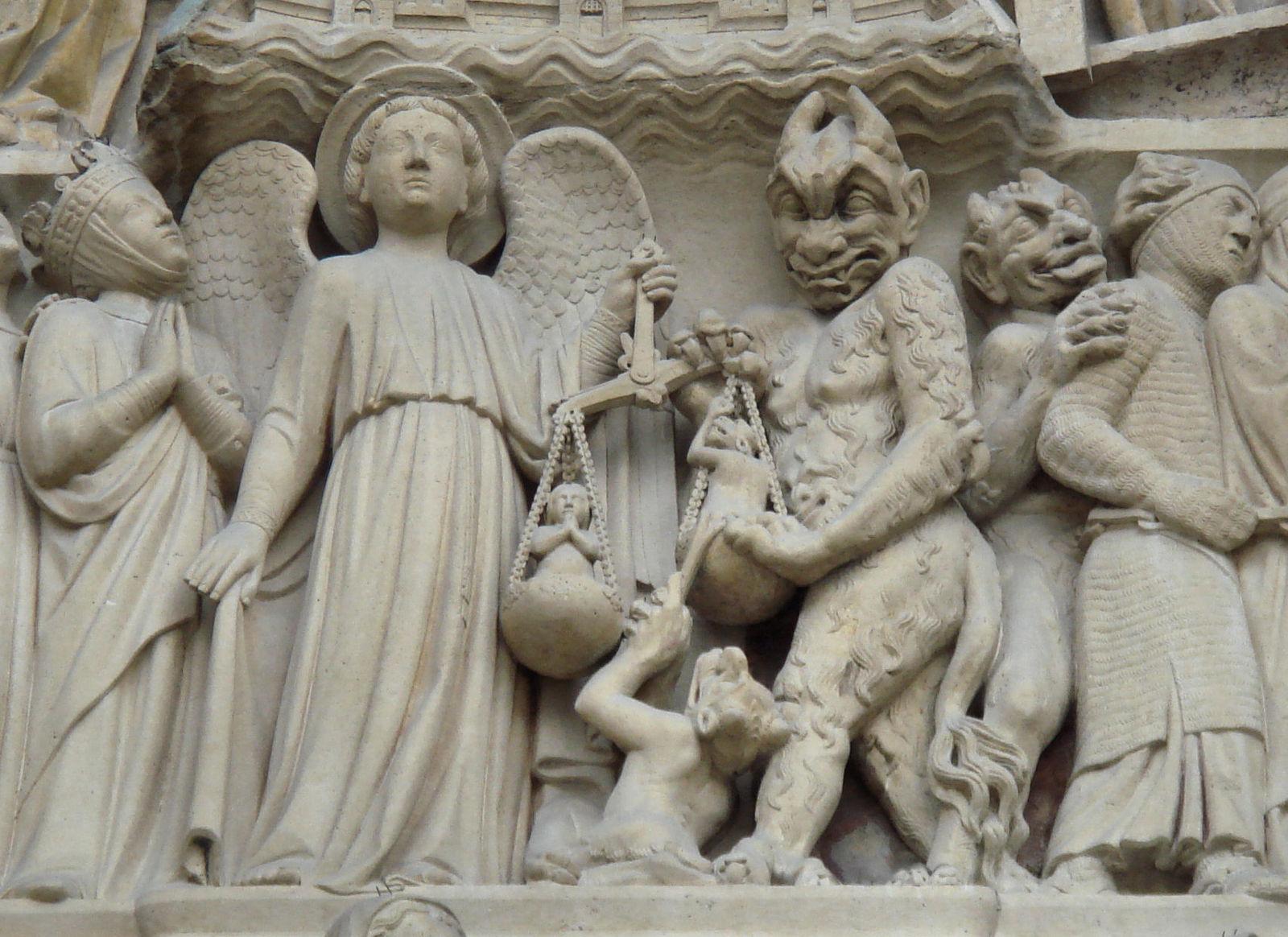
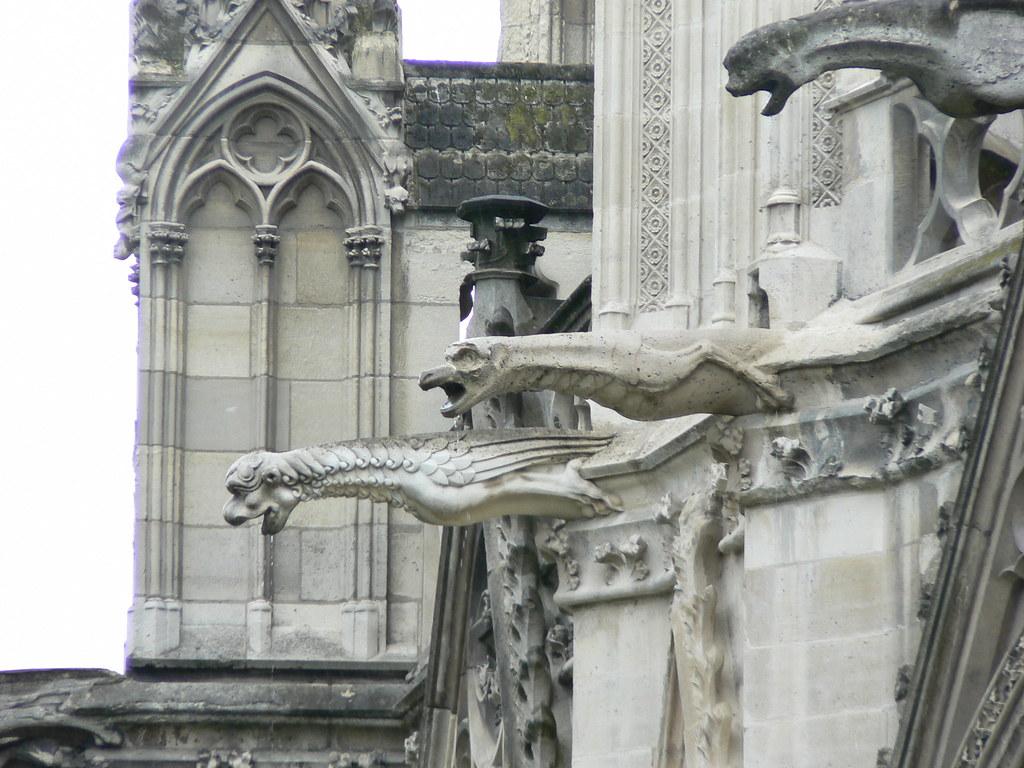
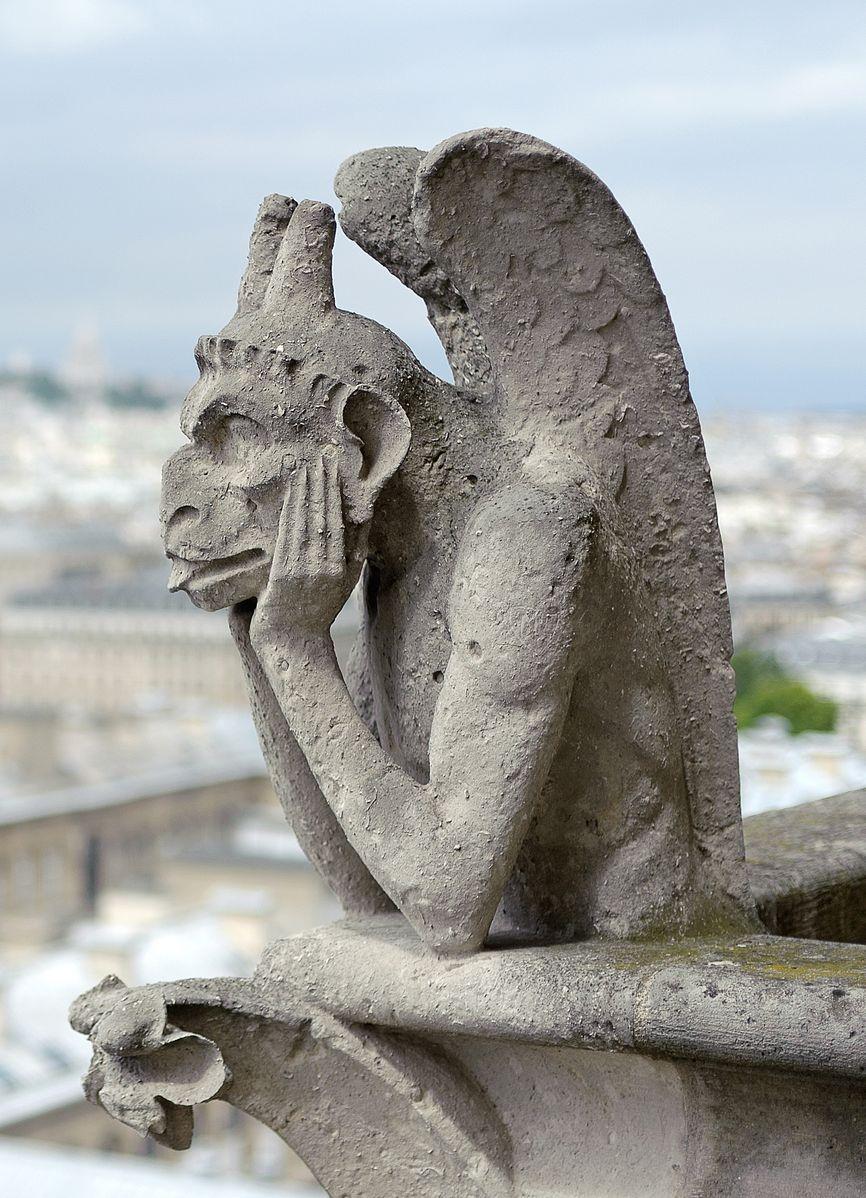
巴黎圣母院超越了教堂,因为它还被艺术所覆盖。 宗教人物和故事的小雕像(7.35)到处都被用作装饰,这是向文盲人口传授其宗教信条的另一种方法。 最初,华丽的雕像是用鲜艳的油漆和金色镀金装饰的。 其他人物,其中最著名的是嵌合体(7.36)和设计成水龙头的石像鬼,它们是邪恶的象征,旨在威胁人们,鼓励人们遵守适当的宗教信仰。 石像鬼(7.37)最初设计于13世纪,旨在将屋顶上的水从建筑物的地基分散开来,并在屋顶线上广泛使用;它们也成为了建筑物的守护者。