

4.5: 深度分支细菌
- Page ID
- 200226

\( \newcommand{\vecs}[1]{\overset { \scriptstyle \rightharpoonup} {\mathbf{#1}} } \)
\( \newcommand{\vecd}[1]{\overset{-\!-\!\rightharpoonup}{\vphantom{a}\smash {#1}}} \)
\( \newcommand{\dsum}{\displaystyle\sum\limits} \)
\( \newcommand{\dint}{\displaystyle\int\limits} \)
\( \newcommand{\dlim}{\displaystyle\lim\limits} \)
\( \newcommand{\id}{\mathrm{id}}\) \( \newcommand{\Span}{\mathrm{span}}\)
( \newcommand{\kernel}{\mathrm{null}\,}\) \( \newcommand{\range}{\mathrm{range}\,}\)
\( \newcommand{\RealPart}{\mathrm{Re}}\) \( \newcommand{\ImaginaryPart}{\mathrm{Im}}\)
\( \newcommand{\Argument}{\mathrm{Arg}}\) \( \newcommand{\norm}[1]{\| #1 \|}\)
\( \newcommand{\inner}[2]{\langle #1, #2 \rangle}\)
\( \newcommand{\Span}{\mathrm{span}}\)
\( \newcommand{\id}{\mathrm{id}}\)
\( \newcommand{\Span}{\mathrm{span}}\)
\( \newcommand{\kernel}{\mathrm{null}\,}\)
\( \newcommand{\range}{\mathrm{range}\,}\)
\( \newcommand{\RealPart}{\mathrm{Re}}\)
\( \newcommand{\ImaginaryPart}{\mathrm{Im}}\)
\( \newcommand{\Argument}{\mathrm{Arg}}\)
\( \newcommand{\norm}[1]{\| #1 \|}\)
\( \newcommand{\inner}[2]{\langle #1, #2 \rangle}\)
\( \newcommand{\Span}{\mathrm{span}}\) \( \newcommand{\AA}{\unicode[.8,0]{x212B}}\)
\( \newcommand{\vectorA}[1]{\vec{#1}} % arrow\)
\( \newcommand{\vectorAt}[1]{\vec{\text{#1}}} % arrow\)
\( \newcommand{\vectorB}[1]{\overset { \scriptstyle \rightharpoonup} {\mathbf{#1}} } \)
\( \newcommand{\vectorC}[1]{\textbf{#1}} \)
\( \newcommand{\vectorD}[1]{\overrightarrow{#1}} \)
\( \newcommand{\vectorDt}[1]{\overrightarrow{\text{#1}}} \)
\( \newcommand{\vectE}[1]{\overset{-\!-\!\rightharpoonup}{\vphantom{a}\smash{\mathbf {#1}}}} \)
\( \newcommand{\vecs}[1]{\overset { \scriptstyle \rightharpoonup} {\mathbf{#1}} } \)
\(\newcommand{\longvect}{\overrightarrow}\)
\( \newcommand{\vecd}[1]{\overset{-\!-\!\rightharpoonup}{\vphantom{a}\smash {#1}}} \)
\(\newcommand{\avec}{\mathbf a}\) \(\newcommand{\bvec}{\mathbf b}\) \(\newcommand{\cvec}{\mathbf c}\) \(\newcommand{\dvec}{\mathbf d}\) \(\newcommand{\dtil}{\widetilde{\mathbf d}}\) \(\newcommand{\evec}{\mathbf e}\) \(\newcommand{\fvec}{\mathbf f}\) \(\newcommand{\nvec}{\mathbf n}\) \(\newcommand{\pvec}{\mathbf p}\) \(\newcommand{\qvec}{\mathbf q}\) \(\newcommand{\svec}{\mathbf s}\) \(\newcommand{\tvec}{\mathbf t}\) \(\newcommand{\uvec}{\mathbf u}\) \(\newcommand{\vvec}{\mathbf v}\) \(\newcommand{\wvec}{\mathbf w}\) \(\newcommand{\xvec}{\mathbf x}\) \(\newcommand{\yvec}{\mathbf y}\) \(\newcommand{\zvec}{\mathbf z}\) \(\newcommand{\rvec}{\mathbf r}\) \(\newcommand{\mvec}{\mathbf m}\) \(\newcommand{\zerovec}{\mathbf 0}\) \(\newcommand{\onevec}{\mathbf 1}\) \(\newcommand{\real}{\mathbb R}\) \(\newcommand{\twovec}[2]{\left[\begin{array}{r}#1 \\ #2 \end{array}\right]}\) \(\newcommand{\ctwovec}[2]{\left[\begin{array}{c}#1 \\ #2 \end{array}\right]}\) \(\newcommand{\threevec}[3]{\left[\begin{array}{r}#1 \\ #2 \\ #3 \end{array}\right]}\) \(\newcommand{\cthreevec}[3]{\left[\begin{array}{c}#1 \\ #2 \\ #3 \end{array}\right]}\) \(\newcommand{\fourvec}[4]{\left[\begin{array}{r}#1 \\ #2 \\ #3 \\ #4 \end{array}\right]}\) \(\newcommand{\cfourvec}[4]{\left[\begin{array}{c}#1 \\ #2 \\ #3 \\ #4 \end{array}\right]}\) \(\newcommand{\fivevec}[5]{\left[\begin{array}{r}#1 \\ #2 \\ #3 \\ #4 \\ #5 \\ \end{array}\right]}\) \(\newcommand{\cfivevec}[5]{\left[\begin{array}{c}#1 \\ #2 \\ #3 \\ #4 \\ #5 \\ \end{array}\right]}\) \(\newcommand{\mattwo}[4]{\left[\begin{array}{rr}#1 \amp #2 \\ #3 \amp #4 \\ \end{array}\right]}\) \(\newcommand{\laspan}[1]{\text{Span}\{#1\}}\) \(\newcommand{\bcal}{\cal B}\) \(\newcommand{\ccal}{\cal C}\) \(\newcommand{\scal}{\cal S}\) \(\newcommand{\wcal}{\cal W}\) \(\newcommand{\ecal}{\cal E}\) \(\newcommand{\coords}[2]{\left\{#1\right\}_{#2}}\) \(\newcommand{\gray}[1]{\color{gray}{#1}}\) \(\newcommand{\lgray}[1]{\color{lightgray}{#1}}\) \(\newcommand{\rank}{\operatorname{rank}}\) \(\newcommand{\row}{\text{Row}}\) \(\newcommand{\col}{\text{Col}}\) \(\renewcommand{\row}{\text{Row}}\) \(\newcommand{\nul}{\text{Nul}}\) \(\newcommand{\var}{\text{Var}}\) \(\newcommand{\corr}{\text{corr}}\) \(\newcommand{\len}[1]{\left|#1\right|}\) \(\newcommand{\bbar}{\overline{\bvec}}\) \(\newcommand{\bhat}{\widehat{\bvec}}\) \(\newcommand{\bperp}{\bvec^\perp}\) \(\newcommand{\xhat}{\widehat{\xvec}}\) \(\newcommand{\vhat}{\widehat{\vvec}}\) \(\newcommand{\uhat}{\widehat{\uvec}}\) \(\newcommand{\what}{\widehat{\wvec}}\) \(\newcommand{\Sighat}{\widehat{\Sigma}}\) \(\newcommand{\lt}{<}\) \(\newcommand{\gt}{>}\) \(\newcommand{\amp}{&}\) \(\definecolor{fillinmathshade}{gray}{0.9}\)学习目标
- 描述深度分支细菌的独特特征
- 举例说明重要的深层分支细菌
在系统发育树上(参见系统方法),树的树干或根代表一个共同的古代进化祖先,通常被称为最后的普遍共同祖先(LUCA),而树枝是它的进化后代。 科学家们认为,深层分支细菌,例如Ac etothermus 属,是大约35亿年前进化产生的这些非Luca生命形式中的第一种。 当放置在系统发育树上时,它们起源于生命的共同根源,深而接近 LUCA 根,因此被命名为 “深度分支”(图\(\PageIndex{1}\))。
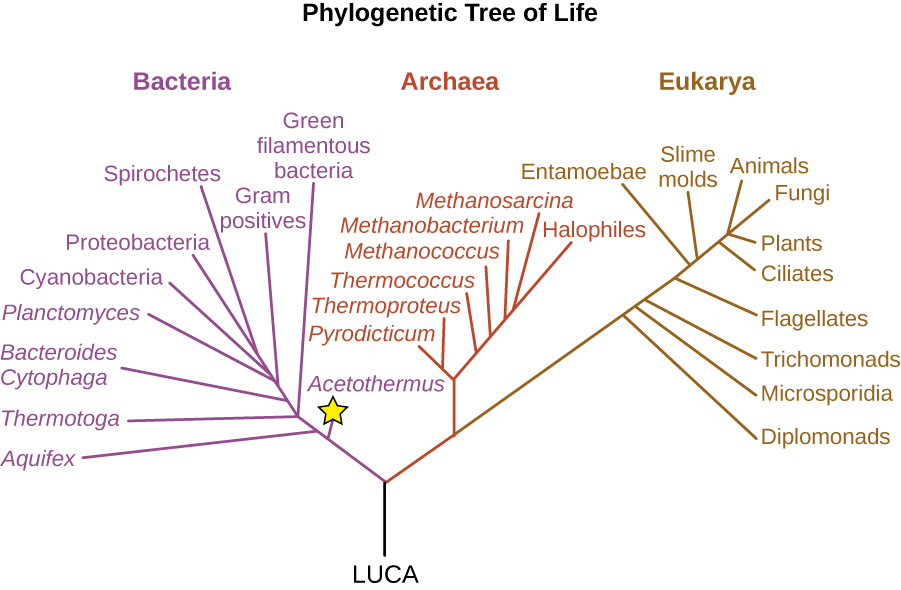
深度分支的细菌可能为古代和现已灭绝的生命形式的结构和功能提供线索。 我们可以假设古代细菌,比如仍然存在的深层分支细菌,是嗜热生物或超嗜热细菌,这意味着它们在非常高的温度下繁殖。 A@@ cetothermus paucivorans 是 1988 年在污水污泥中发现的一种革兰氏阴性厌氧细菌,是一种在 58 °C 的最佳温度下生长的嗜热细菌。1 科学家已确定它是最深的分支细菌,或者是 LUCA 最接近的进化亲属(图\(\PageIndex{1}\))。
Aquificae 类包括深层分支细菌,这些细菌适应了我们星球上最恶劣的条件,类似于生命首次出现时被认为主导地球的条件。 来自 Aquifex 属的细菌是超嗜热生物,生活在温度高于 90 °C 的温泉中。A. pyrophilus 物种在水下火山和海洋热喷口附近茁壮成长,那里的水温(在高压下)可以达到 138 °C。Aquifex细菌使用无机物质作为营养素。 例如,A. pyrophilus 可以减少氧气,并且能够在厌氧条件下减少氮气。 它们还显示出对紫外线和电离辐射的显著抵抗力。 总而言之,这些观察结果支持这样的假设,即深分支细菌的远古祖先在30多亿年前开始进化,当时地球很热,缺乏大气层,使细菌暴露在非电离和电离辐射下。
Thermotogae 类主要以超嗜热以及一些嗜温性(更喜欢中等温度)、厌氧革兰氏阴性细菌为代表,这些细菌的细胞被包裹在一种叫做 toga 的特殊鞘状外膜中。 细胞壁中的肽聚糖薄层具有不寻常的结构;它含有二氨基吡美酸和D-赖氨酸。 这些细菌能够使用各种有机底物并产生分子氢,可用于工业。 该类包含几个属,其中最著名的是 Thermotoga 属。 该属的一个物种 T. maritima 生活在热海洋喷口附近,在 90 °C 的温度下茁壮成长;另一种物种 T. subterranea 生活在地下油库中。
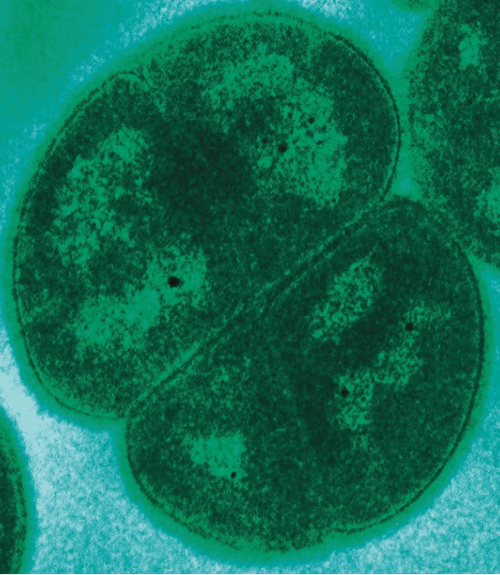
最后,深度分支的细菌 Deinococcus radiodurans 属于一个属,其名字源自希腊语,意思是可怕的浆果。 D. radiodurans 被昵称为 “细菌柯南”,被认为是多极爱好者,因为它能够在许多不同的极端条件下生存,包括极端高温、干旱、真空、酸度和辐射。 它之所以得名,是因为它能够承受杀死所有其他已知细菌的电离辐射剂量;这种特殊能力归因于一些独特的DNA修复机制。
摘要
- 深度分支细菌在系统发育上是最古老的生命形式,最接近最后一个宇宙共同祖先。
- 深度分支细菌包括许多在极端环境中繁殖的物种,这些环境被认为与数十亿年前的地球条件相似
- 深度分支细菌对我们理解进化很重要;其中一些用于工业
脚注
- 1 G. Dietrich 等人。 “A cetothermus paucivorans,nov. gen.,sp. 11 月,一种从污水污泥中提取的严格厌氧、嗜热细菌,将己糖发酵成醋酸盐、二氧化碳和氢气。” 系统和应用微生物学 10 第 2 期 (1988): 174—179。