

3.4: 神经系统的各个部分
- Page ID
- 203445

\( \newcommand{\vecs}[1]{\overset { \scriptstyle \rightharpoonup} {\mathbf{#1}} } \)
\( \newcommand{\vecd}[1]{\overset{-\!-\!\rightharpoonup}{\vphantom{a}\smash {#1}}} \)
\( \newcommand{\dsum}{\displaystyle\sum\limits} \)
\( \newcommand{\dint}{\displaystyle\int\limits} \)
\( \newcommand{\dlim}{\displaystyle\lim\limits} \)
\( \newcommand{\id}{\mathrm{id}}\) \( \newcommand{\Span}{\mathrm{span}}\)
( \newcommand{\kernel}{\mathrm{null}\,}\) \( \newcommand{\range}{\mathrm{range}\,}\)
\( \newcommand{\RealPart}{\mathrm{Re}}\) \( \newcommand{\ImaginaryPart}{\mathrm{Im}}\)
\( \newcommand{\Argument}{\mathrm{Arg}}\) \( \newcommand{\norm}[1]{\| #1 \|}\)
\( \newcommand{\inner}[2]{\langle #1, #2 \rangle}\)
\( \newcommand{\Span}{\mathrm{span}}\)
\( \newcommand{\id}{\mathrm{id}}\)
\( \newcommand{\Span}{\mathrm{span}}\)
\( \newcommand{\kernel}{\mathrm{null}\,}\)
\( \newcommand{\range}{\mathrm{range}\,}\)
\( \newcommand{\RealPart}{\mathrm{Re}}\)
\( \newcommand{\ImaginaryPart}{\mathrm{Im}}\)
\( \newcommand{\Argument}{\mathrm{Arg}}\)
\( \newcommand{\norm}[1]{\| #1 \|}\)
\( \newcommand{\inner}[2]{\langle #1, #2 \rangle}\)
\( \newcommand{\Span}{\mathrm{span}}\) \( \newcommand{\AA}{\unicode[.8,0]{x212B}}\)
\( \newcommand{\vectorA}[1]{\vec{#1}} % arrow\)
\( \newcommand{\vectorAt}[1]{\vec{\text{#1}}} % arrow\)
\( \newcommand{\vectorB}[1]{\overset { \scriptstyle \rightharpoonup} {\mathbf{#1}} } \)
\( \newcommand{\vectorC}[1]{\textbf{#1}} \)
\( \newcommand{\vectorD}[1]{\overrightarrow{#1}} \)
\( \newcommand{\vectorDt}[1]{\overrightarrow{\text{#1}}} \)
\( \newcommand{\vectE}[1]{\overset{-\!-\!\rightharpoonup}{\vphantom{a}\smash{\mathbf {#1}}}} \)
\( \newcommand{\vecs}[1]{\overset { \scriptstyle \rightharpoonup} {\mathbf{#1}} } \)
\(\newcommand{\longvect}{\overrightarrow}\)
\( \newcommand{\vecd}[1]{\overset{-\!-\!\rightharpoonup}{\vphantom{a}\smash {#1}}} \)
\(\newcommand{\avec}{\mathbf a}\) \(\newcommand{\bvec}{\mathbf b}\) \(\newcommand{\cvec}{\mathbf c}\) \(\newcommand{\dvec}{\mathbf d}\) \(\newcommand{\dtil}{\widetilde{\mathbf d}}\) \(\newcommand{\evec}{\mathbf e}\) \(\newcommand{\fvec}{\mathbf f}\) \(\newcommand{\nvec}{\mathbf n}\) \(\newcommand{\pvec}{\mathbf p}\) \(\newcommand{\qvec}{\mathbf q}\) \(\newcommand{\svec}{\mathbf s}\) \(\newcommand{\tvec}{\mathbf t}\) \(\newcommand{\uvec}{\mathbf u}\) \(\newcommand{\vvec}{\mathbf v}\) \(\newcommand{\wvec}{\mathbf w}\) \(\newcommand{\xvec}{\mathbf x}\) \(\newcommand{\yvec}{\mathbf y}\) \(\newcommand{\zvec}{\mathbf z}\) \(\newcommand{\rvec}{\mathbf r}\) \(\newcommand{\mvec}{\mathbf m}\) \(\newcommand{\zerovec}{\mathbf 0}\) \(\newcommand{\onevec}{\mathbf 1}\) \(\newcommand{\real}{\mathbb R}\) \(\newcommand{\twovec}[2]{\left[\begin{array}{r}#1 \\ #2 \end{array}\right]}\) \(\newcommand{\ctwovec}[2]{\left[\begin{array}{c}#1 \\ #2 \end{array}\right]}\) \(\newcommand{\threevec}[3]{\left[\begin{array}{r}#1 \\ #2 \\ #3 \end{array}\right]}\) \(\newcommand{\cthreevec}[3]{\left[\begin{array}{c}#1 \\ #2 \\ #3 \end{array}\right]}\) \(\newcommand{\fourvec}[4]{\left[\begin{array}{r}#1 \\ #2 \\ #3 \\ #4 \end{array}\right]}\) \(\newcommand{\cfourvec}[4]{\left[\begin{array}{c}#1 \\ #2 \\ #3 \\ #4 \end{array}\right]}\) \(\newcommand{\fivevec}[5]{\left[\begin{array}{r}#1 \\ #2 \\ #3 \\ #4 \\ #5 \\ \end{array}\right]}\) \(\newcommand{\cfivevec}[5]{\left[\begin{array}{c}#1 \\ #2 \\ #3 \\ #4 \\ #5 \\ \end{array}\right]}\) \(\newcommand{\mattwo}[4]{\left[\begin{array}{rr}#1 \amp #2 \\ #3 \amp #4 \\ \end{array}\right]}\) \(\newcommand{\laspan}[1]{\text{Span}\{#1\}}\) \(\newcommand{\bcal}{\cal B}\) \(\newcommand{\ccal}{\cal C}\) \(\newcommand{\scal}{\cal S}\) \(\newcommand{\wcal}{\cal W}\) \(\newcommand{\ecal}{\cal E}\) \(\newcommand{\coords}[2]{\left\{#1\right\}_{#2}}\) \(\newcommand{\gray}[1]{\color{gray}{#1}}\) \(\newcommand{\lgray}[1]{\color{lightgray}{#1}}\) \(\newcommand{\rank}{\operatorname{rank}}\) \(\newcommand{\row}{\text{Row}}\) \(\newcommand{\col}{\text{Col}}\) \(\renewcommand{\row}{\text{Row}}\) \(\newcommand{\nul}{\text{Nul}}\) \(\newcommand{\var}{\text{Var}}\) \(\newcommand{\corr}{\text{corr}}\) \(\newcommand{\len}[1]{\left|#1\right|}\) \(\newcommand{\bbar}{\overline{\bvec}}\) \(\newcommand{\bhat}{\widehat{\bvec}}\) \(\newcommand{\bperp}{\bvec^\perp}\) \(\newcommand{\xhat}{\widehat{\xvec}}\) \(\newcommand{\vhat}{\widehat{\vvec}}\) \(\newcommand{\uhat}{\widehat{\uvec}}\) \(\newcommand{\what}{\widehat{\wvec}}\) \(\newcommand{\Sighat}{\widehat{\Sigma}}\) \(\newcommand{\lt}{<}\) \(\newcommand{\gt}{>}\) \(\newcommand{\amp}{&}\) \(\definecolor{fillinmathshade}{gray}{0.9}\)学习目标
- 描述中枢神经系统和周围神经系统之间的区别
- 解释体神经系统和自主神经系统之间的区别
- 区分自主神经系统的交感神经和副交感神经分裂
神经系统可以分为两个主要细分:中枢神经系统(CNS)和周围神经系统(PNS),如下图所示。 中枢神经系统由大脑和脊髓组成;PNS 将中枢神经系统与身体其他部位连接起来。 在本节中,我们将重点介绍周围神经系统;稍后,我们将研究大脑和脊髓。
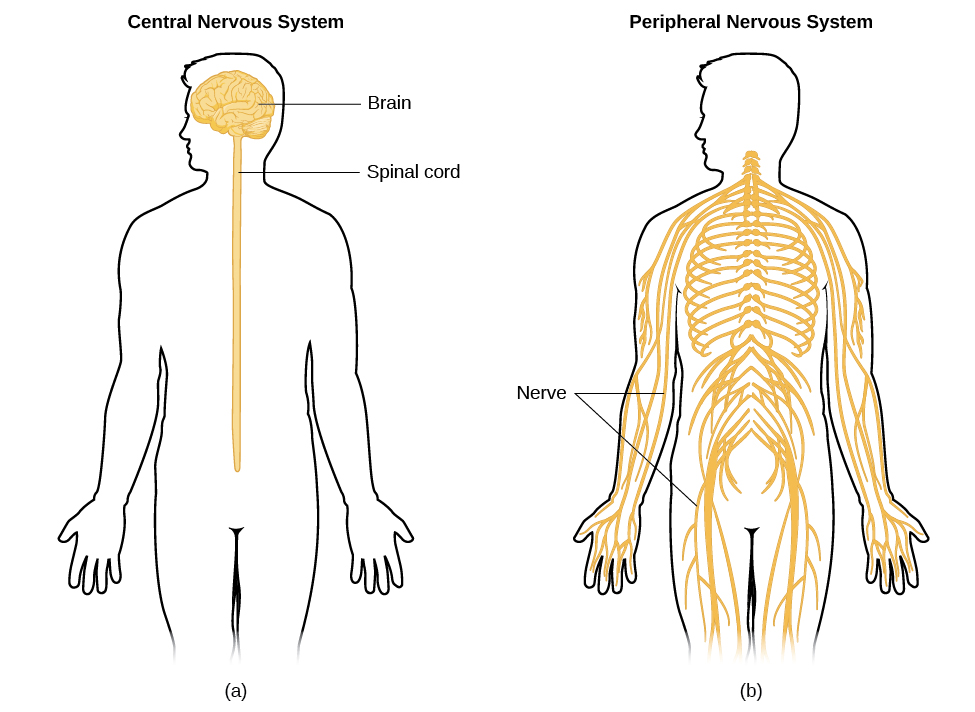
周围神经系统
周围神经系统由厚束的轴突组成,这些轴突被称为神经,在中枢神经系统与身体周围(即中枢神经系统以外的所有物体)的肌肉、器官和感官之间来回传递信息。 PNS 有两个主要细分:体神经系统和自主神经系统。
体神经系统与传统上被认为是有意识或自愿的活动有关。 它参与中枢神经系统的感官和运动信息的传递;因此,它由运动神经元和感觉神经元组成。 运动神经元将指令从中枢神经系统传递到肌肉,是传出纤维(传出意味着 “远离”)。 将感官信息传送到中枢神经系统的感觉神经元是传入纤维(传入意味着 “向前移动”)。 每个神经基本上都是一条双向高速公路,包含数千个轴颈,包括传出和传入。
自主神经系统控制着我们的内部器官和腺体,通常被认为不在自愿控制的范围内。 它可以进一步细分为交感神经和副交感神经部门。 交感神经系统参与人体为与压力相关的活动做好准备;副交感神经系统与使身体恢复常规的日常操作有关。 这两个系统具有互补的功能,协同运行以维持人体的动态平衡。 稳态是一种平衡状态,在这种状态下,生物条件(例如体温)保持在最佳水平。
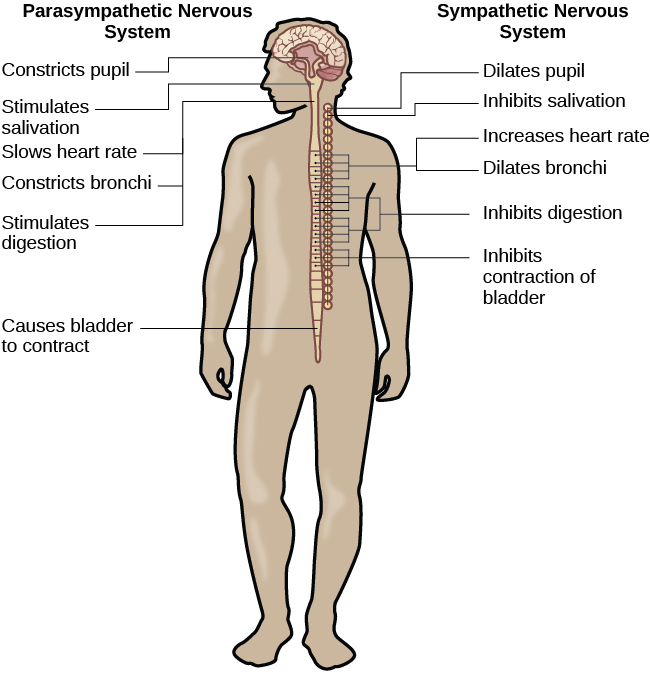
当我们面对压力或高度觉醒的情况时,交感神经系统就会被激活。 这个系统的活动适应了我们的祖先,增加了他们的生存机会。 例如,想象一下,我们的一位早期祖先在外面狩猎小猎物,突然打扰了一只带着幼熊的大熊。 那一刻,他的身体经历了一系列的变化——这是激活同情的直接作用——使他为面对威胁做好了准备。 他的瞳孔扩大,心率和血压升高,膀胱放松,肝脏释放葡萄糖,肾上腺素激增到血液中。 这种被称为战斗或逃跑反应的生理变化使人体获得能量储备和增强的感官能力,从而可以抵御威胁或逃到安全地带。
很明显,这种反应对于我们祖先的生存至关重要,他们生活在一个充满真实人身威胁的世界中,但我们在现代世界中面临的许多激动人心的情况本质上更像是心理上的。 例如,想想当你必须站起来在一群人面前做演讲时,或者在参加大型考试之前的感受。 在这种情况下,你没有真正的人身危险,但是你已经进化为通过战斗或逃跑反应来应对任何感知到的威胁。 这种反应在现代世界中的适应性差不多;事实上,当我们经常面对既无法抗击也无法逃避的心理威胁时,我们会遭受负面的健康后果。 最近的研究表明,心脏病易感性增加(Chandola、Brunner 和 Marmot,2006)和免疫系统功能受损(Glaser & Kiecolt-Glaser,2005)是持续和反复接触压力环境的众多负面后果之一。
一旦威胁得到解决,副交感神经系统就会接管并将身体机能恢复到放松状态。 我们的猎人的心率和血压恢复正常,他的瞳孔收缩,他恢复了对膀胱的控制,肝脏开始以糖原的形式储存葡萄糖以备将来使用。 这些过程与副交感神经系统的激活有关。
摘要
大脑和脊髓构成中枢神经系统。 周围神经系统由躯体和自主神经系统组成。 体神经系统向中枢神经系统传输感官和运动信号。 自主神经系统控制着我们的器官和腺体的功能,可以分为交感神经分裂和副交感神经分裂。 交感激活使我们为战斗或逃跑做好准备,而副交感神经激活与放松条件下的正常功能有关。
Glossary
- autonomic nervous system
- controls our internal organs and glands
- central nervous system (CNS)
- brain and spinal cord
- fight or flight response
- activation of the sympathetic division of the autonomic nervous system, allowing access to energy reserves and heightened sensory capacity so that we might fight off a given threat or run away to safety
- homeostasis
- state of equilibrium—biological conditions, such as body temperature, are maintained at optimal levels
- parasympathetic nervous system
- associated with routine, day-to-day operations of the body
- peripheral nervous system (PNS)
- connects the brain and spinal cord to the muscles, organs and senses in the periphery of the body
- somatic nervous system
- relays sensory and motor information to and from the CNS
- sympathetic nervous system
- involved in stress-related activities and functions