

1.2: 什么是心理学?
- Page ID
- 203251

\( \newcommand{\vecs}[1]{\overset { \scriptstyle \rightharpoonup} {\mathbf{#1}} } \)
\( \newcommand{\vecd}[1]{\overset{-\!-\!\rightharpoonup}{\vphantom{a}\smash {#1}}} \)
\( \newcommand{\dsum}{\displaystyle\sum\limits} \)
\( \newcommand{\dint}{\displaystyle\int\limits} \)
\( \newcommand{\dlim}{\displaystyle\lim\limits} \)
\( \newcommand{\id}{\mathrm{id}}\) \( \newcommand{\Span}{\mathrm{span}}\)
( \newcommand{\kernel}{\mathrm{null}\,}\) \( \newcommand{\range}{\mathrm{range}\,}\)
\( \newcommand{\RealPart}{\mathrm{Re}}\) \( \newcommand{\ImaginaryPart}{\mathrm{Im}}\)
\( \newcommand{\Argument}{\mathrm{Arg}}\) \( \newcommand{\norm}[1]{\| #1 \|}\)
\( \newcommand{\inner}[2]{\langle #1, #2 \rangle}\)
\( \newcommand{\Span}{\mathrm{span}}\)
\( \newcommand{\id}{\mathrm{id}}\)
\( \newcommand{\Span}{\mathrm{span}}\)
\( \newcommand{\kernel}{\mathrm{null}\,}\)
\( \newcommand{\range}{\mathrm{range}\,}\)
\( \newcommand{\RealPart}{\mathrm{Re}}\)
\( \newcommand{\ImaginaryPart}{\mathrm{Im}}\)
\( \newcommand{\Argument}{\mathrm{Arg}}\)
\( \newcommand{\norm}[1]{\| #1 \|}\)
\( \newcommand{\inner}[2]{\langle #1, #2 \rangle}\)
\( \newcommand{\Span}{\mathrm{span}}\) \( \newcommand{\AA}{\unicode[.8,0]{x212B}}\)
\( \newcommand{\vectorA}[1]{\vec{#1}} % arrow\)
\( \newcommand{\vectorAt}[1]{\vec{\text{#1}}} % arrow\)
\( \newcommand{\vectorB}[1]{\overset { \scriptstyle \rightharpoonup} {\mathbf{#1}} } \)
\( \newcommand{\vectorC}[1]{\textbf{#1}} \)
\( \newcommand{\vectorD}[1]{\overrightarrow{#1}} \)
\( \newcommand{\vectorDt}[1]{\overrightarrow{\text{#1}}} \)
\( \newcommand{\vectE}[1]{\overset{-\!-\!\rightharpoonup}{\vphantom{a}\smash{\mathbf {#1}}}} \)
\( \newcommand{\vecs}[1]{\overset { \scriptstyle \rightharpoonup} {\mathbf{#1}} } \)
\(\newcommand{\longvect}{\overrightarrow}\)
\( \newcommand{\vecd}[1]{\overset{-\!-\!\rightharpoonup}{\vphantom{a}\smash {#1}}} \)
\(\newcommand{\avec}{\mathbf a}\) \(\newcommand{\bvec}{\mathbf b}\) \(\newcommand{\cvec}{\mathbf c}\) \(\newcommand{\dvec}{\mathbf d}\) \(\newcommand{\dtil}{\widetilde{\mathbf d}}\) \(\newcommand{\evec}{\mathbf e}\) \(\newcommand{\fvec}{\mathbf f}\) \(\newcommand{\nvec}{\mathbf n}\) \(\newcommand{\pvec}{\mathbf p}\) \(\newcommand{\qvec}{\mathbf q}\) \(\newcommand{\svec}{\mathbf s}\) \(\newcommand{\tvec}{\mathbf t}\) \(\newcommand{\uvec}{\mathbf u}\) \(\newcommand{\vvec}{\mathbf v}\) \(\newcommand{\wvec}{\mathbf w}\) \(\newcommand{\xvec}{\mathbf x}\) \(\newcommand{\yvec}{\mathbf y}\) \(\newcommand{\zvec}{\mathbf z}\) \(\newcommand{\rvec}{\mathbf r}\) \(\newcommand{\mvec}{\mathbf m}\) \(\newcommand{\zerovec}{\mathbf 0}\) \(\newcommand{\onevec}{\mathbf 1}\) \(\newcommand{\real}{\mathbb R}\) \(\newcommand{\twovec}[2]{\left[\begin{array}{r}#1 \\ #2 \end{array}\right]}\) \(\newcommand{\ctwovec}[2]{\left[\begin{array}{c}#1 \\ #2 \end{array}\right]}\) \(\newcommand{\threevec}[3]{\left[\begin{array}{r}#1 \\ #2 \\ #3 \end{array}\right]}\) \(\newcommand{\cthreevec}[3]{\left[\begin{array}{c}#1 \\ #2 \\ #3 \end{array}\right]}\) \(\newcommand{\fourvec}[4]{\left[\begin{array}{r}#1 \\ #2 \\ #3 \\ #4 \end{array}\right]}\) \(\newcommand{\cfourvec}[4]{\left[\begin{array}{c}#1 \\ #2 \\ #3 \\ #4 \end{array}\right]}\) \(\newcommand{\fivevec}[5]{\left[\begin{array}{r}#1 \\ #2 \\ #3 \\ #4 \\ #5 \\ \end{array}\right]}\) \(\newcommand{\cfivevec}[5]{\left[\begin{array}{c}#1 \\ #2 \\ #3 \\ #4 \\ #5 \\ \end{array}\right]}\) \(\newcommand{\mattwo}[4]{\left[\begin{array}{rr}#1 \amp #2 \\ #3 \amp #4 \\ \end{array}\right]}\) \(\newcommand{\laspan}[1]{\text{Span}\{#1\}}\) \(\newcommand{\bcal}{\cal B}\) \(\newcommand{\ccal}{\cal C}\) \(\newcommand{\scal}{\cal S}\) \(\newcommand{\wcal}{\cal W}\) \(\newcommand{\ecal}{\cal E}\) \(\newcommand{\coords}[2]{\left\{#1\right\}_{#2}}\) \(\newcommand{\gray}[1]{\color{gray}{#1}}\) \(\newcommand{\lgray}[1]{\color{lightgray}{#1}}\) \(\newcommand{\rank}{\operatorname{rank}}\) \(\newcommand{\row}{\text{Row}}\) \(\newcommand{\col}{\text{Col}}\) \(\renewcommand{\row}{\text{Row}}\) \(\newcommand{\nul}{\text{Nul}}\) \(\newcommand{\var}{\text{Var}}\) \(\newcommand{\corr}{\text{corr}}\) \(\newcommand{\len}[1]{\left|#1\right|}\) \(\newcommand{\bbar}{\overline{\bvec}}\) \(\newcommand{\bhat}{\widehat{\bvec}}\) \(\newcommand{\bperp}{\bvec^\perp}\) \(\newcommand{\xhat}{\widehat{\xvec}}\) \(\newcommand{\vhat}{\widehat{\vvec}}\) \(\newcommand{\uhat}{\widehat{\uvec}}\) \(\newcommand{\what}{\widehat{\wvec}}\) \(\newcommand{\Sighat}{\widehat{\Sigma}}\) \(\newcommand{\lt}{<}\) \(\newcommand{\gt}{>}\) \(\newcommand{\amp}{&}\) \(\definecolor{fillinmathshade}{gray}{0.9}\)学习目标
- 定义心理学
- 了解心理学教育的优点
在希腊神话中,Psyche 是一位凡人的女人,她的美丽如此之大,可以与女神阿芙罗狄蒂相媲美。 阿芙罗狄蒂非常嫉妒 Psyche,以至于她派儿子爱神去让 Psyche 爱上世界上最丑的男人。 但是,爱神不小心用箭尖刺了自己,疯狂地爱上了 Psyche 本人。 他把 Psyche 带到自己的宫殿给她送了礼物,但她永远看不见他的脸。 在拜访 Psyche 时,她的姐妹们在 Psyche 中引起了对她神秘情人的怀疑,最终,Psyche 背叛了 Eros 希望不被她看见的愿望(图\(\PageIndex{1}\))。 因为这种背叛,爱神抛弃了 Psyche。 当 Psyche 呼吁阿芙罗狄蒂让她与爱神团聚时,阿芙罗狄蒂给了她一系列不可能完成的任务。 Psyche 成功完成了所有这些试验;最终,她的毅力得到了回报,因为她与爱神团聚并最终转变为女神(Ashliman,2001;《希腊神话与希腊神话》,2014 年)。
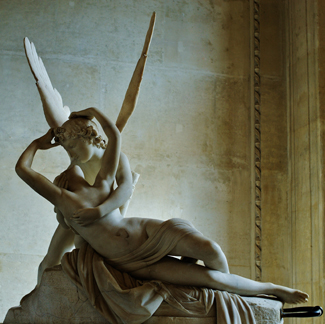
Psyche 开始代表人类灵魂在追求真正的幸福的过程中战胜生活中的不幸(Bulfinch,1855 年);事实上,希腊语 p syche 一词的意思是灵魂,它通常被描述为蝴蝶。 心理学这个词是在灵魂和心灵的概念没有那么明确区分的时候创造出来的(Green,2001)。 根源学表示对心灵的科学研究,心理学是指对心灵的科学研究。 由于科学只研究可观察到的现象,而心灵不能直接观察,因此我们将这个定义扩展到对思想和行为的科学研究。
对世界任何方面的科学研究都使用科学方法来获取知识。 为了应用科学方法,对某件事如何或为什么发生有疑问的研究人员将提出一个初步的解释,称为假设,来解释这种现象。 假设不只是任何解释;它应该符合科学理论的背景。 科学理论是对自然世界某些方面的广泛解释或一组解释,随着时间的推移,这些解释一直得到证据的支持。 理论是我们对自然界那一部分的最好理解。 有了假设,研究人员就可以进行观察,或者更好的是,进行实验来检验该假设的有效性。 然后发布该测试及其结果,以便其他人可以检查结果或在此基础上再接再厉。 科学中的任何解释都必须是可检验的,这意味着这种现象必须是可感知和可测量的。 例如,一只鸟因为快乐而唱歌不是一个可以检验的假设,因为我们无法衡量一只鸟的幸福感。 我们必须问一个不同的问题,也许是关于鸟的大脑状态,因为这是可以测量的。 总的来说,科学只涉及物质和能量,即那些可以测量的事物,它无法获得关于价值观和道德的知识。 这就是我们对心灵的科学理解如此有限的原因之一,因为思想,至少在我们经历的时候,既不是物质也不是能量。 科学方法也是经验主义的一种形式。 获取知识的经验方法是基于观察(包括实验)的方法,而不是仅基于逻辑论证形式或先前权威的方法。
直到1800年代后期,心理学才被接受为自己的学科。 在此之前,思维的运作是在哲学的主持下考虑的。 鉴于任何行为的根源都是生物学的,心理学的某些领域涉及自然科学的各个方面,例如生物学。 没有生物体是孤立存在的,我们的行为受到我们与他人相互作用的影响。 因此,心理学也是一门社会科学。
心理学教育的优点
通常,学生上第一门心理学课程是因为他们有兴趣帮助他人,想更多地了解自己以及他们为什么以自己的方式行事。 有时,学生之所以选择心理学课程,是因为它要么满足通识教育的要求,要么是护理或医学预科等学习课程的必修课。 这些学生中有许多人对这个领域产生了浓厚的兴趣,以至于他们继续宣称心理学是他们的专业。 因此,心理学是全美大学校园中最受欢迎的专业之一(Johnson & Lubin,2011)。 许多知名人士都是心理学专业的学生。 这份名单上只有几个著名人物是Facebook的创作者马克·扎克伯格、电视名人和政治讽刺作家乔恩·斯图尔特、女演员娜塔莉·波特曼和电影制片人韦斯·克雷文(Halonen,2011)。 在美国授予的所有学士学位中,大约有\(6\)百分之几属于心理学学科(美国教育部,2013 年)。
心理学教育之所以有价值,原因有很多。 心理学学生磨练批判性思维能力,并接受使用科学方法的培训。 批判性思维是将一套技能积极应用于信息,以理解和评估该信息。 在一个充满相互竞争的 “事实” 的世界中,评估信息(评估其可靠性和有用性)是一项重要技能,其中许多事实旨在误导人。 例如,批判性思维包括保持怀疑态度、识别内部偏见、运用逻辑思维、提出适当问题和进行观察。 心理学学生还可以在本科课程中培养更好的沟通技巧(美国心理学会,2011 年)。 这些因素共同提高了学生的科学素养,使学生做好了批判性评估他们遇到的各种信息来源的准备。
除了这些基础广泛的技能外,心理学学生还开始了解影响个人行为的复杂因素。 他们欣赏我们的生物学、环境之间的相互作用,以及我们在确定自己是谁以及我们将如何行为方面的经验。 他们学习指导我们思维和行为的基本原则,并认识到个人之间和文化界限之间存在的巨大多样性(美国心理学会,2011 年)。
摘要
心理学源自心理(意思是灵魂)和 —ology(意思是科学研究)的根源。 因此,心理学被定义为对思想和行为的科学研究。 心理学学生培养批判性思维能力,熟悉科学方法,并认识到行为的复杂性。
词汇表
- empirical method
- method for acquiring knowledge based on observation, including experimentation, rather than a method based only on forms of logical argument or previous authorities
- ology
- suffix that denotes “scientific study of”
- psyche
- Greek word for soul
- psychology
- scientific study of the mind and behavior