

1.4: 天文学中的数字
- Page ID
- 202957

\( \newcommand{\vecs}[1]{\overset { \scriptstyle \rightharpoonup} {\mathbf{#1}} } \)
\( \newcommand{\vecd}[1]{\overset{-\!-\!\rightharpoonup}{\vphantom{a}\smash {#1}}} \)
\( \newcommand{\dsum}{\displaystyle\sum\limits} \)
\( \newcommand{\dint}{\displaystyle\int\limits} \)
\( \newcommand{\dlim}{\displaystyle\lim\limits} \)
\( \newcommand{\id}{\mathrm{id}}\) \( \newcommand{\Span}{\mathrm{span}}\)
( \newcommand{\kernel}{\mathrm{null}\,}\) \( \newcommand{\range}{\mathrm{range}\,}\)
\( \newcommand{\RealPart}{\mathrm{Re}}\) \( \newcommand{\ImaginaryPart}{\mathrm{Im}}\)
\( \newcommand{\Argument}{\mathrm{Arg}}\) \( \newcommand{\norm}[1]{\| #1 \|}\)
\( \newcommand{\inner}[2]{\langle #1, #2 \rangle}\)
\( \newcommand{\Span}{\mathrm{span}}\)
\( \newcommand{\id}{\mathrm{id}}\)
\( \newcommand{\Span}{\mathrm{span}}\)
\( \newcommand{\kernel}{\mathrm{null}\,}\)
\( \newcommand{\range}{\mathrm{range}\,}\)
\( \newcommand{\RealPart}{\mathrm{Re}}\)
\( \newcommand{\ImaginaryPart}{\mathrm{Im}}\)
\( \newcommand{\Argument}{\mathrm{Arg}}\)
\( \newcommand{\norm}[1]{\| #1 \|}\)
\( \newcommand{\inner}[2]{\langle #1, #2 \rangle}\)
\( \newcommand{\Span}{\mathrm{span}}\) \( \newcommand{\AA}{\unicode[.8,0]{x212B}}\)
\( \newcommand{\vectorA}[1]{\vec{#1}} % arrow\)
\( \newcommand{\vectorAt}[1]{\vec{\text{#1}}} % arrow\)
\( \newcommand{\vectorB}[1]{\overset { \scriptstyle \rightharpoonup} {\mathbf{#1}} } \)
\( \newcommand{\vectorC}[1]{\textbf{#1}} \)
\( \newcommand{\vectorD}[1]{\overrightarrow{#1}} \)
\( \newcommand{\vectorDt}[1]{\overrightarrow{\text{#1}}} \)
\( \newcommand{\vectE}[1]{\overset{-\!-\!\rightharpoonup}{\vphantom{a}\smash{\mathbf {#1}}}} \)
\( \newcommand{\vecs}[1]{\overset { \scriptstyle \rightharpoonup} {\mathbf{#1}} } \)
\(\newcommand{\longvect}{\overrightarrow}\)
\( \newcommand{\vecd}[1]{\overset{-\!-\!\rightharpoonup}{\vphantom{a}\smash {#1}}} \)
\(\newcommand{\avec}{\mathbf a}\) \(\newcommand{\bvec}{\mathbf b}\) \(\newcommand{\cvec}{\mathbf c}\) \(\newcommand{\dvec}{\mathbf d}\) \(\newcommand{\dtil}{\widetilde{\mathbf d}}\) \(\newcommand{\evec}{\mathbf e}\) \(\newcommand{\fvec}{\mathbf f}\) \(\newcommand{\nvec}{\mathbf n}\) \(\newcommand{\pvec}{\mathbf p}\) \(\newcommand{\qvec}{\mathbf q}\) \(\newcommand{\svec}{\mathbf s}\) \(\newcommand{\tvec}{\mathbf t}\) \(\newcommand{\uvec}{\mathbf u}\) \(\newcommand{\vvec}{\mathbf v}\) \(\newcommand{\wvec}{\mathbf w}\) \(\newcommand{\xvec}{\mathbf x}\) \(\newcommand{\yvec}{\mathbf y}\) \(\newcommand{\zvec}{\mathbf z}\) \(\newcommand{\rvec}{\mathbf r}\) \(\newcommand{\mvec}{\mathbf m}\) \(\newcommand{\zerovec}{\mathbf 0}\) \(\newcommand{\onevec}{\mathbf 1}\) \(\newcommand{\real}{\mathbb R}\) \(\newcommand{\twovec}[2]{\left[\begin{array}{r}#1 \\ #2 \end{array}\right]}\) \(\newcommand{\ctwovec}[2]{\left[\begin{array}{c}#1 \\ #2 \end{array}\right]}\) \(\newcommand{\threevec}[3]{\left[\begin{array}{r}#1 \\ #2 \\ #3 \end{array}\right]}\) \(\newcommand{\cthreevec}[3]{\left[\begin{array}{c}#1 \\ #2 \\ #3 \end{array}\right]}\) \(\newcommand{\fourvec}[4]{\left[\begin{array}{r}#1 \\ #2 \\ #3 \\ #4 \end{array}\right]}\) \(\newcommand{\cfourvec}[4]{\left[\begin{array}{c}#1 \\ #2 \\ #3 \\ #4 \end{array}\right]}\) \(\newcommand{\fivevec}[5]{\left[\begin{array}{r}#1 \\ #2 \\ #3 \\ #4 \\ #5 \\ \end{array}\right]}\) \(\newcommand{\cfivevec}[5]{\left[\begin{array}{c}#1 \\ #2 \\ #3 \\ #4 \\ #5 \\ \end{array}\right]}\) \(\newcommand{\mattwo}[4]{\left[\begin{array}{rr}#1 \amp #2 \\ #3 \amp #4 \\ \end{array}\right]}\) \(\newcommand{\laspan}[1]{\text{Span}\{#1\}}\) \(\newcommand{\bcal}{\cal B}\) \(\newcommand{\ccal}{\cal C}\) \(\newcommand{\scal}{\cal S}\) \(\newcommand{\wcal}{\cal W}\) \(\newcommand{\ecal}{\cal E}\) \(\newcommand{\coords}[2]{\left\{#1\right\}_{#2}}\) \(\newcommand{\gray}[1]{\color{gray}{#1}}\) \(\newcommand{\lgray}[1]{\color{lightgray}{#1}}\) \(\newcommand{\rank}{\operatorname{rank}}\) \(\newcommand{\row}{\text{Row}}\) \(\newcommand{\col}{\text{Col}}\) \(\renewcommand{\row}{\text{Row}}\) \(\newcommand{\nul}{\text{Nul}}\) \(\newcommand{\var}{\text{Var}}\) \(\newcommand{\corr}{\text{corr}}\) \(\newcommand{\len}[1]{\left|#1\right|}\) \(\newcommand{\bbar}{\overline{\bvec}}\) \(\newcommand{\bhat}{\widehat{\bvec}}\) \(\newcommand{\bperp}{\bvec^\perp}\) \(\newcommand{\xhat}{\widehat{\xvec}}\) \(\newcommand{\vhat}{\widehat{\vvec}}\) \(\newcommand{\uhat}{\widehat{\uvec}}\) \(\newcommand{\what}{\widehat{\wvec}}\) \(\newcommand{\Sighat}{\widehat{\Sigma}}\) \(\newcommand{\lt}{<}\) \(\newcommand{\gt}{>}\) \(\newcommand{\amp}{&}\) \(\definecolor{fillinmathshade}{gray}{0.9}\)在天文学中,我们以你以前可能从未想过的比例处理距离,其数字比你可能遇到的任何数字都要大。 我们采用两种方法可以使处理天文数字变得容易一些。 首先,我们使用一种称为科学记数法(有时是十次方表示法)的系统来书写大小数字。 这个系统非常吸引人,因为它消除了许多对读者来说似乎不知所措的零。 在科学记数法中,如果你想写一个像 500,000,000 这样的数字,你可以将其表示为\(5 × 10^8\)。 10 之后的小上升数称为指数,它记录了我们必须将小数点向左移动才能将 500,000,000 转换为 5 的位数。 如果您是第一次遇到此系统或想复习一下,我们建议您查看附录 C 和示例\(\PageIndex{1}\)以获取更多信息。 我们努力保持数字简单的第二种方法是使用一组一致的单位——公制国际单位制或 SI(来自法国国际单位制)。 公制总结于附录 D(参见示例\(\PageIndex{2}\))。
观看这个简短的 PBS 动画,它解释了科学记数法的工作原理以及它为什么有用。
天文学家用来描述宇宙距离的常用单位是光年,也就是光在一年内传播的距离。 因为光总是以相同的速度传播,而且事实证明它的速度是宇宙中最快的速度,所以它成为跟踪距离的好标准。 你可能会感到困惑,因为 “光年” 似乎意味着我们在测量时间,但是这种时间和距离的混淆在日常生活中也很常见。 例如,当你的朋友问电影院在哪里时,你可能会说 “离市中心大约 20 分钟路程”。
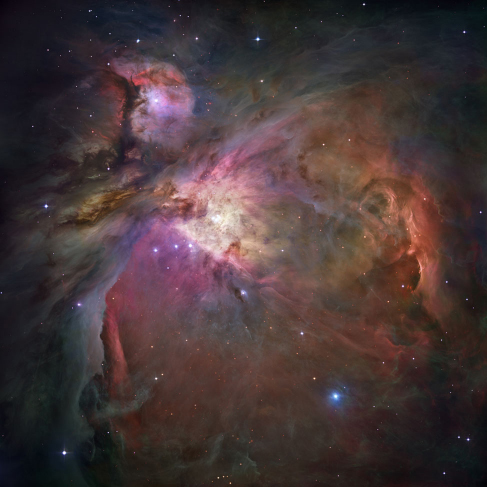
那么,一光年里有多少公里呢? 光以每秒\(3 × 10^5\)千米(km/s)的惊人速度传播,相当于光年\(9.46 × 10^{12}\)千米。 你可能会认为这么大的单位很容易到达最近的恒星,但是恒星的距离远远超出了我们的想象。 即使是最近的恒星也有 4.3 光年的距离,超过 40 万亿千米。 肉眼可见的其他恒星距离数百至数千光年(图\(\PageIndex{1}\))。
示例\(\PageIndex{1}\):科学记数法
2015年,我们星球上最富有的人的净资产为792亿美元。 有人可能会说这是一笔天文数字。 用科学记数法表示这个金额。
解决方案
792亿美元可以写入792亿美元。 用科学记数法表示它变成\(\$7.92 × 10^{10}\)。
示例\(\PageIndex{2}\):熟悉光年
一光年里有多少公里?
解决方案
光线\(3 \times 10^5 \text{ km}\)进来\(1\text{ s}\)。 那么,让我们来计算一年的发展方向:
- 里面有\(1\text{ min}\),\(60 (6 \times 10^1)\text{ s}\)里面\(6 \times 10^1 \text{ min}\)有\(1\text{ h}\)。
- 将它们乘在一起,你会发现有\(3.6 \times 10^3\text{ s/h}\)。
- 因此,灯光遮住\(3 \times 10^5\text{ km/s } \times 3.6 \times 103\text{ s/h } = 1.08 \times 109 \text{ km/h}\)了。
- 有 24 个或者\(2.4 \times 10^1 \text{ h}\)一天之内,然后\(365.25 (3.65 \times 10^2)\text{ days}\)在\(1\text{ y}\)。
- 这两个数字的乘积是\(8.77 \times 10^3\text{ h/y}\)。
- 将其乘以得\(1.08 \times 10^9\text{ km/h}\)出\(9.46 \times 10^{12}\text{ km/light-year}\)。
这相当于灯光在一年内覆盖了将近一万亿千米。 为了帮助你想象这个距离有多长,我们要提一下 1 光年长的绳子可以绕地球周长 2.36 亿次。