

1.3: 法律的来源和类型
- Page ID
- 199553

\( \newcommand{\vecs}[1]{\overset { \scriptstyle \rightharpoonup} {\mathbf{#1}} } \)
\( \newcommand{\vecd}[1]{\overset{-\!-\!\rightharpoonup}{\vphantom{a}\smash {#1}}} \)
\( \newcommand{\dsum}{\displaystyle\sum\limits} \)
\( \newcommand{\dint}{\displaystyle\int\limits} \)
\( \newcommand{\dlim}{\displaystyle\lim\limits} \)
\( \newcommand{\id}{\mathrm{id}}\) \( \newcommand{\Span}{\mathrm{span}}\)
( \newcommand{\kernel}{\mathrm{null}\,}\) \( \newcommand{\range}{\mathrm{range}\,}\)
\( \newcommand{\RealPart}{\mathrm{Re}}\) \( \newcommand{\ImaginaryPart}{\mathrm{Im}}\)
\( \newcommand{\Argument}{\mathrm{Arg}}\) \( \newcommand{\norm}[1]{\| #1 \|}\)
\( \newcommand{\inner}[2]{\langle #1, #2 \rangle}\)
\( \newcommand{\Span}{\mathrm{span}}\)
\( \newcommand{\id}{\mathrm{id}}\)
\( \newcommand{\Span}{\mathrm{span}}\)
\( \newcommand{\kernel}{\mathrm{null}\,}\)
\( \newcommand{\range}{\mathrm{range}\,}\)
\( \newcommand{\RealPart}{\mathrm{Re}}\)
\( \newcommand{\ImaginaryPart}{\mathrm{Im}}\)
\( \newcommand{\Argument}{\mathrm{Arg}}\)
\( \newcommand{\norm}[1]{\| #1 \|}\)
\( \newcommand{\inner}[2]{\langle #1, #2 \rangle}\)
\( \newcommand{\Span}{\mathrm{span}}\) \( \newcommand{\AA}{\unicode[.8,0]{x212B}}\)
\( \newcommand{\vectorA}[1]{\vec{#1}} % arrow\)
\( \newcommand{\vectorAt}[1]{\vec{\text{#1}}} % arrow\)
\( \newcommand{\vectorB}[1]{\overset { \scriptstyle \rightharpoonup} {\mathbf{#1}} } \)
\( \newcommand{\vectorC}[1]{\textbf{#1}} \)
\( \newcommand{\vectorD}[1]{\overrightarrow{#1}} \)
\( \newcommand{\vectorDt}[1]{\overrightarrow{\text{#1}}} \)
\( \newcommand{\vectE}[1]{\overset{-\!-\!\rightharpoonup}{\vphantom{a}\smash{\mathbf {#1}}}} \)
\( \newcommand{\vecs}[1]{\overset { \scriptstyle \rightharpoonup} {\mathbf{#1}} } \)
\(\newcommand{\longvect}{\overrightarrow}\)
\( \newcommand{\vecd}[1]{\overset{-\!-\!\rightharpoonup}{\vphantom{a}\smash {#1}}} \)
\(\newcommand{\avec}{\mathbf a}\) \(\newcommand{\bvec}{\mathbf b}\) \(\newcommand{\cvec}{\mathbf c}\) \(\newcommand{\dvec}{\mathbf d}\) \(\newcommand{\dtil}{\widetilde{\mathbf d}}\) \(\newcommand{\evec}{\mathbf e}\) \(\newcommand{\fvec}{\mathbf f}\) \(\newcommand{\nvec}{\mathbf n}\) \(\newcommand{\pvec}{\mathbf p}\) \(\newcommand{\qvec}{\mathbf q}\) \(\newcommand{\svec}{\mathbf s}\) \(\newcommand{\tvec}{\mathbf t}\) \(\newcommand{\uvec}{\mathbf u}\) \(\newcommand{\vvec}{\mathbf v}\) \(\newcommand{\wvec}{\mathbf w}\) \(\newcommand{\xvec}{\mathbf x}\) \(\newcommand{\yvec}{\mathbf y}\) \(\newcommand{\zvec}{\mathbf z}\) \(\newcommand{\rvec}{\mathbf r}\) \(\newcommand{\mvec}{\mathbf m}\) \(\newcommand{\zerovec}{\mathbf 0}\) \(\newcommand{\onevec}{\mathbf 1}\) \(\newcommand{\real}{\mathbb R}\) \(\newcommand{\twovec}[2]{\left[\begin{array}{r}#1 \\ #2 \end{array}\right]}\) \(\newcommand{\ctwovec}[2]{\left[\begin{array}{c}#1 \\ #2 \end{array}\right]}\) \(\newcommand{\threevec}[3]{\left[\begin{array}{r}#1 \\ #2 \\ #3 \end{array}\right]}\) \(\newcommand{\cthreevec}[3]{\left[\begin{array}{c}#1 \\ #2 \\ #3 \end{array}\right]}\) \(\newcommand{\fourvec}[4]{\left[\begin{array}{r}#1 \\ #2 \\ #3 \\ #4 \end{array}\right]}\) \(\newcommand{\cfourvec}[4]{\left[\begin{array}{c}#1 \\ #2 \\ #3 \\ #4 \end{array}\right]}\) \(\newcommand{\fivevec}[5]{\left[\begin{array}{r}#1 \\ #2 \\ #3 \\ #4 \\ #5 \\ \end{array}\right]}\) \(\newcommand{\cfivevec}[5]{\left[\begin{array}{c}#1 \\ #2 \\ #3 \\ #4 \\ #5 \\ \end{array}\right]}\) \(\newcommand{\mattwo}[4]{\left[\begin{array}{rr}#1 \amp #2 \\ #3 \amp #4 \\ \end{array}\right]}\) \(\newcommand{\laspan}[1]{\text{Span}\{#1\}}\) \(\newcommand{\bcal}{\cal B}\) \(\newcommand{\ccal}{\cal C}\) \(\newcommand{\scal}{\cal S}\) \(\newcommand{\wcal}{\cal W}\) \(\newcommand{\ecal}{\cal E}\) \(\newcommand{\coords}[2]{\left\{#1\right\}_{#2}}\) \(\newcommand{\gray}[1]{\color{gray}{#1}}\) \(\newcommand{\lgray}[1]{\color{lightgray}{#1}}\) \(\newcommand{\rank}{\operatorname{rank}}\) \(\newcommand{\row}{\text{Row}}\) \(\newcommand{\col}{\text{Col}}\) \(\renewcommand{\row}{\text{Row}}\) \(\newcommand{\nul}{\text{Nul}}\) \(\newcommand{\var}{\text{Var}}\) \(\newcommand{\corr}{\text{corr}}\) \(\newcommand{\len}[1]{\left|#1\right|}\) \(\newcommand{\bbar}{\overline{\bvec}}\) \(\newcommand{\bhat}{\widehat{\bvec}}\) \(\newcommand{\bperp}{\bvec^\perp}\) \(\newcommand{\xhat}{\widehat{\xvec}}\) \(\newcommand{\vhat}{\widehat{\vvec}}\) \(\newcommand{\uhat}{\widehat{\uvec}}\) \(\newcommand{\what}{\widehat{\wvec}}\) \(\newcommand{\Sighat}{\widehat{\Sigma}}\) \(\newcommand{\lt}{<}\) \(\newcommand{\gt}{>}\) \(\newcommand{\amp}{&}\) \(\definecolor{fillinmathshade}{gray}{0.9}\)美国法律体系由许多类型的编纂形式的法律组成,其中美国宪法是美国法律的主要来源。 《宪法》规定了联邦法律的界限,所有公民、组织和实体都必须遵守该边界。 它包括国会法案、参议院批准的条约、行政法规和联邦判例法。 《美国法典》(“USC”)汇编了这些法律。
美国法律主要源自宪法、成文法、条约、行政法规和普通法(包括判例法)。
《宪法》
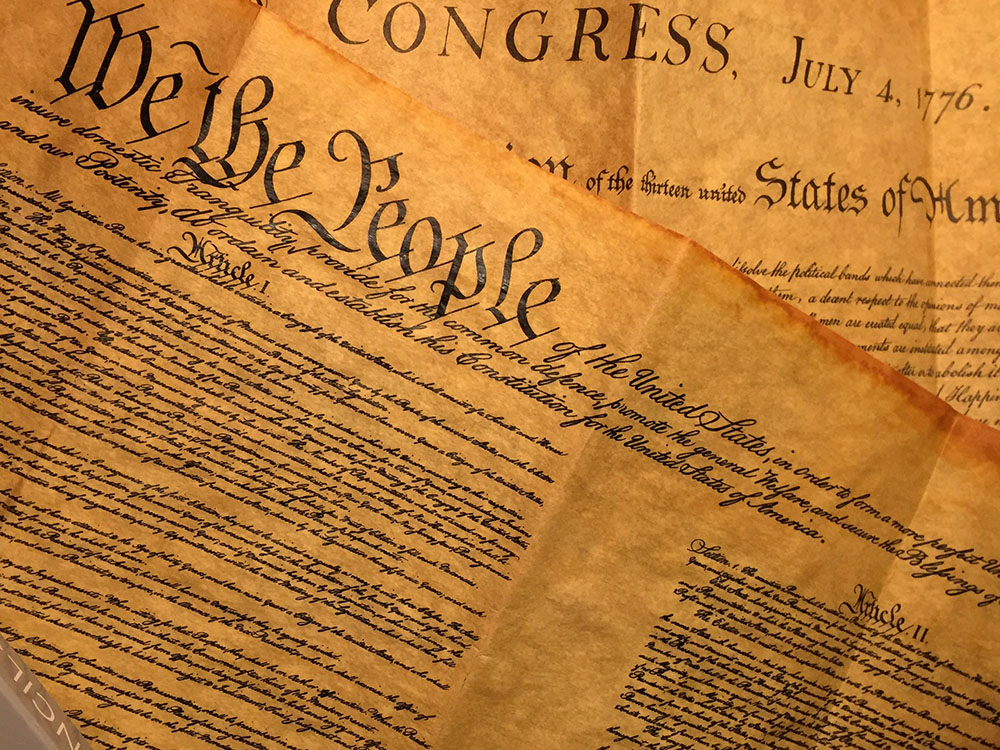
美国宪法是美国最重要的法律。 《宪法》的前十项修正案被称为《人权法案》,它为个人自由和正义提供了具体的保护。 此外,《人权法案》限制了政府的某些权力。 《宪法》赋予国会为某些有限目的(例如监管州际商业)颁布法规的权力,从而授权联邦制定法律。 《美国法典》正式汇编和编纂了联邦法规。
美国普通法
如上一节所述,美国遵循英国法的普通法法律传统。 普通法体系中的法官通过其裁决和解释帮助制定法律。 这套过去的裁决被称为判例法,法官用它来为自己的裁决提供依据。 实际上,法官在对自己的案件作出裁决时依赖先例,即法院先前对类似案件的裁决。
判例法如何运作的一个例子是州诉Wayfair Inc. 案(2017 SD 56,901 n.w.2d 754(S.D. 2017),已授予证书,138 S. Ct. 735(2018)),在该案中,南达科他州最高法院裁定,要求没有州内实体存在的互联网零售商缴纳销售税的州法律是违宪。 除非该裁决被美国最高法院否决,否则它将成为该州判例法和先例的一部分,在提起类似案件时,随后将作出裁决。
联邦法
《宪法》赋予国会为某些有限目的(例如监管州际商业)颁布法规的权力,从而授权联邦制定法律。 联邦法律优先于相互冲突的州和地方法律。 但是,联邦先发制人并非没有限制,因为每个州都有自己的宪法并被视为主权国家。 因此,联邦法律只有在《宪法》列举和授予国会的有限权力范围内颁布,才能优先于州法律。
对《宪法》商业和支出条款的广泛解释将联邦法律的适用范围扩展到了许多领域。 事实上,它在某些领域(例如航空和铁路)的影响范围如此之广,以至于它几乎凌驾于所有州法律之上。 在其他领域,例如家庭法,立法仍然留给各州去做。 最后,许多强大的联邦和州法律在反垄断、商标、就业法等领域共存。
法规
当一项法案成为联邦法律时,它会被分配一个法律编号,并准备由国家档案和档案管理局(NARA)的联邦公报办公室(OFR)公布。 OFR 还对公法进行了法律法定引证,并将其纳入《美国法典》(USC)。
法规
法律与法规的不同之处在于,法律是由美国国会或州议会通过的。 相比之下,法规是行政机构通过的规范法律执行方式的标准和规则。
当国会采取行动授予联邦机构这种权力时,联邦机构通常享有广泛的规则制定权力。 这些被称为 “法规” 的机构规则通常具有法律效力,只要它们能证明对相关法规的合理解释。 例如,环境保护署(EPA)为企业及其污染物的排放和处置制定了法规,以保护环境。 当企业违反这些法规时,EPA有权执行这些法规,而这种执法通常是通过对公司处以罚款或使用其他手段来执行的。
《行政程序法》(APA)允许通过法规,这些法规已编纂并纳入《联邦法规法典》(CFR)。 联邦机构经常起草和分发表格、手册、政策声明、信函和裁决。 尽管这些可能被法院视为有说服力的权威,但它们的效力与法律不同。 换句话说,如果个人或企业质疑政府机构的法规,称该监管违宪,而该方成功地证明了这一点,那么该法规就不会得到执行,该机构将需要对其进行修改或取消。
州法
美国与五十个州一样多元化,也受五十个不同的州宪法、州政府和州法院的管辖。 每个国家都有自己的立法、行政和司法部门。 各州有权制定与联邦《宪法》和联邦法律未优先处理的事项有关的立法。 大多数案件涉及州法律问题,并在州法院提起诉讼。
当地法律
除联邦和州法律外,直辖市、城镇或城市和县也可以制定自己的法律,这些法律与州或联邦法律不冲突。
如上所述,美国法律并不仅仅来自一个来源;相反,它来自多个来源。