

4.2: 数据示例
- Page ID
- 172484

\( \newcommand{\vecs}[1]{\overset { \scriptstyle \rightharpoonup} {\mathbf{#1}} } \)
\( \newcommand{\vecd}[1]{\overset{-\!-\!\rightharpoonup}{\vphantom{a}\smash {#1}}} \)
\( \newcommand{\dsum}{\displaystyle\sum\limits} \)
\( \newcommand{\dint}{\displaystyle\int\limits} \)
\( \newcommand{\dlim}{\displaystyle\lim\limits} \)
\( \newcommand{\id}{\mathrm{id}}\) \( \newcommand{\Span}{\mathrm{span}}\)
( \newcommand{\kernel}{\mathrm{null}\,}\) \( \newcommand{\range}{\mathrm{range}\,}\)
\( \newcommand{\RealPart}{\mathrm{Re}}\) \( \newcommand{\ImaginaryPart}{\mathrm{Im}}\)
\( \newcommand{\Argument}{\mathrm{Arg}}\) \( \newcommand{\norm}[1]{\| #1 \|}\)
\( \newcommand{\inner}[2]{\langle #1, #2 \rangle}\)
\( \newcommand{\Span}{\mathrm{span}}\)
\( \newcommand{\id}{\mathrm{id}}\)
\( \newcommand{\Span}{\mathrm{span}}\)
\( \newcommand{\kernel}{\mathrm{null}\,}\)
\( \newcommand{\range}{\mathrm{range}\,}\)
\( \newcommand{\RealPart}{\mathrm{Re}}\)
\( \newcommand{\ImaginaryPart}{\mathrm{Im}}\)
\( \newcommand{\Argument}{\mathrm{Arg}}\)
\( \newcommand{\norm}[1]{\| #1 \|}\)
\( \newcommand{\inner}[2]{\langle #1, #2 \rangle}\)
\( \newcommand{\Span}{\mathrm{span}}\) \( \newcommand{\AA}{\unicode[.8,0]{x212B}}\)
\( \newcommand{\vectorA}[1]{\vec{#1}} % arrow\)
\( \newcommand{\vectorAt}[1]{\vec{\text{#1}}} % arrow\)
\( \newcommand{\vectorB}[1]{\overset { \scriptstyle \rightharpoonup} {\mathbf{#1}} } \)
\( \newcommand{\vectorC}[1]{\textbf{#1}} \)
\( \newcommand{\vectorD}[1]{\overrightarrow{#1}} \)
\( \newcommand{\vectorDt}[1]{\overrightarrow{\text{#1}}} \)
\( \newcommand{\vectE}[1]{\overset{-\!-\!\rightharpoonup}{\vphantom{a}\smash{\mathbf {#1}}}} \)
\( \newcommand{\vecs}[1]{\overset { \scriptstyle \rightharpoonup} {\mathbf{#1}} } \)
\(\newcommand{\longvect}{\overrightarrow}\)
\( \newcommand{\vecd}[1]{\overset{-\!-\!\rightharpoonup}{\vphantom{a}\smash {#1}}} \)
\(\newcommand{\avec}{\mathbf a}\) \(\newcommand{\bvec}{\mathbf b}\) \(\newcommand{\cvec}{\mathbf c}\) \(\newcommand{\dvec}{\mathbf d}\) \(\newcommand{\dtil}{\widetilde{\mathbf d}}\) \(\newcommand{\evec}{\mathbf e}\) \(\newcommand{\fvec}{\mathbf f}\) \(\newcommand{\nvec}{\mathbf n}\) \(\newcommand{\pvec}{\mathbf p}\) \(\newcommand{\qvec}{\mathbf q}\) \(\newcommand{\svec}{\mathbf s}\) \(\newcommand{\tvec}{\mathbf t}\) \(\newcommand{\uvec}{\mathbf u}\) \(\newcommand{\vvec}{\mathbf v}\) \(\newcommand{\wvec}{\mathbf w}\) \(\newcommand{\xvec}{\mathbf x}\) \(\newcommand{\yvec}{\mathbf y}\) \(\newcommand{\zvec}{\mathbf z}\) \(\newcommand{\rvec}{\mathbf r}\) \(\newcommand{\mvec}{\mathbf m}\) \(\newcommand{\zerovec}{\mathbf 0}\) \(\newcommand{\onevec}{\mathbf 1}\) \(\newcommand{\real}{\mathbb R}\) \(\newcommand{\twovec}[2]{\left[\begin{array}{r}#1 \\ #2 \end{array}\right]}\) \(\newcommand{\ctwovec}[2]{\left[\begin{array}{c}#1 \\ #2 \end{array}\right]}\) \(\newcommand{\threevec}[3]{\left[\begin{array}{r}#1 \\ #2 \\ #3 \end{array}\right]}\) \(\newcommand{\cthreevec}[3]{\left[\begin{array}{c}#1 \\ #2 \\ #3 \end{array}\right]}\) \(\newcommand{\fourvec}[4]{\left[\begin{array}{r}#1 \\ #2 \\ #3 \\ #4 \end{array}\right]}\) \(\newcommand{\cfourvec}[4]{\left[\begin{array}{c}#1 \\ #2 \\ #3 \\ #4 \end{array}\right]}\) \(\newcommand{\fivevec}[5]{\left[\begin{array}{r}#1 \\ #2 \\ #3 \\ #4 \\ #5 \\ \end{array}\right]}\) \(\newcommand{\cfivevec}[5]{\left[\begin{array}{c}#1 \\ #2 \\ #3 \\ #4 \\ #5 \\ \end{array}\right]}\) \(\newcommand{\mattwo}[4]{\left[\begin{array}{rr}#1 \amp #2 \\ #3 \amp #4 \\ \end{array}\right]}\) \(\newcommand{\laspan}[1]{\text{Span}\{#1\}}\) \(\newcommand{\bcal}{\cal B}\) \(\newcommand{\ccal}{\cal C}\) \(\newcommand{\scal}{\cal S}\) \(\newcommand{\wcal}{\cal W}\) \(\newcommand{\ecal}{\cal E}\) \(\newcommand{\coords}[2]{\left\{#1\right\}_{#2}}\) \(\newcommand{\gray}[1]{\color{gray}{#1}}\) \(\newcommand{\lgray}[1]{\color{lightgray}{#1}}\) \(\newcommand{\rank}{\operatorname{rank}}\) \(\newcommand{\row}{\text{Row}}\) \(\newcommand{\col}{\text{Col}}\) \(\renewcommand{\row}{\text{Row}}\) \(\newcommand{\nul}{\text{Nul}}\) \(\newcommand{\var}{\text{Var}}\) \(\newcommand{\corr}{\text{corr}}\) \(\newcommand{\len}[1]{\left|#1\right|}\) \(\newcommand{\bbar}{\overline{\bvec}}\) \(\newcommand{\bhat}{\widehat{\bvec}}\) \(\newcommand{\bperp}{\bvec^\perp}\) \(\newcommand{\xhat}{\widehat{\xvec}}\) \(\newcommand{\vhat}{\widehat{\vvec}}\) \(\newcommand{\uhat}{\widehat{\uvec}}\) \(\newcommand{\what}{\widehat{\wvec}}\) \(\newcommand{\Sighat}{\widehat{\Sigma}}\) \(\newcommand{\lt}{<}\) \(\newcommand{\gt}{>}\) \(\newcommand{\amp}{&}\) \(\definecolor{fillinmathshade}{gray}{0.9}\)数据可以是任何东西。 数据的一些示例包括重量、价格、成本、售出物品的数量、名称、地点。 几乎所有的软件程序都需要数据才能做一些有用的事情。 它可以很简单,可以是地点、人物或数字的名称。 例如,在诸如Microsoft Word之类的文字处理器中编辑文档,您正在处理的文档就是数据。 文字处理软件可以处理数据:创建新文档、复制文档或修改文档。 今天,我们有了一种叫做生物识别的新型数据,它是人类的身体或行为特征,可以以数字方式识别一个人。 例如用于护照的面部识别。 指纹认证用于解锁智能手机。 虹膜识别使用虹膜的高分辨率图像。 存储这些数据以备将来识别。 许多政府和高度安全的公司都使用虹膜识别,因为虹膜识别在识别个人时被认为是无误的。
数据库
许多信息系统旨在将数据转化为信息,以生成可用于决策的知识。 为此,系统必须获取或读取数据,然后将数据置于上下文中,并提供用于聚合和分析的工具。 数据库就是为此目的而设计的。
数据库是有组织的、有意义的相关信息集合。 它是一个有组织的集合,因为在数据库中,所有数据都是相互关联的,并且与其他数据相关联。 数据库中的所有信息都应相互关联;应创建单独的数据库来管理不相关的信息。 例如,包含员工工资信息的数据库不应同时保存有关公司股价的信息。 数字数据库包括由 MS Excel 创建的内容,例如人们每天使用的更复杂数据库的表格,从银行查看余额到访问病历和在线购物。 数据库帮助我们消除冗余信息。 它确保了访问搜索的更有效方式。 过去,数据库我们将成为文件柜。 在本文中,我们将只考虑数字数据库。
关系数据库
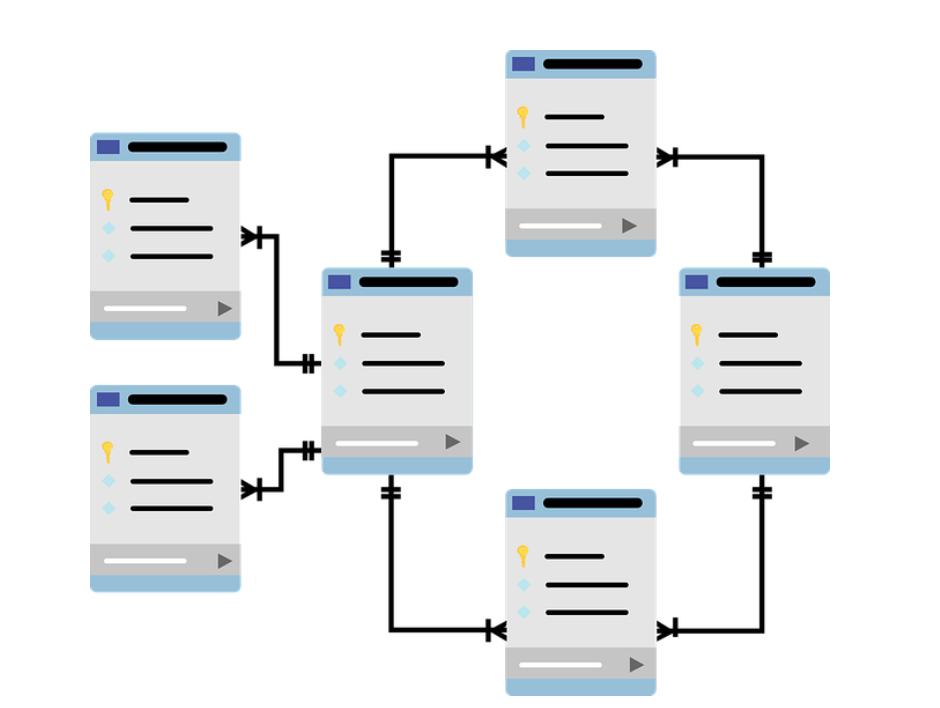
数据库可以用许多不同的方式进行组织,因此可以采取多种形式。 DBMS(数据库管理系统)是一种便于组织和操作数据的软件。 DBMS 充当数据库和最终用户之间的接口。 该软件旨在存储、定义、检索和管理数据库中的数据。 当今其他形式的数据库是关系数据库。 关系数据库的例子有 Oracle (RDBMS)、MySQL、SQL 和 PostgreSQL。 关系数据库是以行和列的有组织方式存储数据的数据库,它将创建一个或多个相关信息表。 每个表都有一组字段,这些字段定义了表中存储的数据的性质。 记录是表中一组字段的一个实例。 要将其可视化,可以考虑一个 excel 电子表格,将记录视为表中的行,将字段视为表列。 在下面的示例中,我们有一个学生信息表,其中每行代表一个学生,每列代表关于该学生的一条信息。 关系数据库模型不能很好地扩展。 这里的 “规模” 一词是指分布在通过网络连接的越来越多的计算机上的越来越大的数据库。 一些公司希望通过从关系模型转向其他更灵活的模型来提供大规模数据库解决方案。 例如,谷歌现在提供基于 NoSQL 的 App Engine Datastore。 开发人员可以使用 App Engine Datastore 开发可从世界任何地方访问数据的应用程序。 亚马逊提供多种数据库服务供企业使用,包括关系数据库服务 Amazon RDS 和 NoSQL 企业解决方案 Amazon DynamoDB。
关系数据库示例
|
字段(列) |
||||
|
记录(行) |
名字 |
姓氏 |
少校 |
出生日期 |
|
安玛丽 |
强 |
法律预科 |
1997 年 2 月 27 日 |
|
|
埃文 |
对 |
商业 |
1996 年 4 月 12 日 |
|
|
米歇尔 |
史密斯 |
数学 |
6/27/1995 |
|