

44.1: היקף האקולוגיה
- Page ID
- 206369

\( \newcommand{\vecs}[1]{\overset { \scriptstyle \rightharpoonup} {\mathbf{#1}} } \)
\( \newcommand{\vecd}[1]{\overset{-\!-\!\rightharpoonup}{\vphantom{a}\smash {#1}}} \)
\( \newcommand{\dsum}{\displaystyle\sum\limits} \)
\( \newcommand{\dint}{\displaystyle\int\limits} \)
\( \newcommand{\dlim}{\displaystyle\lim\limits} \)
\( \newcommand{\id}{\mathrm{id}}\) \( \newcommand{\Span}{\mathrm{span}}\)
( \newcommand{\kernel}{\mathrm{null}\,}\) \( \newcommand{\range}{\mathrm{range}\,}\)
\( \newcommand{\RealPart}{\mathrm{Re}}\) \( \newcommand{\ImaginaryPart}{\mathrm{Im}}\)
\( \newcommand{\Argument}{\mathrm{Arg}}\) \( \newcommand{\norm}[1]{\| #1 \|}\)
\( \newcommand{\inner}[2]{\langle #1, #2 \rangle}\)
\( \newcommand{\Span}{\mathrm{span}}\)
\( \newcommand{\id}{\mathrm{id}}\)
\( \newcommand{\Span}{\mathrm{span}}\)
\( \newcommand{\kernel}{\mathrm{null}\,}\)
\( \newcommand{\range}{\mathrm{range}\,}\)
\( \newcommand{\RealPart}{\mathrm{Re}}\)
\( \newcommand{\ImaginaryPart}{\mathrm{Im}}\)
\( \newcommand{\Argument}{\mathrm{Arg}}\)
\( \newcommand{\norm}[1]{\| #1 \|}\)
\( \newcommand{\inner}[2]{\langle #1, #2 \rangle}\)
\( \newcommand{\Span}{\mathrm{span}}\) \( \newcommand{\AA}{\unicode[.8,0]{x212B}}\)
\( \newcommand{\vectorA}[1]{\vec{#1}} % arrow\)
\( \newcommand{\vectorAt}[1]{\vec{\text{#1}}} % arrow\)
\( \newcommand{\vectorB}[1]{\overset { \scriptstyle \rightharpoonup} {\mathbf{#1}} } \)
\( \newcommand{\vectorC}[1]{\textbf{#1}} \)
\( \newcommand{\vectorD}[1]{\overrightarrow{#1}} \)
\( \newcommand{\vectorDt}[1]{\overrightarrow{\text{#1}}} \)
\( \newcommand{\vectE}[1]{\overset{-\!-\!\rightharpoonup}{\vphantom{a}\smash{\mathbf {#1}}}} \)
\( \newcommand{\vecs}[1]{\overset { \scriptstyle \rightharpoonup} {\mathbf{#1}} } \)
\(\newcommand{\longvect}{\overrightarrow}\)
\( \newcommand{\vecd}[1]{\overset{-\!-\!\rightharpoonup}{\vphantom{a}\smash {#1}}} \)
\(\newcommand{\avec}{\mathbf a}\) \(\newcommand{\bvec}{\mathbf b}\) \(\newcommand{\cvec}{\mathbf c}\) \(\newcommand{\dvec}{\mathbf d}\) \(\newcommand{\dtil}{\widetilde{\mathbf d}}\) \(\newcommand{\evec}{\mathbf e}\) \(\newcommand{\fvec}{\mathbf f}\) \(\newcommand{\nvec}{\mathbf n}\) \(\newcommand{\pvec}{\mathbf p}\) \(\newcommand{\qvec}{\mathbf q}\) \(\newcommand{\svec}{\mathbf s}\) \(\newcommand{\tvec}{\mathbf t}\) \(\newcommand{\uvec}{\mathbf u}\) \(\newcommand{\vvec}{\mathbf v}\) \(\newcommand{\wvec}{\mathbf w}\) \(\newcommand{\xvec}{\mathbf x}\) \(\newcommand{\yvec}{\mathbf y}\) \(\newcommand{\zvec}{\mathbf z}\) \(\newcommand{\rvec}{\mathbf r}\) \(\newcommand{\mvec}{\mathbf m}\) \(\newcommand{\zerovec}{\mathbf 0}\) \(\newcommand{\onevec}{\mathbf 1}\) \(\newcommand{\real}{\mathbb R}\) \(\newcommand{\twovec}[2]{\left[\begin{array}{r}#1 \\ #2 \end{array}\right]}\) \(\newcommand{\ctwovec}[2]{\left[\begin{array}{c}#1 \\ #2 \end{array}\right]}\) \(\newcommand{\threevec}[3]{\left[\begin{array}{r}#1 \\ #2 \\ #3 \end{array}\right]}\) \(\newcommand{\cthreevec}[3]{\left[\begin{array}{c}#1 \\ #2 \\ #3 \end{array}\right]}\) \(\newcommand{\fourvec}[4]{\left[\begin{array}{r}#1 \\ #2 \\ #3 \\ #4 \end{array}\right]}\) \(\newcommand{\cfourvec}[4]{\left[\begin{array}{c}#1 \\ #2 \\ #3 \\ #4 \end{array}\right]}\) \(\newcommand{\fivevec}[5]{\left[\begin{array}{r}#1 \\ #2 \\ #3 \\ #4 \\ #5 \\ \end{array}\right]}\) \(\newcommand{\cfivevec}[5]{\left[\begin{array}{c}#1 \\ #2 \\ #3 \\ #4 \\ #5 \\ \end{array}\right]}\) \(\newcommand{\mattwo}[4]{\left[\begin{array}{rr}#1 \amp #2 \\ #3 \amp #4 \\ \end{array}\right]}\) \(\newcommand{\laspan}[1]{\text{Span}\{#1\}}\) \(\newcommand{\bcal}{\cal B}\) \(\newcommand{\ccal}{\cal C}\) \(\newcommand{\scal}{\cal S}\) \(\newcommand{\wcal}{\cal W}\) \(\newcommand{\ecal}{\cal E}\) \(\newcommand{\coords}[2]{\left\{#1\right\}_{#2}}\) \(\newcommand{\gray}[1]{\color{gray}{#1}}\) \(\newcommand{\lgray}[1]{\color{lightgray}{#1}}\) \(\newcommand{\rank}{\operatorname{rank}}\) \(\newcommand{\row}{\text{Row}}\) \(\newcommand{\col}{\text{Col}}\) \(\renewcommand{\row}{\text{Row}}\) \(\newcommand{\nul}{\text{Nul}}\) \(\newcommand{\var}{\text{Var}}\) \(\newcommand{\corr}{\text{corr}}\) \(\newcommand{\len}[1]{\left|#1\right|}\) \(\newcommand{\bbar}{\overline{\bvec}}\) \(\newcommand{\bhat}{\widehat{\bvec}}\) \(\newcommand{\bperp}{\bvec^\perp}\) \(\newcommand{\xhat}{\widehat{\xvec}}\) \(\newcommand{\vhat}{\widehat{\vvec}}\) \(\newcommand{\uhat}{\widehat{\uvec}}\) \(\newcommand{\what}{\widehat{\wvec}}\) \(\newcommand{\Sighat}{\widehat{\Sigma}}\) \(\newcommand{\lt}{<}\) \(\newcommand{\gt}{>}\) \(\newcommand{\amp}{&}\) \(\definecolor{fillinmathshade}{gray}{0.9}\)מיומנויות לפיתוח
- הגדירו אקולוגיה וארבע רמות המחקר האקולוגי
- תאר דוגמאות לדרכים שבהן אקולוגיה דורשת שילוב של דיסציפלינות מדעיות שונות
- להבחין בין מרכיבים אביוטיים וביוטיים של הסביבה
- הכירו את הקשר בין מרכיבים אביוטיים וביוטיים של הסביבה
אקולוגיה היא חקר האינטראקציות של אורגניזמים חיים עם סביבתם. מטרת ליבה אחת של האקולוגיה היא להבין את התפוצה והשפע של יצורים חיים בסביבה הפיזית. השגת מטרה זו מחייבת שילוב של דיסציפלינות מדעיות בתוך ומחוץ לביולוגיה, כגון ביוכימיה, פיזיולוגיה, אבולוציה, מגוון ביולוגי, ביולוגיה מולקולרית, גיאולוגיה ואקלימטולוגיה. מחקר אקולוגי מסוים מיישם גם היבטים של כימיה ופיזיקה, והוא משתמש לעתים קרובות במודלים מתמטיים.
קישור ללמידה

שינויי אקלים יכולים לשנות את מקום החיים של אורגניזמים, שלעתים יכולים להשפיע ישירות על בריאות האדם. צפו בסרטון ה- PBS "מרגיש את ההשפעות של שינויי אקלים" בו חוקרים מגלים אורגניזם פתוגני החי הרחק מחוץ לטווח הרגיל שלו.
רמות לימוד אקולוגי
כאשר נלמדת דיסציפלינה כמו ביולוגיה, לעתים קרובות מועיל לחלק אותה לתחומים קטנים יותר וקשורים. לדוגמה, ביולוגים של תאים המעוניינים באיתות תאים צריכים להבין את הכימיה של מולקולות האות (שהן בדרך כלל חלבונים) וכן את התוצאה של איתות תאים. אקולוגים המעוניינים בגורמים המשפיעים על הישרדותו של מין בסכנת הכחדה עשויים להשתמש במודלים מתמטיים כדי לחזות כיצד מאמצי השימור הנוכחיים משפיעים על אורגניזמים בסכנת הכחדה. כדי לייצר קבוצה נכונה של אפשרויות ניהול, ביולוג שימור צריך לאסוף נתונים מדויקים, כולל גודל האוכלוסייה הנוכחי, גורמים המשפיעים על רבייה (כמו פיזיולוגיה והתנהגות), דרישות בית גידול (כגון צמחים וקרקעות) והשפעות אנושיות אפשריות על בסכנת הכחדה. אוכלוסייה ובית הגידול שלה (שעשוי להיגזר באמצעות מחקרים בסוציולוגיה ואקולוגיה עירונית). בתוך תחום האקולוגיה, חוקרים עובדים בארבע רמות ספציפיות, לפעמים בדיסקרטיות ולפעמים בחפיפה: אורגניזם, אוכלוסייה, קהילה ומערכת אקולוגית (איור \(\PageIndex{1}\)).

Organismal Ecology
Researchers studying ecology at the organismal level are interested in the adaptations that enable individuals to live in specific habitats. These adaptations can be morphological, physiological, and behavioral. For instance, the Karner blue butterfly (Lycaeides melissa samuelis) (Figure \(\PageIndex{2}\)) is considered a specialist because the females preferentially oviposit (that is, lay eggs) on wild lupine. This preferential adaptation means that the Karner blue butterfly is highly dependent on the presence of wild lupine plants for its continued survival.

After hatching, the larval caterpillars emerge and spend four to six weeks feeding solely on wild lupine (Figure \(\PageIndex{3}\)). The caterpillars pupate (undergo metamorphosis) and emerge as butterflies after about four weeks. The adult butterflies feed on the nectar of flowers of wild lupine and other plant species. A researcher interested in studying Karner blue butterflies at the organismal level might, in addition to asking questions about egg laying, ask questions about the butterflies’ preferred temperature (a physiological question) or the behavior of the caterpillars when they are at different larval stages (a behavioral question).

Population Ecology
A population is a group of interbreeding organisms that are members of the same species living in the same area at the same time. (Organisms that are all members of the same species are called conspecifics.) A population is identified, in part, by where it lives, and its area of population may have natural or artificial boundaries: natural boundaries might be rivers, mountains, or deserts, while examples of artificial boundaries include mowed grass, manmade structures, or roads. The study of population ecology focuses on the number of individuals in an area and how and why population size changes over time. Population ecologists are particularly interested in counting the Karner blue butterfly, for example, because it is classified as federally endangered. However, the distribution and density of this species is highly influenced by the distribution and abundance of wild lupine. Researchers might ask questions about the factors leading to the decline of wild lupine and how these affect Karner blue butterflies. For example, ecologists know that wild lupine thrives in open areas where trees and shrubs are largely absent. In natural settings, intermittent wildfires regularly remove trees and shrubs, helping to maintain the open areas that wild lupine requires. Mathematical models can be used to understand how wildfire suppression by humans has led to the decline of this important plant for the Karner blue butterfly.
Community Ecology
A biological community consists of the different species within an area, typically a three-dimensional space, and the interactions within and among these species. Community ecologists are interested in the processes driving these interactions and their consequences. Questions about conspecific interactions often focus on competition among members of the same species for a limited resource. Ecologists also study interactions among various species; members of different species are called heterospecifics. Examples of heterospecific interactions include predation, parasitism, herbivory, competition, and pollination. These interactions can have regulating effects on population sizes and can impact ecological and evolutionary processes affecting diversity.
For example, Karner blue butterfly larvae form mutualistic relationships with ants. Mutualism is a form of a long-term relationship that has coevolved between two species and from which each species benefits. For mutualism to exist between individual organisms, each species must receive some benefit from the other as a consequence of the relationship. Researchers have shown that there is an increase in the probability of survival when Karner blue butterfly larvae (caterpillars) are tended by ants. This might be because the larvae spend less time in each life stage when tended by ants, which provides an advantage for the larvae. Meanwhile, the Karner blue butterfly larvae secrete a carbohydrate-rich substance that is an important energy source for the ants. Both the Karner blue larvae and the ants benefit from their interaction.
Ecosystem Ecology
Ecosystem ecology is an extension of organismal, population, and community ecology. The ecosystem is composed of all the biotic components (living things) in an area along with the abiotic components (non-living things) of that area. Some of the abiotic components include air, water, and soil. Ecosystem biologists ask questions about how nutrients and energy are stored and how they move among organisms and the surrounding atmosphere, soil, and water.
The Karner blue butterflies and the wild lupine live in an oak-pine barren habitat. This habitat is characterized by natural disturbance and nutrient-poor soils that are low in nitrogen. The availability of nutrients is an important factor in the distribution of the plants that live in this habitat. Researchers interested in ecosystem ecology could ask questions about the importance of limited resources and the movement of resources, such as nutrients, though the biotic and abiotic portions of the ecosystem.
Career Connection: Ecologist
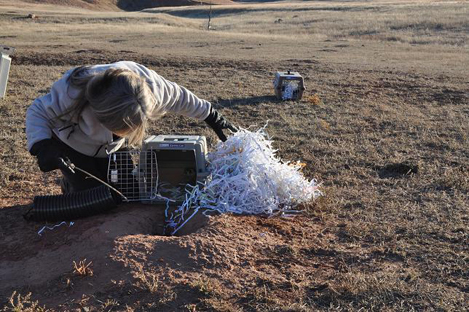
A career in ecology contributes to many facets of human society. Understanding ecological issues can help society meet the basic human needs of food, shelter, and health care. Ecologists can conduct their research in the laboratory and outside in natural environments (Figure \(\PageIndex{4}\)). These natural environments can be as close to home as the stream running through your campus or as far away as the hydrothermal vents at the bottom of the Pacific Ocean. Ecologists manage natural resources such as white-tailed deer populations (Odocoileus virginianus) for hunting or aspen (Populus spp.) timber stands for paper production. Ecologists also work as educators who teach children and adults at various institutions including universities, high schools, museums, and nature centers. Ecologists may also work in advisory positions assisting local, state, and federal policymakers to develop laws that are ecologically sound, or they may develop those policies and legislation themselves. To become an ecologist requires an undergraduate degree, usually in a natural science. The undergraduate degree is often followed by specialized training or an advanced degree, depending on the area of ecology selected. Ecologists should also have a broad background in the physical sciences, as well as a sound foundation in mathematics and statistics.
Link to Learning

בקר באתר זה כדי לראות את סטיבן ווינג, אקולוג ימי מאוניברסיטת אוטגו, דן בתפקידו של אקולוג ובסוגי הנושאים שאקולוגים חוקרים.
סיכום
אקולוגיה היא חקר האינטראקציות של יצורים חיים עם סביבתם. אקולוגים שואלים שאלות בארבע רמות של ארגון ביולוגי - אורגניזם, אוכלוסייה, קהילה ומערכת אקולוגית. ברמה האורגניזמית, אקולוגים חוקרים אורגניזמים בודדים וכיצד הם מתקשרים עם סביבתם. ברמת האוכלוסייה והקהילה, אקולוגים חוקרים, בהתאמה, כיצד אוכלוסיית אורגניזמים משתנה עם הזמן ואת הדרכים שבהן אוכלוסייה זו מתקשרת עם מינים אחרים בקהילה. אקולוגים החוקרים מערכת אקולוגית בוחנים את המינים החיים (המרכיבים הביוטיים) של המערכת האקולוגית וכן את החלקים הלא חיים (המרכיבים האביוטיים), כגון אוויר, מים ואדמה, של הסביבה.
רשימת מילים
- אביוטי
- רכיבים שאינם חיים של הסביבה
- ביוטי
- מרכיבים חיים של הסביבה
- בני מינו
- אנשים שהם בני אותו מין
- אקולוגיה
- לימוד האינטראקציה בין יצורים חיים לסביבתם
- הטרוספציפיים
- אנשים שהם בני מינים שונים