

9.2 : Relations entre les groupes
- Page ID
- 166832

\( \newcommand{\vecs}[1]{\overset { \scriptstyle \rightharpoonup} {\mathbf{#1}} } \)
\( \newcommand{\vecd}[1]{\overset{-\!-\!\rightharpoonup}{\vphantom{a}\smash {#1}}} \)
\( \newcommand{\dsum}{\displaystyle\sum\limits} \)
\( \newcommand{\dint}{\displaystyle\int\limits} \)
\( \newcommand{\dlim}{\displaystyle\lim\limits} \)
\( \newcommand{\id}{\mathrm{id}}\) \( \newcommand{\Span}{\mathrm{span}}\)
( \newcommand{\kernel}{\mathrm{null}\,}\) \( \newcommand{\range}{\mathrm{range}\,}\)
\( \newcommand{\RealPart}{\mathrm{Re}}\) \( \newcommand{\ImaginaryPart}{\mathrm{Im}}\)
\( \newcommand{\Argument}{\mathrm{Arg}}\) \( \newcommand{\norm}[1]{\| #1 \|}\)
\( \newcommand{\inner}[2]{\langle #1, #2 \rangle}\)
\( \newcommand{\Span}{\mathrm{span}}\)
\( \newcommand{\id}{\mathrm{id}}\)
\( \newcommand{\Span}{\mathrm{span}}\)
\( \newcommand{\kernel}{\mathrm{null}\,}\)
\( \newcommand{\range}{\mathrm{range}\,}\)
\( \newcommand{\RealPart}{\mathrm{Re}}\)
\( \newcommand{\ImaginaryPart}{\mathrm{Im}}\)
\( \newcommand{\Argument}{\mathrm{Arg}}\)
\( \newcommand{\norm}[1]{\| #1 \|}\)
\( \newcommand{\inner}[2]{\langle #1, #2 \rangle}\)
\( \newcommand{\Span}{\mathrm{span}}\) \( \newcommand{\AA}{\unicode[.8,0]{x212B}}\)
\( \newcommand{\vectorA}[1]{\vec{#1}} % arrow\)
\( \newcommand{\vectorAt}[1]{\vec{\text{#1}}} % arrow\)
\( \newcommand{\vectorB}[1]{\overset { \scriptstyle \rightharpoonup} {\mathbf{#1}} } \)
\( \newcommand{\vectorC}[1]{\textbf{#1}} \)
\( \newcommand{\vectorD}[1]{\overrightarrow{#1}} \)
\( \newcommand{\vectorDt}[1]{\overrightarrow{\text{#1}}} \)
\( \newcommand{\vectE}[1]{\overset{-\!-\!\rightharpoonup}{\vphantom{a}\smash{\mathbf {#1}}}} \)
\( \newcommand{\vecs}[1]{\overset { \scriptstyle \rightharpoonup} {\mathbf{#1}} } \)
\(\newcommand{\longvect}{\overrightarrow}\)
\( \newcommand{\vecd}[1]{\overset{-\!-\!\rightharpoonup}{\vphantom{a}\smash {#1}}} \)
\(\newcommand{\avec}{\mathbf a}\) \(\newcommand{\bvec}{\mathbf b}\) \(\newcommand{\cvec}{\mathbf c}\) \(\newcommand{\dvec}{\mathbf d}\) \(\newcommand{\dtil}{\widetilde{\mathbf d}}\) \(\newcommand{\evec}{\mathbf e}\) \(\newcommand{\fvec}{\mathbf f}\) \(\newcommand{\nvec}{\mathbf n}\) \(\newcommand{\pvec}{\mathbf p}\) \(\newcommand{\qvec}{\mathbf q}\) \(\newcommand{\svec}{\mathbf s}\) \(\newcommand{\tvec}{\mathbf t}\) \(\newcommand{\uvec}{\mathbf u}\) \(\newcommand{\vvec}{\mathbf v}\) \(\newcommand{\wvec}{\mathbf w}\) \(\newcommand{\xvec}{\mathbf x}\) \(\newcommand{\yvec}{\mathbf y}\) \(\newcommand{\zvec}{\mathbf z}\) \(\newcommand{\rvec}{\mathbf r}\) \(\newcommand{\mvec}{\mathbf m}\) \(\newcommand{\zerovec}{\mathbf 0}\) \(\newcommand{\onevec}{\mathbf 1}\) \(\newcommand{\real}{\mathbb R}\) \(\newcommand{\twovec}[2]{\left[\begin{array}{r}#1 \\ #2 \end{array}\right]}\) \(\newcommand{\ctwovec}[2]{\left[\begin{array}{c}#1 \\ #2 \end{array}\right]}\) \(\newcommand{\threevec}[3]{\left[\begin{array}{r}#1 \\ #2 \\ #3 \end{array}\right]}\) \(\newcommand{\cthreevec}[3]{\left[\begin{array}{c}#1 \\ #2 \\ #3 \end{array}\right]}\) \(\newcommand{\fourvec}[4]{\left[\begin{array}{r}#1 \\ #2 \\ #3 \\ #4 \end{array}\right]}\) \(\newcommand{\cfourvec}[4]{\left[\begin{array}{c}#1 \\ #2 \\ #3 \\ #4 \end{array}\right]}\) \(\newcommand{\fivevec}[5]{\left[\begin{array}{r}#1 \\ #2 \\ #3 \\ #4 \\ #5 \\ \end{array}\right]}\) \(\newcommand{\cfivevec}[5]{\left[\begin{array}{c}#1 \\ #2 \\ #3 \\ #4 \\ #5 \\ \end{array}\right]}\) \(\newcommand{\mattwo}[4]{\left[\begin{array}{rr}#1 \amp #2 \\ #3 \amp #4 \\ \end{array}\right]}\) \(\newcommand{\laspan}[1]{\text{Span}\{#1\}}\) \(\newcommand{\bcal}{\cal B}\) \(\newcommand{\ccal}{\cal C}\) \(\newcommand{\scal}{\cal S}\) \(\newcommand{\wcal}{\cal W}\) \(\newcommand{\ecal}{\cal E}\) \(\newcommand{\coords}[2]{\left\{#1\right\}_{#2}}\) \(\newcommand{\gray}[1]{\color{gray}{#1}}\) \(\newcommand{\lgray}[1]{\color{lightgray}{#1}}\) \(\newcommand{\rank}{\operatorname{rank}}\) \(\newcommand{\row}{\text{Row}}\) \(\newcommand{\col}{\text{Col}}\) \(\renewcommand{\row}{\text{Row}}\) \(\newcommand{\nul}{\text{Nul}}\) \(\newcommand{\var}{\text{Var}}\) \(\newcommand{\corr}{\text{corr}}\) \(\newcommand{\len}[1]{\left|#1\right|}\) \(\newcommand{\bbar}{\overline{\bvec}}\) \(\newcommand{\bhat}{\widehat{\bvec}}\) \(\newcommand{\bperp}{\bvec^\perp}\) \(\newcommand{\xhat}{\widehat{\xvec}}\) \(\newcommand{\vhat}{\widehat{\vvec}}\) \(\newcommand{\uhat}{\widehat{\uvec}}\) \(\newcommand{\what}{\widehat{\wvec}}\) \(\newcommand{\Sighat}{\widehat{\Sigma}}\) \(\newcommand{\lt}{<}\) \(\newcommand{\gt}{>}\) \(\newcommand{\amp}{&}\) \(\definecolor{fillinmathshade}{gray}{0.9}\)Histoire des relations intergroupes
L'immigration chinoise a pris fin brusquement avec la Loi d'exclusion chinoise de 1882. Cet acte est le résultat d'un sentiment antichinois nourri par une économie déprimée et des pertes d'emplois. Les travailleurs blancs ont accusé les migrants chinois de prendre un emploi, et l'adoption de la loi a entraîné une diminution du nombre de travailleurs chinois. Les Chinois n'avaient pas les moyens de rentrer en Chine ou de faire venir leur famille aux États-Unis. Ils sont donc restés isolés physiquement et culturellement dans les quartiers chinois des grandes villes. Une législation ultérieure, la Loi sur l'immigration de 1924, a encore réduit l'immigration chinoise. La loi comprenait la loi sur les origines nationales fondée sur la race, qui visait à maintenir le stock ethnique américain aussi non dilué que possible en réduisant le nombre d'immigrants « indésirables ». La loi d'exclusion chinoise de 1882 est un exemple de colonialisme interne parce que les travailleurs chinois ont été exploités économiquement pendant leur séjour aux États-Unis. Ce n'est qu'après la loi sur l'immigration et la nationalité de 1965 que l'immigration chinoise a de nouveau augmenté et que de nombreuses familles chinoises ont été réunies.
Exclusion sinoise/asiatique

Expansion de l'exclusion asiatique
Le Gentlemen's Agreement de 1907 (, Nichibei Shinshi Kyōyaku) était un accord informel entre les États-Unis d'Amérique et l'Empire du Japon selon lequel les États-Unis n'imposeraient pas de restrictions à l'immigration japonaise et le Japon n'autoriserait pas une nouvelle émigration vers les États-Unis. États. L'objectif était de réduire les tensions entre les deux nations du Pacifique. L'accord n'a jamais été ratifié par le Congrès des États-Unis et a été remplacé par la loi sur l'immigration de 1924.
La Seconde Guerre mondiale et les politiques anti-japonaises
Bien que les Américains d'origine japonaise aient des racines profondes et durables aux États-Unis, leur histoire ici n'a pas toujours été facile. La loi californienne sur les terres étrangères de 1913 s'adressait à eux et à d'autres immigrants asiatiques, et interdisait aux étrangers de posséder des terres. Les camps d'internement japonais de la Seconde Guerre mondiale, dont il a été question plus haut pour illustrer l'expulsion, ont été une action encore plus horrible.
Génocide du Cambodge
Pourquoi les enclaves sont si populaires
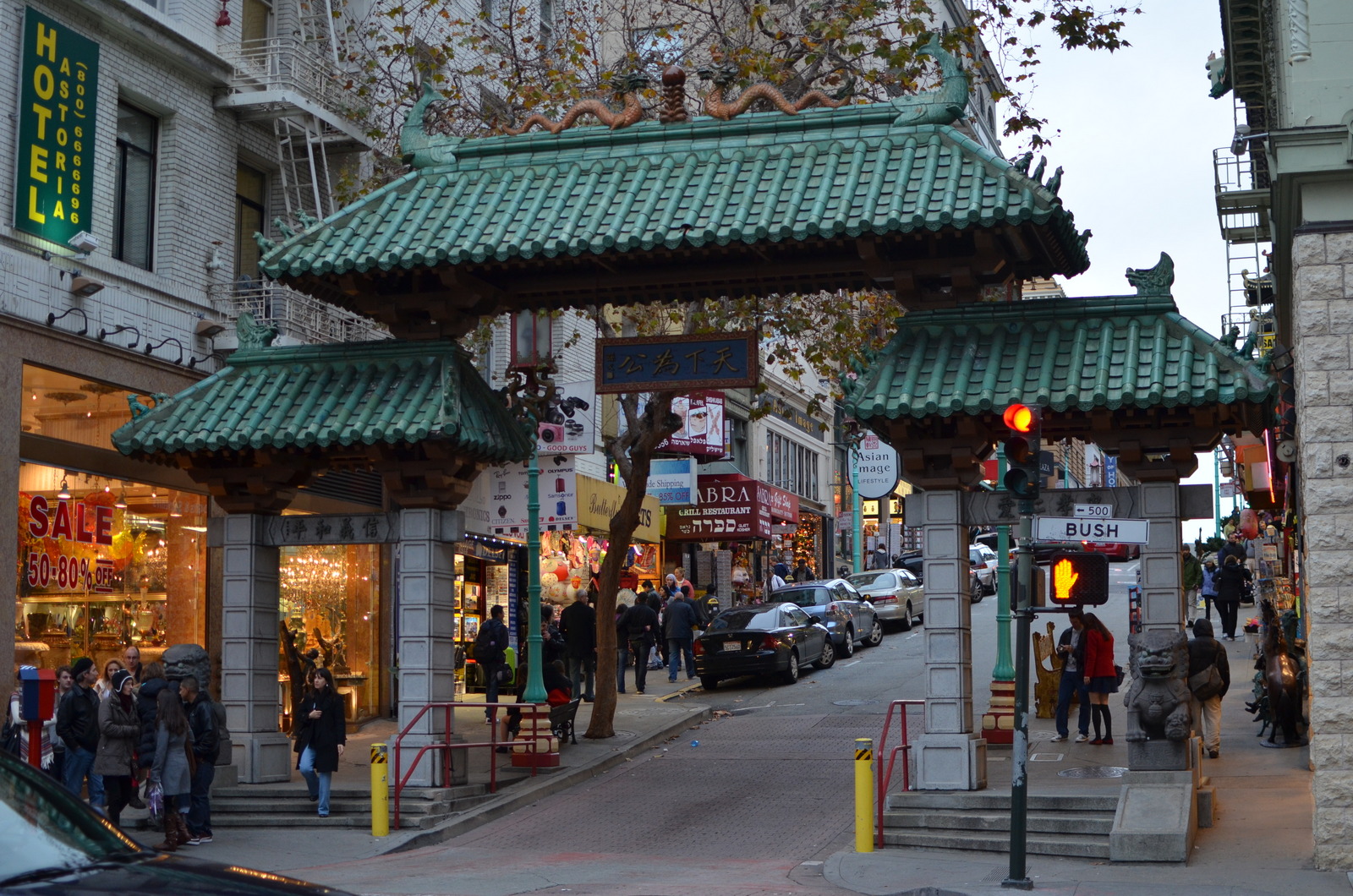
Figure\(\PageIndex{6}\) : Des enclaves asiatiques dynamiques sont omniprésentes. (CC BY-NC-ND 2.0 ; Owen et Aki via Flickr)
Qu'y a-t-il dans un nom ?
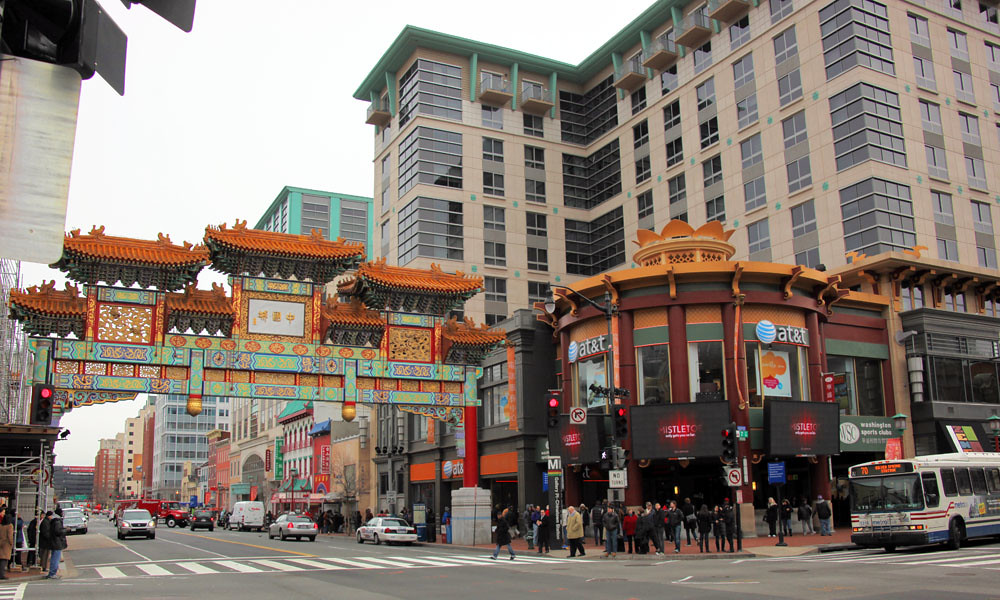
Tout est mélangé ?
Avancer et forger une nouvelle identité
Racisme et violence anti-asiatiques
La compétition ethnique mène à la violence
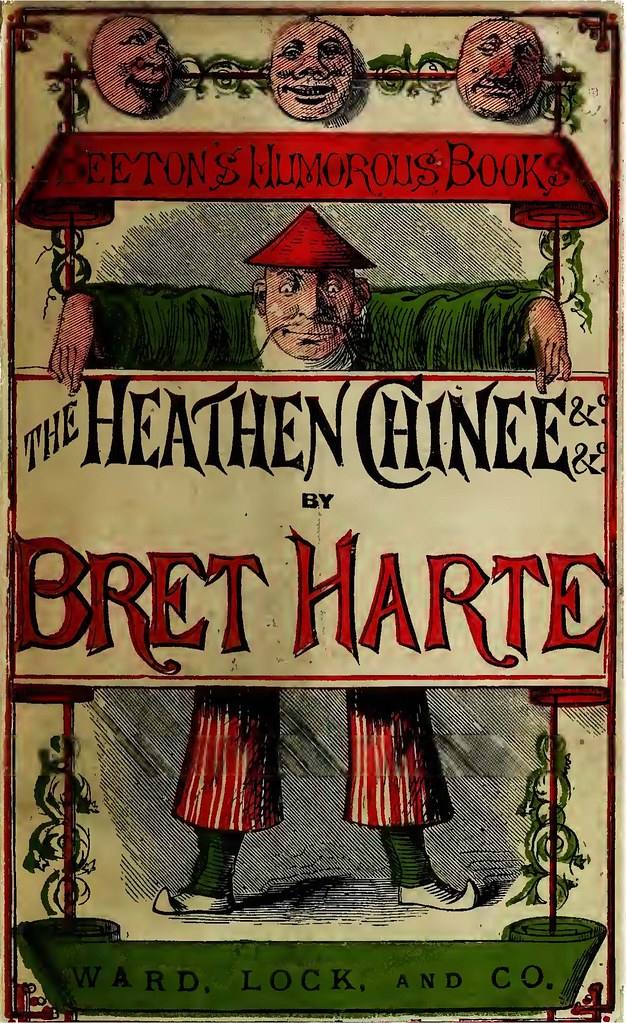
Figure\(\PageIndex{9}\) : « EM_ARK13960T1CK18S1T_001 » (CC PDM 1.0 ; Jonathan Hgrossman)
La formation de la solidarité
La définition d'une peine cruelle et inusitée
La lutte contre le racisme et la xénophobie en Asie : la situation liée à la COVID-19
Figure\(\PageIndex{10}\) : Wuhan : humain. (CC PDM 1.0 ; mockba1_1999 (William Sutherland) via ipernity)